Music Web Express 3000, December 2011

Guitar Player Magazine, September 2011

Guitar Player Magazine, September 2011  (PDF)

The Perfect Sound Forever Magazine, April 2011 (part 2)

Guitar Player Magazine, Holiday 2010

Guitar Player Magazine, Holiday 2010: The Complete Interview

The Perfect Sound Forever Magazine, December 2010 (part 1)

Music Web Express 3000, July 2010

Billy's Bunker, July 2010

Nashoba Valley Newspapers, November 2009

WRUV on-air interview, August 2009  (NPR Vermont)

OnClassical Magazine, June 2009  (Italy)

Unfretted Magazine, June 2008  (Canada)

The Beat Magazine, December 2004

The 13th Fret: Artist of the Month: October 2004


Guitar Player Magazine; September 2011

Kevin Kastning and Mark Wingfield on Improvising an Album

by Barry Cleveland

KEVIN KASTNING AND MARK WINGFIELD strive to transcend the traditional limitations of their instruments—albeit in very different ways. Kastning typically plays custom acoustic guitars such as 12-string extended baritone, 12-string alto, and his recently acquired 14-string Contraguitar. Wingfield eschews the typical magnetic pickups and amplifier in favor of digital technology that enables him to alter the attack, sustain, resonance, and other timbral characteristics of his electric, allowing him to, for example, articulate notes and phrases like a horn player. “The blend of Mark’s unique electric guitar voices with my extended-range instruments and unorthodox tunings created something very special,” says Kastning of the duo’s debut release, I Walked Into the Silver Darkness [Greydisc]. “I don’t think we were prepared for what happened when we began recording together. The pieces just took on an organic life of their own.”

Although it was the first time the two guitarists had played together, and the music was entirely improvised—or perhaps more accurately, “spontaneously composed”—the material possesses a striking cohesion, and the sort of nuanced interaction that usually only occurs with experience and familiarity. Intricate structures emerge, in which dynamic lines interact across parallel planes, touching here, diverging there, while traversing shimmering harmonic clusters, brooding pools of dissonant darkness, pockets of microtonal fluctuations, and myriad other tonalities.

“There was an instant connection as soon as we started to play together,” enthuses Wingfield. “We both seemed to know where the other was going next, though rather than thinking about it I was simply absorbed in the music, listening and letting it happen.”

The success of the duo’s collaboration may be partially explained by the fact that both artists are accomplished composers. “I hear Mark more as a composer than a guitarist,” explains Kastning. “We both come from composer backgrounds and have a purely non-guitar composing aspect of our lives. That is a huge commonality between us, and I think that compositional approach and sense of form, structure, harmonic theory, and even narrative sparked a unique and special chemistry.”

There is also significant overlap in Kastning and Wingfield’s musical tastes. “We like much of the same music,” says Wingfield. “In particular, artists from the ECM Records catalog, and classical composers such as Bach, Bartok, and Elliott Carter. But those commonalities can only account for a small part of what happens during improvisation of this type—a process that opens up whole areas of musical imagination that are simply not accessible in any other way.”

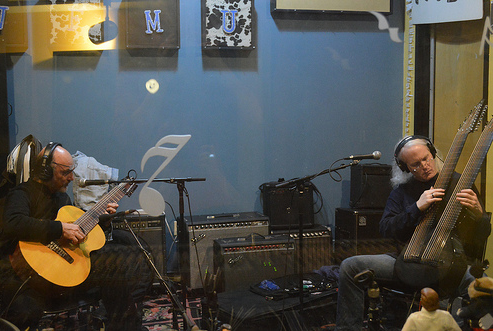
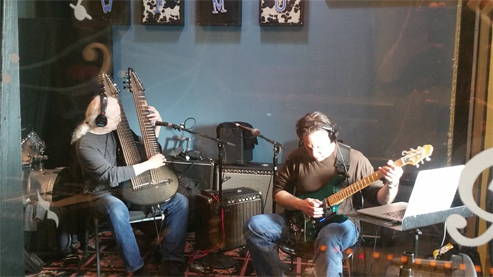
KASTNING PLAYED four custom-built guitars on I Walked Into the Silver Darkness: a Santa Cruz DKK-12 12-string extended baritone, a Santa Cruz KK-Alto, a Cervantes Rodriguez classical, and a 14-string Contraguitar built by Daniel Roberts Stringworks. The Contraguitar was recorded in stereo using Gefell M930 and M295 microphones, and the other instruments were recorded using a matched pair of AKG 414-XLIIs—all feeding a Millennia HV-3D mic preamp. Wingfield played a Patrick Eggle LA Plus guitar, mostly through a Roland VG-88, though he also used an Axon AX 50 MIDI converter into an Apple Macbook Pro running MainStage software (hosting Spectrasonics Omnisphere, Waves GTR, and Logic’s EXS sampler) on a few pieces to create “supplementary and textural sounds.” Everything was recorded to a 24-track Alesis HD24XR Hard Disk recorder.


  Back to top


Guitar Player Magazine; Holiday 2010

Kevin Kastning

by Barry Cleveland


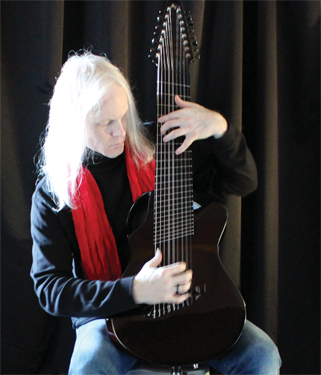
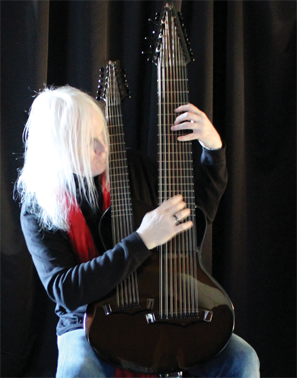
KEVIN KASTNING HAD JUST RECEIVED HIS NEW “CONTRA guitar”— a 14-string extended-range instrument co-designed and built by Dan Roberts, formerly of Santa Cruz Guitar Company— the day before our interview. The Contraguitar joins the Santa Cruz KK-Alto, DKK Extended Baritone, and DKK-12 12-String Extended Baritone guitars in Kastning’s pantheon of unique stringed instruments. Although Kastning studied classical and jazz composition formally—including taking private lessons from Pat Metheny while attending the Berklee College of Music—and is fluent in both traditions, the music he plays on these guitars is as singular as the instruments.

Kastning’s latest release, Returning [Greydisc], represents his fourth collaboration with virtuoso Hungarian acoustic guitarist Sándor Szabó. As on the duo’s previous albums (Parabola, Parallel Crossings, and Resonance), the music is entirely improvised—though it nonetheless possesses such inherent compositional integrity that one might reasonably question the spontaneity of its origins. Szabó’s acoustic 12-string baritone guitar interweaves almost supernaturally with Kastning’s extended-range instruments to create a sort of impressionistic neoclassical folk music of such consistency and emotional depth that it would still be astonishing even if it had been painstakingly composed rather than manifesting mysteriously in the moment.

Besides channeling The Source in real time with Szabó, Kastning has composed numerous piano sonatas, string quartets, and other classical works, as well as collaborating with acoustic guitar innovator Siegfried on several recordings, and contributing to 2008’s Unplugged & Unfretted: A Collection of the World's Acoustic Fretless Guitarists (he also plays fretless acoustic). Kastning is currently recording with legendary cellist David Darling, and a mostly improvised album with English electric jazz guitarist Mark Wingfield is in the offing for 2011.

The music on your albums with Sándor Szabó is entirely improvised, yet most of it sounds composed. How is that possible?

I will tell you as much as I know about the process. All of the albums were recorded in a single day. That’s how well we play together. On the first album, we brought little sketches that were a couple of bars long, but we abandoned that fairly quickly because we were thinking so much alike and our interaction felt really natural. For example, pieces would begin and end in unison. We might discuss some things ahead of time like, “I’m going to begin this piece in 5/4, give me two bars up front,” or “You start in that register and I’ll start in this register”—but that’s about it. And on some pieces one of us would just begin playing without any discussion at all, and we would go from there. A lot of people say they’re surprised when they find out that those are all improvised pieces.

What does improvisation mean to you?

I don’t think of it so much as improvisation as I do real-time composition. You pick up a score of music and there was a time when that was improvisation. Written music is really just frozen improvisation. When I’m playing solo pieces, I’m thinking about the form. But when I’m working with Sándor, I’m just listening to him and getting a sense of where the composition is going. After that, I just stay out of the way and let the music go where it wants to go. I’m not thinking about scales or harmonic structures, I’m not thinking about transitional moments or sections in the piece— I’m just sensing the piece as a whole, letting it go where it wants to go, and giving it all the space and nurturing it needs to do that.

You speak of the music almost as if it was an entity. How do you conceptualize the source of creativity?

I feel that music comes from somewhere else. I don’t pretend to create it. I just allow it to come through. A lot of times I’ll listen back to a recording and there will be a tremendous amount of stuff that I don’t remember playing or even recognize as me. It sounds like a very spiritual thing to some people, and maybe it is, but I think it’s something that’s not really of this physical plane. That source could be God, or something so deep within the artist that they’re not even aware of it, or it could be nature. And it is also partly the chemistry between two or more people. It’s a big question, and I’m not that smart of a guy [laughs].

Talk a little bit about your primary instruments and tunings.

Nothing that I’m doing now involves a 6-string guitar in standard tuning. I do a lot of practicing on classical guitar, but I don’t record with one, and I do most of my composing on piano. I have three main instruments, and a fourth arrived yesterday. The first three are the Kevin Kastning series instruments that I developed with Santa Cruz, specifically with Dan Roberts when he was there. Dan and [Santa Cruz Guitar Company founder] Richard Hoover really made these things happen for me. The DKK Extended Baritone has a 28.5"-scale and is tuned to F#, in other words a whole step above a bass, though for the Retuning album it was tuned to E. The instrument I consider my main guitar is the DKK-12 12-String Extended Baritone, which is a 12-string version of the same instrument, also tuned to F# . Most baritone guitars are maybe one or two whole steps below concert pitch, but these are a full 7th below. The third guitar is the KK-Alto, which is another 12-string instrument that’s tuned to A, a fourth above standard tuning.

The fourth instrument is the Contraguitar?

Yes. I wanted an instrument that could go down to E without being a bass, and also go well into the alto range on the top—that sort of upper cello register sound. I also wanted to have more than six courses of strings, and the final instrument has seven, for a total of 14 strings. Dan and I worked out the details over a tremendously long time, so that by the time we had nailed down what it was going to be, he had started his own company, Daniel Roberts String Works. The Contraguitar has a 30" scale length and the nut is 3.25" wide. Right now I have it set up in octave tuning from E to A. I’ll start using some of my personal tunings with it once I get acclimated to playing it. The voicing and textures are orchestral in scope.

Describe your picking technique.

Recently I’ve been playing almost entirely with my fingers, using what is essentially classical technique, which partly came out of frustration with the pick. First of all there’s something between you and the string. Also, when you play a chord on a piano, you’re hearing all the notes at once, and on the guitar you don’t always, because you tend to strum bass to treble across the strings. That has always bothered me. With my fingers, if I’m playing a four-note chord voicing I can grab all four notes at once and it sounds like a complete harmonic structure. Also, a lot of my lines are angular, with leaps of an octave or more inside of a line or a phrase. While I can do that with a pick, it happens much more instantaneously and cleanly with my fingers.

When I do play with a pick, my technique tends to confound other guitarists—and I don’t necessarily mean that in a good way [laughs]. I hold the pick backwards using the rounded edge, and at a 45-degree angle rather than parallel to the strings, so I’m not picking with a direct attack. Also, I hold the pick between my thumb and first two fingers, and I just brush the strings instead of pounding the sound out, which makes it tend to sound more like fingers than a pick anyway.

Is your left-hand technique also rooted in classical playing?

While I was in high school I would watch cello players. Cellists keep their thumb in the middle of the back of the neck at all times, which provides tremendous reach with their fingers, and opens up a whole world of chord voicings that wouldn’t be possible otherwise. Of course, the technique is common with classical guitarists, but I didn’t know that at the time. That approach doesn’t work with the Contaguitar, however, as the neck is so wide that I wind up placing my thumb more under the treble strings than in the middle, and to reach the bass strings it comes out from behind the neck entirely, at which point I use it more like an additional finger.

What are the most important things you took away from studying with Pat Metheny?

The first had to do with my time. I had already been playing professionally when I began studying with Pat, and nobody had ever suggested that I needed to work on my time. But in a very genuine way he told me my time was inexcusable, which really got me thinking about time and rhythm in ways that I never had, and that had a tremendous impact on me. The second really good thing was more spiritual and emotional. It was early in my first semester, and I was depressed because I felt like all of the teachers and students were these killer musicians, and I was just kind of hiding behind the furniture wondering when I was going to be found out. Pat must have picked up on it because at the end of the first lesson he said, “You probably hear a lot of guys with great chops at Berklee, but I want you to completely ignore them, because they’re not your competition. I’m your competition. You just worry about me.” I felt a lot better after that, because rather than comparing myself to others I could focus on what really mattered.


  Back to top


Between Two Worlds, Creating a Third
Interview, Part 1 by Mark S. Tucker


Kevin Kastning is a somber, introspective, serious musician who has produced a series of duet guitar CD's that would be proclaimed a succession of rara avis'es in any time period in any culture. One could name such works as 'chamber jazz,' for lack of a better term, while looking to the best examples yet produced (the ECM label) but their true derivation lies in the classicalist canon. Kastning has absorbed a wide spectrum of the esteemed masters from de Machaut to Berg and beyond, so it comes as no surprise that the textures of Beethoven's "Moonlight Sonata" Gregorian chant's unearthly ache and melancholy, and Mahler's moody fantasias are just as present as Satie's gymnopedies and gnossiennes, Messiaen's spatial irrealities and Schnittke's abstractions. None of these, however, is ever stated within their own terms; Kastning has made them his own.

He looks for the compelling stain of genius in everything, and this is why his pair-up with Siegfried and with Sandor Szabo have resulted in releases that recall the zenith of the Towner/Abercrombie team, Bill Connor's darkest aspects, Egberto Gismonti's most intense thoughtfulness and a small number of other guitarists who have, to one degree or another, experimented in this mode: Philip Catherine, Steve Khan, Larry Coryell, Jukka Tolonen, Alain Markusfeld, etc., though I perhaps err a bit in citing them. Again, this is by no means common music.

To listen to Kastning's work is to plunge into, bringing into service the label name, a greymist world. The atmospheres are vast and cloudy, riddled with fogs, barren wastes, lowering skies, phantasmal presences, echoes of incidents lurking at the border of perception. Each track induces a laconic contemplation subtly enthralling. The confines of the master fantasists (Hodgson, Lovecraft, Vance, Delaney, etc.) are evoked, though little is threatening in Kastning's realms. Rather, an exquisite tension is maintained, a sense of forever being on the verge of some revelation that will be enlightening while disquieting, a form of existentialism laced with nihilism within stoically Socratic netherlands.

The sympathies between this guitarist and his partners is almost spooky. In a concatenation of extemporaneous stylings, rapport is achieved preternaturally, telepathic in harmony. Anyone truly enraptured by the instrument and its further possibilities in acoustic expression - this necessarily precludes most general music audients - recognizes two landmarks in this mode: the aforementioned Towner & Abercrombie's Sargasso Sea and Five Years Later. As a sidenote, I was fortunate enough, many years ago, to have caught those two masters on tour at Hop Singh's in Culver City, California (it didn't hurt that the thoroughly neglected leonine Wayne Johnson opened for them either), and it has remained to this day one of the most riveting displays of musicianship I've yet witnessed. Keeping in mind that I've seen Jimi Hendrix, Pat Metheny, Tomasz Stanko, the Moody Blues, Srinivas, the Hyderabad Bros., Stevie Ray Vaughan, Philip Glass and myriad stellar acts in concert, I do not make that statement lightly and thus boast of having a small rough idea of what constitutes great music. Kastning, Szabo, and Siegfried all sit as explorers constituted of exceptional prowess, kindred to the above. They, the CandyRat label, and too few others are taking the acoustic guitar into new dimensions. Those who think the possibilities in the instrument have been exhausted are in for a surprise.

It's easy to get lost in such music, elevated mind theater of a stripe rarely encountered, painting in the air, sonic sculptures. Therefore, when interviewing Kevin, I decided to forego most of the standard inquiries regarding data otherwise available on the Web, posing just enough within technology aspects to orient the reader to the unorthodoxy of every aspect of this gentleman, afterwards zeroing in much more fully on aesthetics and art qua art. Thus, this first section hits the brick and mortar fundament more than the second will. I've read interviews with Kevin, perused some of his writings, and we'd e-chatted here and there following my reviews, in various venues, of his work, so I know him to be of enviable intelligence, rare comportment, and, well, just a nice guy. I think the reader will readily agree, while perhaps a bit daunted by the depths to which one guitarist descends to unearth that which composes his music... and himself.


PSF: I'd like to address a few mechanics first - and I apologize for any redundancies that may occur with past interviews, but I'd like PSF readers based properly in this matter - then dive into aesthetics. You've had modified guitars built for you by the Santa Cruz luthiers. How did that come about? Who approached who, and what were the discontents with standard design?

KK: Around 1999 or 2000, I began speaking with Santa Cruz about a modified D-type guitar. I love the rich, smoky, throaty, wide voice of their Ds, as much as that voice just speaks to me very directly and emotionally. The drawback, the discontent, with D types from other makers is that they are bass-heavy voices by nature, which I like in a D. However, with other makers, it stops there. The upper registers are usually not well balanced, and do not speak nearly as well as the bass registers. Usually the upper registers are dark, muddy and compressed. I had a couple of Martin D-28s which had the depth of voice I wanted, but as I moved up into the upper registers, it was as if someone was pulling back the gain slider; the top end was compromised and just wasn't there. The Santa Cruz Ds are not like that; they have a deep and roaring bass register, but they are the most well-balanced Ds I've heard; the upper registers are just sparkly and full. I also find their instruments to be very responsive. So I began speaking with them about one of their Ds, but there were some modifications I wanted. One was a cutaway, to access the upper registers. And slightly altered voicing. As I spoke with them over the course of a few weeks, I got to know their (at that time) production manager, Dan Roberts. Dan and I established a rare lingua franca regarding luthiery and instrument voices.

PSF: Let me interrupt for a moment, as I'm struck with this desire to articulate darkness. When I was interviewing organomorphic architect James Hubbell (for a book that never got off the ground), he was adamant that we should leave darkness alone because it's the source of art and inspiration, a sentiment I understood and respected but did not agree with - well, the "leave it alone" aspect only - for various reasons, and here you are exploring how that mapping can be done from a mechanistic aspect, which I find a singular and fascinating exploration.

KK: It would be interesting to discuss that with James Turrell. I find his work endlessly fascinating, and even tangibly audible. I've been in installations of his where I just get lost, and I mean that literally. Some of his work is so all-encompassing and immersive that spatial relationships and distance either change meaning, or dissolve altogether. I can clearly see various sides for and against Hubbell's point. It may be that artists are fearful of looking too closely at what I term "the source," which he may define as darkness, or asking questions of it or about it. I don't see it as darkness, or a darkness; other than it is not tangible or corporeal. I can understand that, by its very nature of being amorphous, this could be interpreted as darkness, since there is nothing to physically see or grasp. I would also posit that for others, it may not be a darkness, but a source of light. I again nod to Mr. Turrell. I've done my own questioning in the past, and looked at it as much as possible. I don't think that I emerged out the other end of that process any closer to having a concrete grasp or understanding. Yet what I have learned is not to question the actual process itself. I think attempts can and maybe even should be made to examine the source, but, in the moment, I have come to find in my work that I just have to trust it and let it lead me. I am by nature highly inquisitive, but, at the same time, I feel that I am here to serve art in whatever direction it might take. It's like a river meander. A river meander, being an element of nature, is going hold interest and beauty; and is a kind of natural art moreso than something like a canal, which is arguably a man-made river, thus having little or no meander. I try to take myself out of where the river wants to go, and let the meander take its own course and happen as it will, an organic rather than a controlled process.

As far as the KK series instruments relate to this, the process is almost akin to having a sound in my head before the instrument exists, in my brain, in my ears, floating a like a huge, transparent, delicate bubble of liquid. Each time this has happened, compositions form and exist within the bubble. My task is to relate and explain that bubble of liquid to Dan, to try to put an instrument around that sound, that texture, that sonic environment. The sound fully exists before the instrument is built, yet it is not of the physical world. Dan's task is to manifest that sound environment and landscape into the physical in the form of an instrument. With each instrument, the sounds, compositions, and processes have grown ever more complex, expanding. Originally, with the custom D from Santa Cruz, it was a simpler process to extract a dark yet not unbalanced voice out of an already existing and known instrument platform and type.

So, in pursuing that, it took the better part of a year for the first D to be completed, but it was and is a wonderful instrument. Dan went far and above what I had requested without asking me, but clearly knew what I was seeking. A year later, I mentioned to him that I was thinking of commissioning a modified OM from Santa Cruz. A D and an OM are both 6-string concert-tuned instruments, but the voices are almost at opposite ends of the spectrum, and thus complement each other nicely. He asked me if I'd consider becoming an artist endorser for them, and we could really work on the OM together. I said oh no, you don't want ME as an artist endorser! No one knows me, I'm not going to help your company at all. He just said to think about it. I called him again in a few months, and said I wanted to discuss some OM design possibilities; for example, an extended fingerboard in concert with a cutaway and some specific voicings. He was agreeable, and again asked if I'd do an artist endorsement for them. I again became squeamish. Dan said something that really spoke to me that day, after I again said "you really don't want me for this." Dan said that no one was doing anything like my music. No one was doing what I was doing, and he found it to be totally originally and truly artistic. He said that my music put much in the way of demands on an instrument, and for Santa Cruz to be associated with my music would mean a lot to them. He said they wanted to partner with me and support what I was doing; that it wasn't about fame or commerce, but about the music. That really spoke to me. So, after mulling it around for a few months... I called him again. I said yes, let's move forward on the OM, and I'll become an artist endorser, too. Dan really went all out on it, and the voice I had spent months describing to him was right there in the OM when it arrived here. Completely and entirely.

PSF: This is so rare, this collusion just to forward art, shared among kindred minds, tackling the obtuser aspects of how it's really done. I know Matthew Montfort and a few other guitarists are interested in expanding the range and palette of the instrument are engaged in similar efforts but not to this degree. We've seen John McLaughlin, Alan Holdsworth, and others strike somewhat into the territory but never with such rapport, single-mindedness, and dedication.

KK: Well, around this time, 2002 I think, I had just finished an album with Siegfried called Book of Days, and we were beginning to work on new compositions which would become the album Bichromial. In 2004, I utilized both the D and OM on early sessions for Bichromial; it was about an eight-month recording process. During the months we were in the studio, I began to hear and compose pieces for a low-register string instrument. Lower than guitar, but not a bass. I could not realize or execute these pieces on guitar; the register was all wrong, the scale length was wrong, the voice was all wrong, the textures were not there. I called Dan and started to explain what I was hearing to see if he had any suggestions. He said "You're describing a baritone guitar." I said "What's that?" I had never heard of this. I asked him some questions about the baritone registers and tunings. It sounded intriguing. He said why don't you let me send one over to you; you can use it in the studio, see if that's what you're hearing. He shipped out a Santa Cruz DBB baritone to me. It was tuned to C below E when it arrived, which is the lowest tuning for which it was designed. It was in the direction of, but not exactly, what I was hearing. I experimented with string gauges and lowered tunings for weeks, finally settling on A below E. It wasn't perfect, as the instrument wasn't designed for this, the registers weren't balanced; the lowest notes on the A string didn't speak as well as the rest of the range, but it was pretty close. Nonetheless, it was certainly encouraging and even exciting.

PSF: What, then, was the upshot?

KK: There are several pieces on Bichromial which were recorded using that DBB. I was really falling in love with it. After the record was released, I was talking to Dan about what I perceived to be the limitations of the DBB, but they really weren't limitations as such. The guitar just was not meant to be tuned as low as I was using it, nor was it designed to support the semi-massive string gauges I was utilizing. I was really pushing it beyond anything it was designed to do. We began talking about what I came to call an "extended baritone," which would have a longer scale tuned to F# below E, which is one whole step above a bass guitar. Heavier string gauges for sure. We had to modify the low two tuners to accept the larger gauges as well as craft a wider neck and fingerboard. Santa Cruz happily built this for me, which came to be called the DKK in their model nomenclature. It arrived about midway through the recording sessions for the album which would be released as Scalar Fields.

I was very excited about it; this was exactly what I had been hearing. It was perfect. The DKK has this cello-like singing quality in the upper registers, which was a wonderful surprise; neither Dan nor I knew what the upper registers would be since it was such a bass-register instrument. Such an experiment had never before been attempted, but, all through the design and build process, the one thing I stressed regarding the instrument voice was balance. Yes, it was a bass-register instrument, but I tend to use the full ranges of instruments, so I wanted the upper registers to speak equally well. It was all that and more; it's just a massive edifice of a huge, pipe-organ-cello kind of rumbling singing fantasy. I used it on about half of the pieces on Scalar Fields.

PSF: The grail was found? The quest ended?

KK: Just after Scalar Fields was released, I was out one day, thinking about the two instruments I'd used most on those sessions: my Martin 12-string, and the DKK extended baritone. The thought just popped into my head: "Too bad they can't be combined." Instant satori. I remember just stopping and heading for a phone. I called Dan, and said "Let's do a 12-string version of the DKK." I explained the tuning scenario I had in mind along with a couple of quick details, tunings, and scale length. I asked Dan if he thought it was possible. He said "Yes, I think so". We spent about a year on that one, which came to be called the DKK-12. It was also tuned to F# below E, but, unlike a concert 12-string, all courses are in octaves, no unisons. When it arrived, I was just flabbergasted. I'd never heard anything like it. Dan and Santa Cruz had once again exceeded my expectations by a very wide margin. The first record on which I used the DKK-12 was Resonance, with Sandor Szabo. In fact, once Sandor heard it, he ordered a 12-string baritone too! Since 2006, the DKK-12 has been my main instrument voice.

PHOTO:
The KK series guitars

PSF: The never-ending journey. I suspect you'll sooner or later begin to envision extensions to the DKK-12. I've always wondered if, for instance, harp guitars couldn't be improved to achieve a more muscular and active response from the drone strings or perhaps if, say, a 10 to 15 non-paired-string acoustic guitar mightn't be variably tunable to provide playable drones as well as active strings. Given the ceaseless quest for innovation and the advancing of expression, these thoughts occupy the aesthete and the creative listener. You seem very much interested in expanding accepted borders, so I wonder what future design alterations you foresee, and what would, though it may presently be just on the barely pragmatic side of possible, be your dream guitar?

KK: Interesting timing on this question, as a new invention of mine called a Contraguitar just arrived here a couple of weeks ago. This is a long scale, 14-string, 7-course instrument. The full story behind it is on my site so I won't repeat it here. This is pretty close to a dream instrument for me. I've worked on it with Dan for over three years (he departed Santa Cruz and has since founded his own company: Daniel Roberts Stringworks; the Contraguitar was built by the new Stringworks). One factor that influenced its design is the 11-string, 11-course Altengitarre, which is a short-scale classical guitar tuned to G above E for courses 1 through 6; the remaining five strings are usually tuned stepwise, descending. This is an instrument originally intended for playing renaissance and baroque lute transcriptions, though I've yet to use it for that. The low five courses were designed as continuo, or drone strings, meant to be played open, not stopped. Again, not how I was using it. I was utilizing all 11 courses equally. But the lowest bass courses are somewhat difficult to reach. So the width of the neck and fingerboard for the Contraguitar were impacted by the width of the neck and fingerboard on the Altengitarre, as well as the reach. The Contraguitar will most likely become my main instrument going forward. It's tuned E (bass) through A and covers the registers of a bass, a baritone, and is up into the low alto range as well.

While it was originally conceived as the logical extension of the direction in which I was going with the DKK-12, it has turned out to be an order of magnitude beyond that. The Contraguitar covers the registers of three separate instruments: bass, baritone, and guitar; as well as dipping into the low alto registers. I've already been speaking with Dan about the next phase; it will be something in the 16 to 18 string region in a course configuration of 8 to 11. The Contraguitar was born exactly like the DKK: I had compositions for which an instrument to realize them did not exist. It's an astounding instrument - again, exceeding my expectations. I just can't hear it enough.

PSF: And, from what I'm inferring as you delineate all this, there are always new problems. What cropped up now?

KK: Well, there is the issue of tunings. On the DKK-12 and the KK-Alto, I've devised various sets of intervallic tunings. In these tuning scenarios, the root or diapason string remains constant, while the octave strings are no longer tuned to octaves, but each course is tuned to a different interval. Harmonic possibilities just exploded. This has unlocked entire new worlds for me, new colors have been discovered, and the depth and breadth of what was possible has expanded exponentially... and is continuing to expand as I learn the Contra. Harmoonic and compositional horizons surround the distance.

PSF: Let's turn to engineering matters. The recording method you prefer - microphone to preamp to recorder - sounds a lot like Robert Fripp's audio verite work. In this, I'm guessing you like as pure an immediate constructionist approach as can be attained as versus the artificiality of 'post' work (dub-ins, pitch control, effects, etc.)...not to mention as much of the player's presence co-equal to the guitar itself as can be met. This, of course, leads to an inquiry regarding synthesizers and such, which are fairly distancing on several levels. You compose for piano but are you eschewing interpolating synths into your guitar 'darkworks' or, for that matter, any of the composing you do?

KK: Correct, that is my preferred studio approach. It is quite direct - yet not just direct, it's a captured performance, no different than an orchestra in a concert hall surrounded by recording gear. For me, it's the most beautiful and pure vehicle for capturing what is otherwise ephemeral. To use the work I've done with Sandor as an example for this question: what is the difference between composing on manuscript score paper and composing to tape? Both are equally valid compositional doctrine with the same terminus. The end point of both is a completed composition. A composition in a printed score is little more than frozen improvisation. In real-time composition, the tape becomes the manuscript score paper; thus, the process of capturing this composition should be as pure as possible.

PSF: I'm so glad you brought a crucial point up: the fact that compositions and improvisations are basically the same thing. I've had arguments with other critics and encountered resistance, yet when I interview musicians like Tomasz Stanko, they speak precisely in that direction. I have to shake my head when I read composers and players maintaining that composing and improvising are distinct and separate activities. Plainly, they are not. One starts from nothing and creates, the other creates atop a given platform, but both are new material no matter how you look at it. I think if classical musicians could understand this, they'd cease being duplication machines and strike out more on their own as distinct creative artists a la Kronos Quartet and others.

KK: Yeah, I would imagine you'd get that from other critics. Not being artists, they'd not have the experience of being a part of that creative process, of that birthing procedure. You're rare in that you not only see it, you understand it and get it. On the other hand, I don't really see you as a critic! I would not be surprised if you received that reaction from some musicians as well. Composing and improvisation take different forms, are sometimes achieved with different media, differing locus - manuscript paper versus tape, for example. But the end game, the intersection, results in a composition. Frozen improvisation. And I must stress that I speak now of pure improvisation, wherein the entire composition and everything in it, is created - everything, every compositional element - not a jazz improvisation where the soloist is locked into a pre-existing framework of predetermined diatonic chords and form. Fixed harmony. Fixed meter and rhythm. Fixed and very finite form. The end result in this scenario is merely differing melodies over the chord changes and repeat. This is a type of improvisation to be sure, an element OF improvisation, but it is not pure. It is only one element of composition, not entire compositions. It's the difference between painting a house and architecting it.

The classical musicians I know... well, it's a different discipline. In conservatory, they're not taught composition. They're not exposed to the tools of composition or any element of that discipline. They learn their instrument, but only as it applies to sight-reading and interpretation. I do have tremendous respect for this process and for the musicians too. I'm not trying to take away from that. I was once in a master class of a very well-known classical guitarist. I won't mention her name, but she is currently the head of the guitar department of a highly respected conservatory. She played a couple of pieces very beautifully, great technique to be sure. There was a Q and A session after the class, for which I stayed. Someone asked her "How do you feel basing your entire career on never having created a single note of your own?" She got a completely blank look on her face and said "I don't know what you mean." The audience member politely explained that she was an interpeter, not a creator, and asked if that bothered her. Again, blank stare, but this time she simply said "No." Now, if this is what someone wants to do, if this is their passion, that's a wonderful thing. But the disquieting part of this scenario is that the thought of composing or the act of creating, not re-creating, seems to have never occurred to her. So foreign was this concept that she didn't even seem to know how to answer the question. I have seen this syndrome in many, though not all, of the classical musicians I've known. I've put that question, though in gentler form, to a few classical musicians with whom I was comfortable. Some didn't know what to say. Regarding the matter of composing, one particularly honest one replied "I don't know how to do that." I pointed out that they could learn. I received a shrug in reply. Then again, the obverse of this would be someone asking me if I'd ever thought about never composing a single note and only focusing on recreating the compositions of others. It would probably be my turn for a blank stare.

But, getting back to your curiosity about keyboards, I haven't composed or recorded anything involving electric keyboards (synthesizer) yet. Yet. I mean, I have composed pieces for cathedral organ, harpsichord, 10 piano sonatas thus far; you know, acoustic keyboard instruments, nothing yet for electric keyboards. I don't know if I will, but I know if I say I never will, the next record will be synthesizer and guitar pieces (chuckles). I have spoken with Chuck Wild a bit about a project, but due to his label contractual obligations, we can't do it. I've heard some lush and atmospheric orchestral patches which are very evocative but don't have an overtly synthetic texture. I like those. They are not trying to emulate real orchestras but, instead, rather unique sonic textures based on orchestra. Orchestral sui generis. There are instances wherein an electric instrument, a guitar or a synthesizer, when paired with an acoustic instrument, can provide very welcoming environments and evocative textures and sound worlds. The timbral atmosphere of an acoustic/electric duet tends to magnify the unique sonic and tonal elements of the opposite voice. Instead of the blend you get with an acoustic duet, in a mixed duet (acoustic and electric), the stark contrast truly frames each instrument. Executed well, it can have a genuine and deep emotional impact and reach.

PSF: Yes. Ever since Machaut, who prefigured the Romantic and Impressionistic in music, sonic transfiguration of emotion has been the frontier. Previously, the artist had to achieve that through manipulation of sonority and its applications, rules dominating; now, sonority has to subordinate to the artist, rules created at need. Atmosphere, not a succession of well-ordered appointed notes, dictates.

KK: I have a kind of addiction to harmonic atmospheric environments. I've composed pieces, some string quartets, which incorporate this phenomenon, but I've not done a recording project of a similar nature involving a mixed duet. Nothing is planned or in the works, but I would be open to something with acoustic guitar voices and keyboards if it were the right project and the right person.

PSF: Do you avoid electric guitar entirely always, even privately, or just concentrate on acoustic instruments in order to maintain the exquisite environments you and Szabo, and you and Siegfried, create in that very particularized fashion?

KK: Yes, total avoidance. The electric doesn't speak to me as something I'd want to use. In my hands, it feels plastic and synthetic; it's not the thing itself, there is something between me and "it." For me, in my work, an electric guitar sounds and feels like the difference between a nine-foot Steinway and a portable Casio. They both have keys, but are they the same instrument? Acoustic instruments are very demanding, and I do devote my working time to them. Each KK series instrument has really been intensely demanding to learn, and now I'm learning the Contraguitar. Knowledge of concert six-string doesn't map directly to them, just being able to get a good tone is an entire learning process. In fact, the Contraguitar is changing aspects of tone production for me; it is akin to learning an entirely new instrument.

PSF: Myself having both electric and acoustic guitars (and readily confessing to absolute amateur status) and having listened to innumerable guitar recordings, I find I have to define the two versions as completely alien to one another - that is, the acoustic really is a completely different instrument from the electric in almost all possible ways save for the commonality of possessing strings and frets. Have you given thought to exploring the possibilities electric guitars yield in terms of tone, variation, extrapolation, and in fact entirely new milieus that might stretch the outer limits of your canvases and visions even more variegatedly?

KK: It is indeed a wholly different instrument. I have in the past played electric, though I've not touched one in probably 20 years. I've heard true artists on the instrument - Alan Holdsworth comes to mind - but, for me, with electric, it seems as if there is something between me and "it." There is an unnatural barrier, an artifice, a mechanism. With an acoustic, there are no impediments, it is very direct and organic, everything about it - the touch, the resonance, the voice, the air being pushed out of it, the fact that it is a more physical instrument - and I think that's a direct connection to personal touch, voice, tone, response, and overall technical execution.

On an acoustic instrument, I really think a preponderance of the voice of the instrument is due in no small part to the player. Tone production is in the player's fingers. There's just no where to hide; nothing is going to create or assist in tone production for you. Much of an individual's voice is in his hands. I don't hear that as much on electric. With electric, there are so many non-player or non-human variables which impact the end tone: pickups, outboard effects, amps, amp modeling. With an acoustic instrument, it's just you and it. I hear more breadth, depth, and vista with an acoustic; yet, at the same time, it can be so intimate as to be inside your heart. To me, when I'm playing electric, it's a mechanism. For me, it doesn't feel like a true instrument with a soul; with a voice.

The key words here are "to me." I have heard true artists on the instrument, I'm not slagging it. I'm only saying it's not my instrument. As for stretching the outer limits of canvases and visions, the acoustic guitar, both steel and nylon, has yet to be really and fully explored. By expanding the ranges and registers of the acoustic with the extended range instruments I've developed, I hope to make a small scratch in the surface of what is yet to be discovered and explored.

PSF: So... electrics are out? End of story?

KK: Well, all that being said (chuckles again), my next record project is an album with Mark Wingfield, who is a British electric guitarist. Mark's playing is very expressive and original. He is a rarity in that he has his own distinctive voice on electric. With myself on acoustic guitars and Mark on electric, the result will be something rather unusual for us both. I'm looking forward to it.

PSF: Have you considered turning the mood of your oeuvre a little on its head and working with, say, an acoustic version of the (electric) piccolo guitar or any such higher-pitched axe? John Abercrombie has done so with an electric and achieved distinctively unique turns of sound. Would such a transfer or augmentation fit your vision?

KK: Again, interesting timing on this question. In 2008, I developed the 12-string KK-alto guitar in cooperation with Santa Cruz. This is a short-scale 6-course 12-string tuned to A above E. The courses are in unisons, not octaves - or I should say that the starting point is unisons. I do various intervallic tunings with the alto as well. During a stop on the 2009 European tour, Sandor and I recorded a new album wherein I am using the alto and the 12-string extended baritone, each tuned in various intervallic tunings of my own devising. That record will be out in spring 2011 and is the first album of mine to feature the A alto guitar. I did some experiments while designing the alto guitar with my Martin 12-string, using my alto gauges and tuning to G above E. That works, but just barely. You can hear this instrument on Returning. It's close to the same alto A register, but the voice is very compressed. The promise and potential are there, but it doesn't quite work. The KK-Alto in A is an entirely different beast; the instrument is just alive. It sounds less like a guitar, and more like an amalgam of harpsichord and mandolin. It is absolutely a different instrument than the extended baritones; I had to learn it and allow it to teach me things. For all the KK series instruments, this is a process that is ever continuing, as is all the growth and expansion.
 

END OF PART 1


Back to top


A Second Conversation
Interview, Part 2 by Mark S. Tucker

"I should mention a few things somewhat briefly. This is certainly as much Kevin's interview as mine, we both worked long and hard at it (and much thanks go to Jason Gross for so readily allowing our prolixity). In fact, at some point, we simultaneously realized it was turning into a partial seminar in aesthetics. I will not apologize for the length as I feel the American public needs this sort of exercise, and indeed, within the PSF and wider readership, there are those who will immediately appreciate the depth of exploration. More, that depth is why I undertook this at all. In the last few years, I had somewhat given up the colloquy aspect of writing; for me personally, interviews are just too much work, requiring far more in re-listens, ponderings, the process of shaping worthwhile questions, and then a lot of editing- far more of everything than is evident in the reading of the completed product. However, over the extent of reviewing Kevin's work for X number of years (hey, my memory sucks lately, and I'm practically innumerate, so reminiscence and time-numbers don't mix for me) and a number of private e-conversations, I came to appreciate not only his unique and masterful style in music-making but also an exceedingly incisive mind, a rare thing.

Kevin makes a number of intriguing assertions and opinionations here, as do I (my wont) and he could easily be a prime critic of a stripe almost absent in America (far more prevalent in Europe) should he choose to do so. In the course of what you're about to read, this became yet another verification that I had made an unusually good choice. Only this interview and the one I conducted with Copernicus, available for perusal in the PSF archives, have been this absorbing. I suspect more than one controversy will arise from our exchange, and I couldn't be more pleased.

As those who follow my work already understand, I am not in this game for either money (please ignore the gales of laughter you may now hear in the distance, all from crits who know precisely what I mean) or to satisfy anyone but those who enjoy the life of the mind. My intent is to help resuscitate and further the almost dead art of criticism and discourse, and in that, I must have a worthy counterpart lest a joining of the ranks with too many of my "brother" crits and with equally imbecilic artists - whom I otherwise frequently, nastily, and sardonically deride - occur (shudder!).

This present discourse has forced me to re-examine more than one personal tenet. While I may not harmonize entirely with Kevin, and he not always with me, his appraisals are thoughtful, forceful, and backed by immense insight into the mechanics of his art, much more so than I can even begin to muster. The analysis he offers is compelling as I encourage interviewees to speak frankly and not concern themselves with whatever I or anyone may or may not think, and the blend of the two has resulted in many engaging and singular revelations, gestures, and evidences of provocative ideation that will extend to the reader. This, ladies and gentlemen, is precisely what informs me that my earlier tendency to want to eschew the interview process was premature; there is much still to warrant the toil when it results in this level of outcome. That is to say: I am delighted with and gratified by this encounter. My only regret is that we did not have the space to continue ever more dialectically into aesthetics... but that would have forced us to pen an entire book.

So then, please look upon our meeting of the minds as a Socratic form of chamber recital, if you will, and join in from your armchair where you feel it appropriate. You will be welcomed."


PSF: I was intrigued by the compositional experiments noted in the "String Quartet No. 5" work in transposing harmony and melody against and into each other. This notion of the interleaving of strands is very much like Michio Kaku's string theory: everything being woven while remaining distinct and separate. What antecedents, what roots, are you using in this technique, and what structures are you reaching for?

KK: The antecedents originated in some of my previous compositions. A vertical overlay and intertwining of polyrhythmic textures is something I'd used in the past, but not the extent of the fifth string quartet. I had envisioned something like a rope, a twisting and interwinding of both and of simultaneous singular and multiple strands, a polyrhythmic density stacked and layered to the point that it produces its own harmonic density. I had been carrying this around with me for a long time. I think bits of it escaped in previous pieces, but not to this extent. The structures for which I was reaching were a kind of density akin to... well... in the manner of the construction of chords, I was hearing something equating that, but instead of single notes as vertical chord and harmonic components, I was hearing differing tuplet-based rhythmic structures as the vertical building blocks. In previous compositions, it peeked out a little here and there. In the fifth quartet, it became the structure itself. It is possible that it originated in another way, or was subliminally planted. One day in winter, I was out driving near where I live, which is a very forested and hilly area. There was snow on the ground, and, with this white background, the trees stood out in sharp contrasting detail like a black and white photograph. As I was driving through this, I glanced out the left window and saw the trees whizzing by in blurred smeared detail. As this was a fairly dense forest, some of the trees were closer, some were further back, so there was a kind of 3-D effect of closer trees/distant trees. My first thought was "Where have I heard this before?." Then I thought that this was an odd reflex to a visual scene, but I could indeed hear something. A couple of seconds later, a snippet of the fifth quartet popped into my head: the polyrhythmic, or perhaps I should say, the polytonality of the layered tuplet rhythms sounded exactly like those trees looked. Thus the fifth quartet could have had a subconscious genesis vis a vis driving through forested New England roads.

PSF: You've said that the recording process happens pretty much in a day. What do you and Sandor (Szabo, guitarist) start out with - brief sketches? A set of chord changes? Perhaps a few tightly scripted passages? And, percentage-wise, how large a part does pure improv play?

KK: With Sandor, it is a single day. We've done seven complete albums that way so far. With (guitarist) Siegfried, it can be several months. I've been working on some solo recordings, and that has its own pace. The process with Sandor on the first album involved, at first, small sketches, mere germs of ideas, a hint of a suggestion. It can be a verbal description, a declaration of meter, an assignment of register, a determination as to whom begins a piece and how; it can be all, some, or none of those. Sandor and I don't have a formula, we just have a soul connection, many influences in common and matching end points in mind. Pure improvisation plays a tremendous part. On every record, there are entire pieces which are improvisations in their entirety. However, I don't like to think of it as improvisation. I think a more accurate term of what I do is real-time composition. All composed, written, scored compositions were at one time improvisations. Written compositions are little more than frozen improvisation. Think of it in this context as improvisations which have been frozen at a moment in time and space. Sandor and I are composing, but to tape instead of score paper, in real-time instead of editing and erasing, refining and perfecting with a pencil over an infinite period... though I certainly do plenty of that, too, it just doesn't take place in the studio.

My work with British electric guitarist Mark Wingfield has taken on a similar flow. Mark and I recorded material for three albums over the course of two days in the studio in November 2010. Our first album together will be released in spring 2011. We approached our work together much like I do with Sandor. A brief discussion would transpire prior to rolling tape, and the result is the performance you'll hear on the record. This album will be pretty different from anything either Mark or I have ever done, and we're both rather excited about it.

PSF: Yeah, since you were kind enough to cut me a pre-release rough, I have to say it's great stuff, another step forward in expanding your horizons. Wingfield blends a lot of influences - esp. Metheny, early Frisell, Rypdal, Abercrombie - into his own vocabulary and demonstrates masterly discretion in all the weird and cool slurs, trills, and bric-a-brac he peppers his part of the "conversation" with. I was also a bit surprised at your movements behind him in various places and then the exchange of front and backing roles all through the release... similar to but very different from your work with all the others. How did it feel to be committed to that kind of electric environment, something you normally eschew? What did you discover as it progressed? There's a definite feel of shift of perspective.

KK: Thank you, and I daresay a shift of perspective is correct. I don't hear the exchanges in terms of front to back; in fact, I'm not sure I hear the parts as exchanges at all. I hear them as equal and side-by-side, even though I can fully understand a front-to-back perspective on these works. The recording sessions were pretty intense. Two very full and long days. During the sessions, I was only focused on the pieces, letting them organically form and come to life. I mean, that's my usual approach, but simultaneously I can tell if what's being created and tracked is strong, if it's headed in the direction of a record and that kind of sensing. However, during the sessions with Mark, I didn't have that sense. I think I was so focused on what was transpiring that I didn't know what we had. I remember during a break on the second day, late at night, I even asked Mark if he thought what we were doing was anything usable. He said yes, but I just couldn't tell; I thought what I was doing was horrible. I loved what he was doing, though. It wasn't until several weeks later, when I heard a few of the rough mixes, that I realized what we had done. Oddly enough, I didn't feel it as an electric environment as opposed to an acoustic environment. It was just creating, composing in real-time, very different to me in that there were various new situations during the sessions; hence the shift in perspective. But the electric-vs.-acoustic environment wasn't one of them.

PSF: What were the changes?

KK: This was the first recording session with the 14-string Contraguitar. I had recorded a couple of quick solo pieces with it, but nothing in an actual recording or performance situation such as with Mark. At the time of the tracking sessions, I'd had it for less than two months, so I was just starting to learn it, really. I also played classical guitar on a few pieces with Mark; I'd not done that on other records. And I used some new percussive and tapping techniques on which I'd been working, so some new paths for me there, and you sensed it by saying a shift of perspective, which it certainly was. I am excited about our work together, and this album will be the first in a series for us.

PSF: Your choice of label is appropriate (Greydisc), as your work is often Rouaultian in its hues, but you've mentioned Pollock as one of your influences graphically. I also envision Tanguy, Klee, certainly Greco's View of Toledo, and the like. In fact, one easily envisions Roualtian denizens in your Greco-Toledo environments, but what images are you seeing as you write and play? And what images are you creating? Listener and player mind-theaters often differ on the same works, and it might be intriguing to note here how closely or widely the tableaux match.

KK: Yes! The sky in Greco's Toledo! Can you not hear that sky just by looking at it? And that is a very interesting comparison to Rouault. I can understand your hearing those thick dark textures in there. It's less that I am envisioning these visual works when playing or composing; I tend to hear them when I see them. I have stood in front of some late-period Pollocks for what seemed like hours and just listened. Same for Rothko, some of the less representational and more of the abstract expressionist pieces of De Kooning, and Kandinsky sometimes. Different visual and aural textures to be sure, but equally strong and utterly palpable with aural tangibility. Architecturally, I have gotten something very similar from Gehry, Calatrava, and even elements from Gothic cathedral architecture, elements like the flying buttress and the percentage of window versus wall area, or the cathedral at Reims, which has double-span flying buttresses. I wonder how this same concept would be expressed in music. What is the compositional equivalent? How does it translate? How does a work of art in a non-music medium translate over and into music? What is that process? What is the resultant linear structure, form, harmonic structure?

PSF: I'm glad you mentioned Gehry. I only recently got into his work. Marvelous stuff. He reminds me of [James] Hubbell [mentioned in Part 1 of this interview]. In such people, I can see the mindset resemblances between work such as yours and theirs, endeavors abandoning parameters of thought that do not recognize boundaries but usher in whatever creates the art, but what has been the history of your reception in the consumer/appreciator environment for indulging purely artistic means and ends?

KK: Yeah, I am a huge fan of Gehry. I go see his buildings whenever I can. I view his buildings as living sculptures. A good friend of mine used to work with him, and, a few years ago while visiting in California, I got a tour of Gehry's offices. Really amazing! What a treat that was. To define our terms, you're referring to two separate and perhaps disparate entities when you say consumer and appreciator environments. In the consumer environment, it varies by country. On the European tour last year, I was constantly amazed at the people I'd meet who brought copies of my albums for me to sign, and even people that told me they had all my albums. In the U.S., I don't see that quite as much, but I suspect art holds a more sacred position on the list of priorities and life in Europe. There's centuries more of this heritage and value system instilled there, and it shows. Art is more revered there, and there's less of the hollow and sacrilegious sense of commercial success which mistakenly equates to successful art such as we see in the U.S.. In the appreciator environment, I am regularly surprised at the emails I receive and what people say to me when I meet them.

I'll share one example with you. Last year, I received a very touching e-mail from a woman in California that told me she had lost her husband to a fatal disease; I believe he was in his mid-40’s. He had passed on about eight months prior to her e-mail. She said that music had always been very important in their life together, but since he had died, she had lost her love of music; in fact, she said she had not been able to listen to it at all since then, there was too much pain of loss wrapped into her experience of music. But then someone had given her one of my CD’s. She said it was the only music she'd able to listen to, and it was the first thing that had given her any sense of comfort or peace since she lost her husband. It took me a couple of weeks to reply to her e-mail; I just did not know what to say. And I have received other e-mails which were very touching and personal. So, to answer your question: I do get these glimpses from time to time wherein people let me know that, yes, it is appreciated.

PSF: Shostakovich sits in your portfolio of reverences, and I find your material not unlike the somber and disconsolate sections of his 14th Symphony. Have you, or you and Sandor, or you and Siegfried, considered working with melismatic vocalists, perhaps even somewhat a la Machaut?

KK: Shostakovich, yes. The opening of the 4th symphony - had I composed only that, I could die happy. The transitional moment around the 0:16 mark where the percussion signals the entrance of the ostinato eighth-note figure in the strings just destroys me, and again around 1:15 where the low brass re-enters. Then the full-on brass chord with percussion at 1:28. And that's just in the first two minutes! My favorite symphonies of his are 4, 8, and 14. 14 just knocks me over. In the second movement, he so entirely and completely exploits the extreme upper violin registers, like the sound is just being ripped from somewhere deep inside the instrument itself. But it's not just sound fabric for the sake of texture or post-modernity, it is a charged emotional excursion; a complete communication. Yet that communication, that message, could only be delivered using the sopranino violin texture as its vehicle. It's brilliant, yet it is just raw feeling.

Yes, I am a total fan of Machaut and another composer who I somehow associate with him in intent and direction: Ciconia, even though Machaut was ars nova and Ciconia was ars subtilor. Regarding vocalists, four or five years ago, I did some recording dates with French artist Laurent Brondel. He is a very interesting person, composes songs which are like 4-minute movies. We have standing plans to work together again in the future. I have not considered working with any other vocalists, but that's not to say I wouldn't if it were the right project.


PSF: Let me for a moment bring in the Eno brothers. Your work is not all that dissimilar, at least in effect, to Brian's quieter ambient constructions while quite reminiscent, in aspect and authority, to Roger's chamber work, though where the latter's is still-life-beautiful, yours is purgatorially vibrant and daunting, beauty of an entirely different order. This bleeds into the Impressionist/Romantic factor in neoclassical work. Brian finds classical music (wryly, it must be noted, especially in view of his attention to Faure on Discreet Music) as dead and obviously you do not, but isn't it true, to wax political for a moment, that much of the elder catalog reeks of class oppression and pandering while the new moves in Carter, Partch, Cage, and others seek to renew the highest strain of transcendent intelligence by taking the core of the hoary elder wont and re-refining it down into the Everyman's rising presence in the world, the unique and unconfined individual no matter where he or she arises? Oh, and to throw a bit more tinder on the fire: Is Brian right? Is classical music dead?

KK: It might seem by stating "re-refining it down into the Everyman's rising presence in the world" that you're referring to minimalism, which could indeed be viewed as a dumbing-down of classical or composed music. I wouldn't think of those terms as applying to Carter, Partch, or Cage! Art moves forward; it lives and breathes and evolves and develops and deepens and expands by forward momentum. Minimalism is not that. Minimalism in music arguably was a reaction to composers such as the Second Viennese School, and their offshoots; for example, Milton Babbitt, rest in peace. The minimalists, and in this group I am not speaking of Arvo Pärt or any members of that school, seemed to be saying, "Modern music is too hard; here's something simple and non-challenging. See how easy it is?" And the artistic-kiss-of-death term gets joyously applied to it and painted with a broad brush: accessible. It's accessible! So it must be good! We no longer have to think about what we're hearing. We're no longer challenged or rewarded or inspired because it's accessible. This would be akin to a group of painters saying that Rothko, DeKooning, Pollock, Francis Bacon, Max Ernst: all too hard. Their art is not accessible. Let's use the label from a soup can as the new art. Sure, it's vapid, but look how accessible! You don't have to think about it. P. T. Barnum once said "If you make people think they're thinking, they'll love you. If you really make them think, they'll hate you." Enter minimalism. There are composers who currently walk the Earth that are indeed pushing music forward and expanding the art; I speak now of Elliott Carter. As for Carter, I certainly do not hear his work as being aimed at the Everyman. I hear Elliott remaining true to Elliott, and truth in art will never die. Elliott Carter may well be a genius and visionary, but I doubt that his true impact and value will be realized for a very long time.

I don't see the older catalog of reeking of class oppression or pandering, not at all. Let's apply this argument to any great work of art. Would you point to, let's say, a novel by Emile Zola or Thomas Hardy and say well clearly they were pandering and this work reeks of class oppression? Could one point to a Vermeer, a Fragonard, Freidrich, or Turner painting and say the same? I don't see pre-20th century music as pandering or reeking of class oppression any more than I would authors or painters whom were the peers of these composers. J. S. Bach was employed by the church for almost 30 years, but I don't hear his work as being the domain of the religious any more than I hear Telemann as being in the domain of the cultural elite. Clearly, Haydn was funded by the bourgeoisie, but when you distill what Haydn was saying, it was art. Art knows no class distinction. Art as a product or result of human emotion doesn't understand pandering... unless we're back to minimalism, which I do hear as a kind of pandering, but this is possible because I hear minimalism as completely bereft of any emotional content or seed; however, this is only the opinion of one person. I have full respect for Brian Eno's work and actually enjoy it, but I would have to part company with him on his statement that classical music is dead. It's very much a living organism, one with roots and ancestors time traveling in retrograde over a thousand years. And those same roots stretch beyond us into the future. It is a syzygical relationship: Stravinsky couldn't have been Stravinsky without Gesualdo. There could have been no Schoenberg without Brahms, who took so much from Beethoven, who looked to Haydn, and on and on. There is no delineation of life or death in art, it is all alive. The art of today has everything which preceded it coursing through its veins. That said, classical music could be dead to Brian, as he sees it in the context of his work, and I could see that. But even then, I'd have to ask him the question a second time. I think as long as an entire body of or singular work of art invokes feelings and an emotional response, that body or work of art is not dead but very much alive.


PSF (grinning): Actually, I wasn't thinking about minimalism, though I certainly wasn't about to stop your line of thought, and your answer brings up a wealth of questions re: art qua art, so let's pursue that for a moment or two. Firstly, the term 'minimalist' is pretty bad, almost as impertinent as 'anarchist', which is 100% gawdawful; as a mutant form of anarchist, I have to question the early wisdom of the movement just in that term alone. 'Serial minimal' is a bit better on the musical side, and, in that, the wellsprings are identifiable enough: Glass, Reich, Adams, Nyman, etc.. With them, after all, following on Tom Johnson's coining of the very term 'minimalist,' began a very apprehendable style. Glass, for me, is resplendent, truly magnificent, nonpareil. In fact, I have a serious problem in listening to his work, because, once I start, I want to hear the entire catalogue again - except perhaps the "non-minimalist" oeuvre, the Bowie adaptations, 1000 Airplanes, the more formalist structures, etc., all of which I find puzzling. I think it might be best to go graphic in order to circle this somewhat oblique chain of thought, though.

Let's start with Warhol, whom I blasphemously consider to have been an idiot (hence, Lou Reed's obsession with him), and waltz over to Oldenberg, Christo, etc. Warhol truly dumbed down art to the mental level of the banking establishment that now runs The Art World and pretty much always has. Oldenburg, Rauschenberg, and others trotted in the absurd (leviathan handsaws arching over rivers, etc.), an extension of Dada and its over-ballyhooed icon shattering. Christo just inserted gigantism and tremendously outsized brazenness, and very simplistic uses of them at that. Taking things further, if you combine Tom Wolfe's From Bauhaus to Our House with his The Painted Word, two landmark critiques that damn the influx of the dollar and the businessman, the game is seen... and this is where I think Eno is indeed referring to class oppression and its deadly aftereffects, even if Brian doesn't realize it underneath his own rhetoric. The classical canon is choked out with patronage, blue bloodery, and the effete pseudo-refinements of the bourgeoisie, fey and palsied mirror-gazing to the Nth egoistic degree. I'll leave aside the indomitable genius of Bach and Beethoven, whom I aver are gods because of their mind-blowing transfusions away from the deathly estate of nobility and clergy and toward the fertile synergy of more protean non-class-restricted consciousness. I'll instead point to Machaut and Mozart, infantes terrible and decidedly held in disfavor by patrons for their much more groundling beingnesses inside and outside art, their presumption to question class as Thackery did. Genius saved them while endearing them to the peasants, but...

The tricky part is that the old nobility was well educated and fairly creative - dauntingly so in figures like Bacon, DeVere, etc. - which flowed down to the proletariat which aped it in the sort of, for instance, conversational street repartee almost impossible to find anywhere today, especially the United States. Where Salieri was a courtier, Mozart could care less about The Order Of Things except to achieve his ends, not the gentry's. Where Salieri addressed the oh-so-refined world of money, title, and privilege - which Thomas Hardy, F. Scott Fitzgerald, and others would later skewer, battling the monolith and, as you infer, clearly not pandering; I maintain they were plainly addressing class oppression - Mozart penciled in debauchery, mad titillation, and passion unrestrained by pedantic formalisms.

Minimalism and serialism explored what Beethoven pondered in "Moonlight Sonata" and what Satie laid out in his gnossienes and gymnopedies, the flip side of manual dexterity and high-side composing, instead heading for neglected avenues of change in more balladic forms. Cage threw in Zen, Partch ushered in the proles and lumpenproles, and now the lines of distinction were blurring because genius could reside anywhere, not solely in approved venues historically sacrosanct. I agree completely that art is caniballistic, must be so, but that devouring the old eventually becomes unsatisfactory if the elder virtues are not simultaneously questioned and then dethroned when necessary, maintained when fitting the needed expression.

And for examples of depth in minimalism, let me point to Gabor Szabo, Nick Drake, Fripp's reduction of classicalism in "Song of the Gulls," the Towner/Abercrombie duets, Japan's "The Tenant," Cage's solo prepared piano pieces of course, etc.. I think minimalism's true genesis is in tone poetry and the broadening of gesturalism rather than more clearly delineated forms.

KK: I am going to agree with you in regards to Warhol. His was visual minimalism made as commercial as possible. This is a tangible example of the dumbing-down of art. I can't see Warhol as an artist, but more of a graphic designer or illustrator at best. However, I am going to have to part ways with you on your view of Mozart. Mozart was no genius. I think people look at Mozart and see child prodigy + prolific output = genius. That's not the equation for genius. Mozart set the cause of music and the forward momentum in that art form back a few hundred years.

Let's examine this. Mozart was born six years after the death of Bach. Bach expanded music, took it to places previously unknown, removed boundaries, and created a complexity and depth that, except for perhaps Gesualdo, was heretofore unknown. Yet not only compositional depth existed within Bach's universe but also a lyrical depth. Here was an artist who could build music with the architectural complexity of a cathedral yet could craft a heart-touching melodic line of pure emotional lyricism. Bach moved music forward, expanded what was possible. He embraced chromaticism, pointed toward the future. Mozart was like the punk rock reaction to Bach's progressive rock, if you will. Mozart was Philip Glass playing the same triad for an hour to Bach's Second Viennese School. Mozart's music was not only simplistic but also incredibly repetitious. Not just in his overall output, but within any single piece of his. Entirely formulaic. Each piece contains in profusion, and is structured upon and around, the following three components: a leading-tone melody, running static eighth-note figures in the left hand or orchestral accompaniment, and a long long line of dominant cadences. Put those three ingredients together and: instant Mozart! To put a finer point on it, Mozart wrote one single piece of music 625 times. Piece no. 626 was more Franz Sussmeyer than Mozart, and is in fact the only piece of his which does not make me reach for the off button when it comes on the radio.

Let's examine this from another angle. Assume I'm a baker. I bake the same loaf of bread over 600 times. Maybe each one is a different size, but each loaf is from the same recipe. Each element of my baking output is a loaf of bread from one recipe. Does that make me a genius baker? Would anyone look at that and proclaim such a baker to be a genius? It makes me a prolific and extremely limited baker. Child prodigy, vast output, and early death is not the definition of genius. Being a media darling is not the definition of genius. We could arguably say that in fact Mozart was the first minimalist. He threw away most of what preceded him and embraced nursery-rhyme style sing-song melodies which depended on the leading-tone mechanism. He rejected chromaticism. He minimized harmony down to the I-IV-V progression, and in many cases, just the I-V progression. He stuck the same static running eighth-note figure in the accompaniment as though he just didn't know what to do for an accompaniment or blithely rejected it as unimportant. I'm not saying Mozart is to be avoided. I have quite a few Mozart CDs, and I've spent vast amounts of time listening, hoping to find something onto which I can latch, something new or unique. After all, it would be a tremendous resource with his vast output. The only element of his writing that I like is his orchestration, but there is where it ends for me. Here again, the label of the artistic kiss of death comes into play: accessibility. Maybe you choose not to follow a Bach fugue, so Mozart is great for background music; it neither challenges nor rewards. It's accessible, the definition of simplistic, non-threatening. Again: P.T. Barnum's quote.


As an aside, I think that ‘genius' is a word so overused as to be like a small stone in a creek bed that has been worn smooth from overuse. It has lost its original definition. When I think of a genius in music, I think of Bach. I also think of Arnold Schoenberg. Schoenberg invented an entirely new system of harmony. Schoenberg proposed radical evolutionary changes to the system of notation, as did Cowell; I'll get to him shortly. Schoenberg created his own theory of composition and followed it. Listen to the third or fourth string quartet. It's all in those pieces. Dodecaphonic or "serial" composition was such a vast palette for him, and the artists directly influenced by Schoenberg cannot be underestimated. I speak now of Alban Berg and Anton Webern. Listen to Webern's "Five Movements" for string quartet, the Berg "Lyric Suite" for string quartet, or even the opening of Act II of "Lulu," those first few chords that open Act II. Had I composed just that, again, I could die happy. Another person deserving of genius status is Henry Cowell. Read his book New Musical Resources, which was written in the 1930’s but even today sounds fresh and challenging. Cowell also had wondrous concepts for the evolution of musical notation; though different from Schoenberg's, they were no less brilliant. His invention of tone clusters was visionary, and that has certainly made a deep impact on me. Every day. How many composers did Bartok visit to ask if he might use their discovery in his own compositions? Ernst Krenek is another one in this mould. We could discuss him all day; sadly, he too has been overlooked.

Regarding minimalism, I think you cast a much wider minimalism net than do I. I consider people like Glass, Steven Reich, Nyman, Terry Riley, the New York school to be minimalists. I hear some of your examples more as austere or sparse, which I actually like a lot. I think of Arvo Part as austere, and I truly enjoy his work. I think of minimalism as two or three notes or a triad, perhaps an arpeggiated triad, repeated and being the entire structure of a piece. Cage's pieces for prepared piano may be in their own little category; I like those a lot. In fact, the recent set of cello works by Philip Glass I actually liked, too.

All that being said, I do suspect that Mozart and the New York minimalists could in fact have a very important role in the classical or composed musics. I think it's quite possible that their work may serve as a kind of Classical 101. Because it's "accessible," it provides an easy and welcome entry into the classical world for new listeners. As new listeners become more experienced and their tastes develop and horizons broaden, they move on to more interesting composers and discover the vast universe of composed music, a very good thing indeed.

PSF: I was intrigued that you play a fretless guitar on the side. I've been a big fan of Mark Egan's fretless bass work but the use of fretless six-string is rare. If I recall correctly, Matthew Montfort also uses one, but I can't conjure up another name beyond. In what I've heard of your and Sandor's work, I don't remember detecting the instrument. I'm curious why it's not included in the duet CD’s... or have I just not been attentive enough?

KK: I don't think I've used the fretless on any of the records with Sandor. I used it on "Scalar Fields" and the new album Gravity of Shadows, both with Siegfried. I'm also featured on the International Fretless Artists 2008 album and have been asked to contribute a track to their 2011 release. Fretless is at once liberating and limiting. It's a rare beast, and there are not many fretless practitioners out there right now. I hope to see that changing, though.

PSF: I and others can't help but compare your duo work to Towner and Abercrombie, Bill Connors, some Egberto Gismonti, and the whole general austere ECM musique noir, indeed quite akin as well to the electric-siders like Terje Rypdal. What's your take on those gentlemen's such recordings, and why do you suppose this quietly disturbing melancholicly effulgent mode is so uncommon?

KK: I like Ralph Towner and Egberto; I'm less familiar with Connors or Rypdal. The quietly disturbing melancholicly effulgent mode you nicely describe may be uncommon due to the rarity of the proper chemistry required to achieve that oeuvre. I don't think there are many instances wherein two musicians could sit down and, in real-time, compose and perform an album or concert. Within that microcosm, no doubt the subset of duo guitarists is almost non-existent. I hear most other guitarists as an amalgam of their guitaristic influences; in other words, I hear most guitarists as guitarists, not as musicians. If your goal is to be a good guitarist, then there's nothing wrong with that. If you seek to be a musician, you must choose a different path. So many of them sound like a rehash of other guitarists. I suspect if you put two of these kinds of guitarists together, it just wouldn't work, not really. It could result in a big guitar mush of indecipherable entanglements and collisions, and, to repurpose a phrase from James Joyce, all manner of guitarhappy values and macromasses of meltwhile guitar.

I think for real-time compositional duets to really work, both members have to be true musicians and composers. I define 'musicians' in the sense that their voice is not limited to their instrument and only informed by others playing their instrument. I'm using guitarists as an example here, but it's certainly not unique to them. I've known pianists who have never seriously listened to, for example, any cellists but only other pianists as a frame of reference. To me, that makes them a pianist, not a musician. And again, nothing at all wrong with that if your goal is to be a pianist.

To be a musician, regardless of instrument, requires tremendous work, not only on your own instrument but study, exposure to, and absorbing influences from all instruments and voices and then from other instrumental groupings: solo instrument literature, duets - for example, the Prokofiev violin duets, trios, quartets - and on and on right up to and including orchestral works. All those permutations: orchestra with choir, with organ (like the 3rd Saint-Saens symphony), concertos, the Martinu piece for string quartet and orchestra, it just goes on and on. A tremendous influence for me is early music, specifically works composed between 1000 and 1600 AD. The pieces from this period in which I am most interested are all a capella vocal, no instruments at all. There are lessons to be learned from each of these settings which are sui generis to them, with colors, textures, form, and lines to which you'll not be exposed in any other way, even from the homophony from that period. Then to distill all this into a duet setting, where all works are spontaneously composed or composed in real-time, seems to be a rarity not only with guitar but with any instruments in duet setting. For example, I've been listening to an album of late by David Darling and Ketil Bjornstad titled Epigraphs, just a stunning work, beautiful and moving. I don't hear a pianist and a cellist, I hear two artists. I hear not only duet pieces but pieces with orchestral scope. Artists on this level are beyond rare, and to couple them in a duet setting is rarer still. I am certainly not there yet.


PSF: I suspect a twosome is your ideal personal playing climate, though I see where you and Sandor played concerts with Dominic Miller. First, why are those trios not released? The proposition of another participant frankly makes the connoisseur slaver. Secondly, might you in the future consider a quartet or larger format, perhaps even writing for several guitars?

KK: I don't know that a duet is my ideal climate, I'm not sure I have an ideal climate. I love duos, and I feel that there is so much to be explored within that setting that I am certainly looking forward to the discovery of new planets within the duet universe, but I also like the solo environment, both in composing and in recording. I've had a few offers to do solo performances, and I haven't felt like I was ready for that, not just artistically but emotionally or physically. It is an area of concentration for me, and I'm about to accept one of those solo offers. The Contraguitar is the perfect vehicle for this. The upcoming duet album of myself and Mark Wingfield will be a new direction for both Mark and me; he only plays electric guitar. The meld of his unique and beautiful voice coupled with my acoustic and extended-range voices has made for something of a shocking beauty for which I suspect neither of us were prepared. And I'm working on a solo album at present. I've done trio settings which were fantastic, some have been recorded but nothing released as yet. Sandor and I have a record in the can that is us and a brilliant artist of a percussionist named Balazs Major, a Hungarian artist. That record will be released in 2012. In the past, I've recorded and performed in quartet and larger groupings, but I don't feel a pull to return to any of that, not at present anyway. I do love the duo setting, and I really think I'm only scratching the surface of what is possible in that galaxy.

The trios with Dominic Miller were performed in concerts on tour; to my knowledge nothing of those were recorded. It was an interesting trio: I usually stuck to 12-string extended baritone, Dominic was playing classical guitar, and Sandor was using various instruments. The disparate textures blended really well, and Dominic brought something lyrical which is outside any of what Sandor and I do, so it provided an unusual and beautiful grouping both sonically and compositionally. I hope we do it again one day.

Regarding composing for a guitar ensemble, I've not really thought about it, but if it were the right project, I'd consider it. I was contacted by a university a few years ago and asked if I'd do a guitar ensemble arrangement of one of my compositions, but I couldn't fit it into the schedule within their time frame. Nice of them to ask, though!

PSF: Ever since watching the old video footage of Mike Oldfield's Tubular Bells, with its multi-guitar section, I've wondered how many guitars one could compose for before everything becomes white noise. I'm thinking along the lines of Steve Reich's Music for 18 Musicians, though the style would not have to be so serial-minimal, and I suspect the result would be stunning. As you harbor an affinity for polyrhythmically dense work, what might be your thoughts in that direction?

KK: Could be interesting. I'd approach each guitar voice part as a single-line, more linear than vertical, conceptually, instead of a classical polyphonic part. I'd probably avoid anything denser than double-stops on each part. It would require very precise execution, both technically and musically. As for how many parts... I don't know! I guess I'd have to try various ensemble sizes and then compose from there. I could see dividing the overall ensemble into sections, much like in an orchestra, and use divisi writing within the sections when required. I could certainly explore some very interesting polyrhythmic landscapes in that environment. I do not think a de facto minimalist limitation would need to be applied. I suspect if the composing was done very carefully with regard to register and ranges, just about anything could be attempted. I do like the polyrhythmically dense as well as the harmonically dense and even the melodically dense, which can take on elements of the other two as well.

PSF: In your interviews and written words, I see little reference to the more serious rock and roll efforts - that is, progressive rock. I wonder if you have heard, for instance, Gentle Giant's Gentle Giant or Acquiring the Taste, King Crimson's Lizard, Focus' Moving Waves, PFM's The World Became the World, Yes' Tales from the Topographic Oceans, and such? Do you have affinities for any aspect of the rock idiom or has the unsettlingly large proportion of inane works within it deterred you from exploring the style? Probably what I'm asking is: what's your artistic regard of the rock musics?

KK: I'm smiling here. The only work on your list with which I'm unfamiliar is PFM. In my high school and early college years, I literally wore out a couple of copies of Tales from Topographic Oceans. There are a few others which should be on that list: Jethro Tull's A Passion Play, the first UK album, Yes' Close to the Edge and Relayer (just staying abreast of the shifting odd meters in "The Gates of Delirium" is wondrous), Genesis' Foxtrot and Selling England by the Pound, and no doubt I'm omitting some other key works here. There's an Italian band currently active called The Watch, and they are right in that mould. I love all that; very emotional, in my opinion, and, in most cases, technically difficult works: A Passion Play is a single 45-minute composition, Topographic Oceans is over an hour and a half and in four movements. This is music which has been clearly impacted by, if not outright modeled upon, orchestral works, really beautiful pieces. I don't count those among my influences, but I do enjoy them.

PSF: Proust is named as an influence, but I see/hear Joyce, Dante, Poe, Gene Wolfe (particularly his haunting ‘Earth of the New Sun’ quadrilogy and the fascinating short-story cycle leading into it), and others as well. What do you bring over from your literary consumption when you compose or play? Where many composers, Morton Subotnick being just one, tributize literature, you re-plant some of its seeds. How do you regard the interaction of literature and music?

KK: So much of the creative process for me is internal: events, concepts, feelings, emotions, processes, textures, dynamics, structure, the line, form, and elements on and on and on which are not verbal or tangible constructs, not for me anyway. When I read someone like Eliot or Joyce, specifically Ulysses and Kerouac, for example Visions of Cody, and Proust, who can make the ethereal concrete and tangible, that is miraculous and completely outside my realm. Then there is the question of Joyce's Finnegans Wake, which is almost a sound piece. To take something like the inner dialogues in Ulysses or some of Eliot's imagery or Rilke's verbal textures, these are works of art which jolt me into another location. By that I mean that they take me somewhere which would be otherwise inaccessible. There are a tremendous number of works of music which do this as well, but the locations where I end up are vastly different. Same with certain paintings. Pollock. There's a contemporary Irish artist named Ken Browne who seems not to use paint on canvas but emotion on canvas. His work just knocks me over.

But to return to literature, I don't know if I see a direct interaction as you say, but I do see a similar thread in the creative and expressive process, at least as regards the authors I've mentioned here... yet, as I said, an arrival at a different location. They take me outside myself, and, once that's achieved, I began to automatically think of the analogy or equivalent in music. For example, how could the inner dialogue of Ulysses be expressed in notes and chords? What kind of harmonic structure could be invented to draw a parallel with some of the word sounds in Finnegans Wake? What about the intensely deep, revealing, and honest first-person narrative of Proust?, the visual imagery invoked by Eliot?, what would this sound like? I've not composed or recorded anything which is directly based on a literary work, not yet, though if I did, I wouldn't reveal that it was in fact based on literature. I'd be the only person that knew it was based on Finnegan. But the exposure to and impact from this kind of art makes an indelible mark on me, and, like the impact of certain paintings, as one absorbs and finds growth and fuel in these kinds of works, the nutrients from that soil give life to the entire plant.


PSF: Yeah, Finnegans Wake. Man o man, what a headache that would be! Still, I envision a surreal melodic progression often digressing while atonality and oblique contrasts incidentalize shifts in narrative as the "story" progresses. I always think back to what Subotnick did with just a few scraps of ancient poetry when he realized Wild Bull. By the way, when I interviewed him, I was rather surprised that he expressed a definite interest in laptopping and turntabling... but then, that was the sort of scope he and compeers were exercising back in the day.

KK: "Surreal melodic progression often digressing while atonality and oblique contrasts incidentalize shifts in narrative as the story progresses." Consider that stolen! Actually, I don't know what I would do for a Finnegans Wake piece. It may happen, though. I have at times wondered why there's not a film version of the book. My familiarity with Subotnick is somewhat limited, though I am quite familiar with a piece he did in the late '80’s entited "And the Butterflies Begin to Sing." I like it a lot, in fact.

PSF: The work you pen and spontaneously create would certainly be described as 'heady' and complex, so I doubt we'll be seeing Kastning or Szabo/Kastning ditties any time soon heralding the latest Toyota four-by. Yet, much of your fare is so endemically moody that I can easily see it running in the more abstractly pensive films finding favor in art-house audiences (more than one Peter Greenaway film would, for instance, have been ideal). Have you been approached to work with movie directors, and would you take such labor on? If not, why not?

KK: In the past, it wasn't something I'd pursued or was something in which I was interested. Such seemed too limiting to me, too boxed-in...to compose based on what's onscreen and what the director wants. I am well acquainted with someone who was a vice-president at Sony Pictures, however, and he once asked if I'd be interested in doing any soundtrack composing. I don't know if it was a rhetorical question or if he had something specific in mind. At the time, I said I wasn't interested, but now I think if the opportunity presented itself and I felt that I could make a contribution to the film, then yes, I'd consider it. There are a couple of films of Werner Herzog's for which I felt the kind of affinity that I would have certainly been interested in trying something. You mentioned Greenaway, and I could also see that working.

PSF: With Herzog, are you referring to Popul Vuh and their soundtrack for Nosferatu? Perhaps Aquirre or Fitzcarraldo as well?

KK: Well no, actually I think I was watching Encounters at the End of the World, and I just started internally hearing things, new pieces which would have fit very well, or so I thought. I've always liked the way in which Herzog crafts a narrative.

PSF: Keith Jarrett, the modern god of the piano, is a reference you cite, and he's certainly more than legendary for his improv solo work. What connection do you see between spontaneity and spirit? One is hardly going to find such subtlety in, oh, Lynyrd Skynyrd's or Hawkwind's jamming, much as one may like both and for good reason, so what does improvisation measure or manifest, and where does it depart from "mere" variations on basic thematics and enter extemporaneous originality?

KK: I guess spontaneity without spirit could render something rather vapid. I think the, as you say, mere variation on basic thematics might be a definition of jazz. I've nothing against jazz; in fact, I am a lifelong fan of Bill Evans. However, it's a fairly narrow and very pre-defined type of improvisation. And by that I mean it's really employing only one element of improvisation: that of melody. The form, rhythm, tempo, meter, and complete harmonic framework is pre-determined, as are the roles of each instrument. I don't include the work of Ornette Coleman in that statement, as I feel he pushed beyond the harmonic structure of jazz. I think where it enters, again to use your phrase, extemporaneous originality is within the realm of real-time composition; in other words, with nothing pre-defined. So we're comparing a single element to an art form with all elements included. Think of it like this: imagine a violin concerto where the orchestral part was completed but only half the solo violin part was written. The soloist's charge is to complete it during the performance; in other words, to improvise the missing parts. Now envision the blank manuscript paper which eventually went on to contain the orchestral parts and the completed solo violin part. There was a time when that composition was still in the realm of improvisation, before it was all written down. Let's say that jazz is analogous to the first example, wherein the orchestral parts are all completed: not much improvisation required, possible, or allowed. Think of writing the entire work as real-time composition, where the performer is also the composer, thus having total control over each element at all times. Quite a difference.

PSF: I'm always struck dumb and dismayed to find such work as yours typified as "difficult." Sophisticated, yes; rich while spare, certainly; in a class damn near of its own, of course; but difficult??? Your songs are relaxing while engaging. One can fall asleep to them or sit and be fascinated by the inventions and multiple conversations. In fact, I find a paradox: the feel and texture are terrene, yet the mind soars while listening. What does it say of a society - and I'm thinking particularly of America - that it still clings to the artistically simplistic, blase, moribund, and all-too-familiar? What is the artist's duty or challenge in such a culture? How does he/she successfully carry that out?

KK: Interesting. When you say "... clings to the artistically simplistic, blase, moribund, and all-too-familiar," again there's a cogent description of minimalism and Mozart. To return to your observation: those are some interesting takes on my work. I suspect it may get stamped as difficult vis a vis being difficult to categorize, or it may seem so new as to be alien or alienating to some less adventurous listeners. As an aside, my work gets regular air time on an Australian radio show called "Difficult Listening." I like that. The new is not always readily embraced...or perhaps my work isn't seen as "accessible," thank God. In our present day, it's tragic that what sells becomes equated with what's good. If a record sells a million copies, it has to be great, right? Not necessarily.

Before I respond to the next question, let's define our terms. I'm speaking of "artist" as someone concerted with art and expression foremost, and not commerce. I think the artist's duty is the same in the present culture as it has always been: truth, to remain true to their artistic vision. Again, truth in art. How they successfully carry this out may only be known to them, or even. Only they know their artistic vision, yes? Hence, only they will know if they've achieved it.


PSF: Though they are not mentioned in your site references, I'm sure more than a few well-versed listeners are going to locate elements of Penderecki, Crumb, Kurtag, Galasso, even Takemitsu and similar unorthodox creatives in your releases. Myself, as someone breathtaken with Xenakis, I was elated to read of your affinity for his opuses. Though your and his methods are different, they nonetheless erect a good deal of the same imagery. What exactly do you take away from listening to Xenakis? And, speaking of which, have you ever heard Jasun Martz's The Pillory?

KK: Yes, all those except Galasso and Martz, I need to look into those guys. Good ears on hearing any Kurtag in there! And my first composition professor was a student-slash-protege of Penderecki. I've studied Penderecki scores with input from him, which was truly amazing. You can add Ives to that list; his 4th symphony is something about which I think with great frequency. What a monolithic milestone! And his 2nd string quartet. Yeah, Xenakis. I hear his work as being so abstract that it won't fit on manuscript paper. One example is the string quartet "tetras" from 1983. I hear that as if the score systems weren't straight, but on a continuous S-curve, almost a pure abstraction. I love his work, very unique voice and concept. Each time I hear "tetra," is like the first time. I suppose what I take away from Xenakis is a kind of abstraction and architecture to which I'd otherwise never be exposed. They causes me to think and hear differently - again, to return to "tetras," imagining things that almost won't fit on paper. How would that kind of abstraction work on guitar, or any of the KK series of instruments, and in considerations of unorthodox instrumental usage and voicings, even combinations of instruments?

PSF: There's a profuse amount of quite naturally dominant/subordinate interplay in the duet CDs, as though one player listens, embroiders, and concretizes while the other stretches wings. Then places are traded. The subordinate, though, can be very subtle in his ministrations. I'm thinking particularly of "Returning to a Place We've Never Been" on Returning and "Tanz Grotesque, No. 3" on Resonance. There's almost never a direct vying for place or intense match-up anywhere... no guitar duels, if you will. Is this a matter of temperament, respect, design, or any combination of those?

KK: Temperament, respect, design, a guiding sense of form and structure, all at once and in service to the composition. The subtle ministrations, as you so succinctly surmise, are key at determining the meaning of all else. In the work with Sandor and me, if you focus on what Berg referred to as the hauptrhythm (primary voice) yet ignore or try to mentally tune out the nebenstimmen (secondary voice), you'll find that the hauptrhythm loses its meaning. The nebenstimmen, though ostensibly in the background, is constantly of equal importance as the hauptrhythm, so I think 'subordinate' is probably a mild inaccuracy; both lines are equal, neither would be possible without the other. I think you'll also find that in my work with Mark Wingfield.

PSF: Are you saying there was a sort of real-time instantaneous interdependence rather than leader/follower at the moment of play? I've always wondered about some of Yes' oeuvre, where, in listening to each separate instrument's line, it's almost shocking how dissociated they can be, yet everything falls together beautifully. How the whole survives the documentation process is another matter, but the recorded evidence is that everyone was in the pocket in a unique way. Is this what you're referring to?

KK: I can't speak for Yes, as I know some of their recording processes involve layering and not all of what ends up on the record were live performances, but (was) overdubbed and layered. For what they do, that's a perfectly valid approach. From what I've read, Topographic Oceans was largely created that way. That is certainly not to say they can't pull it off live; I've seen them a half-dozen or so times, and to see them tear through something like "Close to the Edge" in its entirety, even adding new complex details to it, is an amazing display. I only mean that I can't vouch for how they work in the studio. I can only tell you how I work in the studio and on all the duo and (as yet unreleased) trio albums: that means no overdubs, live performance only. But no, I don't think of or hear it as a leader/follower kind of setting or a relegation of primary and secondary component import, it is only the composition unfolding in real-time. I am doing my best to stay out of the way and allow that to go where it will. As I alluded earlier, what may sound like a hauptrhythmus would cease to have any meaning or impact if the nebenstimmen were removed. A fine example of this in practice and in real-life are the two Bartok violin sonatas. Historically, violin sonatas have been solo vehicles and showpieces for violin; not so with Bartok. His violin sonatas are like piano concertos; the piano part is astonishing and incredibly complex on those. I hear both instruments having equal importance and complete equality throughout. The structure of the pieces are so perfectly balanced between violin and piano that I can't hear those enough.

PSF: Having just finished listening to Scalar Fields with Siegfried, I note not a qualitative difference but a meta-quantitative one, a reduction of notes that nonetheless adds up to much the same effect, albeit I'd label this disc as para- and supra-melancholic. Is the title indicative of an allusion to the Teslavian scalar technology the U.S. government is secretly engineering or is it a play on words linking that to musical scales... or both?

KK: Wow, that's quite an analysis of that title! That particular name was suggested by Siegfried. He originally, as I recall, equated it to the technique of scalar field measurement concepts. It was equated as the scalar field measurement concept overlaid upon musical constructs; hence a double meaning, as "scalar" could refer to music scales. I thought it was a fine title, actually. Yes, it is a sparser set of compositions than many of my other works.

PSF: Then there's the pattern conjoining Kastning (K) and Siegfried (S) in a semi-cryptic aesthetic chemical relationship. The question of chemistry brings up a psycho-biology of personality. Though the tone in that release may be very kindred to the Szabo collaborations, the texture and volatility - that is, the airiness (rather than the fieriness almost universally mistaken against the term) - are miles apart. Do you choose your partners based on a set of certain criteria each time out?

KK: Good question. Oddly enough, I'm not usually the one doing the choosing. Siegfried, Sandor, and Mark Wingfield all chose me, but I concurred based on what I heard in their work. I knew in each instance that it would be a great fit. The work with Mark took a little convincing, because, as I've mentioned, he plays only electric, and I had never considered partnering with an electric guitarist. But as I listened to his albums, I heard an artist, not a guitarist. He did an release titled Three Windows, which is a trio record with him, a harpsichordist, and saxophonist. As soon as I heard that, I knew we'd be a great duo combination. I think we pushed each other outside our comfort zones and into the unknown. There is an instance of a duo project wherein I wasn't chosen nor did I do the choosing. I have an album date this year with bassist Michael Manring, and that came about by two mutual acquaintances who both said "You guys need to be working together!" as they felt we were kindred artistic spirits. I've long enjoyed Michael's work, and it turns out he was familiar with mine. He contacted me, and we began discussing a project together. There is an instance where I did select someone for a duo project: I've been a huge fan of cellist David Darling for years, and, one day while listening to one of his records, it occurred to me that we would work really well together, so I wrote to him and asked if he'd like to do something together. His response was an enthusiastic yes, so later this year, he and I will be in the studio together.

PSF: There's a musical current I like to tag as "somnambuesthetics," wherein certain musicians (Steve Roach, Robert Rich, Loren Nerell, Chuck van Zyl, etc.) like to play elongated synthesizer concerts people can fall asleep within, literally inviting them to bring blankets, sleeping bags, and etc. to the concert hall. I use a small roster of CDs to drift into lethean netherworlds as well (Roger Eno's Voices, Phil Glass' Koyaanisqatsi, Erling Wold's Missa Beati Notkeri Balbuli Sancti Galli Monachi, Bang on a Can's Music for Airports, David Hykes' Harmonic Meetings, etc. - and now the Kastning/Szabo and Kastning/Siegfried CD’s), so I'm highly sympathetic to this, but what really intrigues me is the level of thought and mind entered into when listening to higher order sonic artworks. It's a crossing of boundaries which makes me wonder if dream, abstraction, nightmare, pure being, creativity, and attenuated thought aren't all just different aspects of the same state. With your omnivorous intelligence, what do you make of it all?

KK: Yes, and Chuck Wild also. I think it's an interesting genre, actually. I'm not as familiar with it as I'd like to be, but am listening to more of it. I do think that abstraction, pure being, and even dreams are all components of creativity. I've not considered them being different aspects of the same state, but that poses an interesting theory.


MUSIC WEB EXPRESS 3000
presents an interview with
SÁNDOR SZABÓ AND KEVIN KASTNING
July 2010


MWE3: Tell us something about each of your musical backgrounds and how long you’ve been playing guitar and any other instruments as well.

Sandor: I started studying classical guitar at age 13 and then I tried all the possible styles, rock, folk, jazz. Then my attention turned to the real improvised music, and I also began to compose. In the meantime I started to search for the eastern music and I went deeper into the contemporary classical music also. By now all these influences determined what and how I play now. From the beginning I play many different kinds of acoustic guitars, nylon and steel strings, 10,12,16 strings, fretless 8 and 24 string double neck koboz, baritone 6 and 12 strings.

Kevin: I began playing trumpet and piano when I was 7. I wrote my first pieces that same year, too, using piano. To this day, I still compose on piano; never on guitar. I added French horn when I was about 10; the school orchestra needed a French horn, and I love learning new instruments, so I volunteered right away. I started playing guitar when I was 11 or 12. I also play mandolin and bass. Since about 2002, I’ve been an artist endorser for Santa Cruz Guitars, and Richard Hoover (owner/founder of SCGC) has been incredibly supportive; both to me personally and to my music. The Santa Cruzes are perfect for what I do; their voicing is so balanced and responsive. They have built three instruments for me which I’ve basically invented: the 6-string extended baritone, the 12-string extended baritone, and the 12-string alto guitar. Some of the other guitars I play are fretless acoustic 6-string and also classical guitar; as well as standard acoustic 6- and 12-string. My main instruments are the three KK series from Santa Cruz. I’m working now with a very gifted luthier in Montana named Daniel Roberts. I could never say enough good things about him. Dan was at Santa Cruz when the two KK series baritones were built; he had a big hand in both of those. At present, he’s building another of my inventions called the Contraguitar. It will be a 14-string instrument with a wider range than anything else. I suspect this will become my main instrument.


MWE3: How did you two guitarists meet and what would you say was the initial chemistry that led to your first recordings?

Sandor: Things never happen by chance. A few years ago I was searching for baritone guitar makers, and I found Kevin Kastning as an endorser of the Santa Cruz baritone guitars. When I listened to his samples on his website, I thought that I found the most modern American guitar player, who seemed to me as if he came from another planet. Then when I toured in the States and Canada, I visited Kevin, and at once we started to record. The chemistry was obvious and so strong. When we started to play freely, he reacted and responded in the music in a way that no other guitar player could. The improvisation with him sounded as structured composition. It was refreshing to improvise with someone who never used any jazz clichés.

Kevin: In 2006, I received an email from Sandor. I had heard of him, and knew who he was. He started by asking some questions about the Santa Cruz KK baritones. We exchanged some of our albums, and found that we had much in common both artistically and personally. It wasn’t long until Sandor asked if I’d do an album with him. I wasn’t looking for a new duet partner or collaborator, but I knew that something special would come of this. I sensed I had found a kindred soul. So I said yes. On our first studio session together, we recorded the album “Resonance” in a single day. As an aside, we’ve recorded all of our albums in a single day each. We both knew we had a connection unlike any either of us had experienced; I think we meshed musically more than either of us ever had with anyone else. During a break in the recording sessions on that first day, Sandor asked if I’d do an album per year with him. By then, I knew we had to!


MWE3: Tell us about your new CD,
Returning, when and where it was recorded, some information on the way the album was recorded and how it reflects your overall musicianship and/or guitar style.

Sandor: With Returning, we symbolically wanted to return to the Source of All The Music, and we wanted to show that the music still has the ritual and sacred power if it is played properly. We think that there are many kinds of ways to improvise. We have chosen the most difficult, when we just lift over the music from another reality. When we play it is a ready and complete music, nothing more to do with it. This means of course a lot of responsibility from the player. We never experiment, because in the Source the music is waiting for to be reborn in and via the human soul and it just manifests as a ready music on the instrument.
When we play in duo, we play in a different way. I am mostly a solo guitar player, but I always play in a different way in duo. We are solved in each other and this creates another kind of approach of the Source.

Kevin: The compositions on Returning are more extended than the pieces on our previous albums; not just in compositional duration, but more extended in emotional depth, harmonic complexities, and even structural form. One person wrote to me, and said they hear the pieces on Returning as darker than the other records. I wouldn’t refute that; I think that kind of depth and intensity can come across as dark.
With our records, I think each one goes deeper than the preceding one. That is certainly true with Returning.
We recorded Returning in a single day in my studio in northern Massachusetts. It was tracked live in the studio, just as you hear it on the record; no overdubs, no EQ, no compression or limiting.


MWE3: How would you compare the sound of
Returning to your earlier CD releases including Parabola, Parallel Crossings and the Resonance albums? Can you describe the evolution in the sound and/or development of musical ideas between the different recordings?

Sandor: Each album sounds a little different. However, we created a typical sound which can be heard on all the albums. The difference is much rather in the guitars and the tunings we played and used. We are also different every time, so even if we do not want to change anything, things changes and that can be heard.

Kevin: As far as sonics, recording and mixing, are concerned, I think all our albums sound very good. I don’t know that the recorded sound, the quality of the recordings, has changed all that much. The evolution of the musical ideas, as you put it so nicely, certainly has. Sometimes I think of our records as steps on a staircase; each album is the next higher step. The communication between each other, as well as with the Source, is ever evolving and becoming deeper. And is something I’m always pursuing.


MWE3: How did recording the Returning album with 24bit/96k resolution impact the overall sound quality and can you describe the special steps that were taken in the mixing and mastering stages?

Sandor: We recorded the albums in Kevin’s studio in a high resolution hard disc recorder, using the possible highest quality mics and preamps. The mix was done in my studio in Hungary also on devices of the possible highest level. As for my recording concept I have a very simple concept for recording acoustic guitar. I use mics in stereo setup with Jecklin Disc. I try to find the only one position which gives me the guitar real sound. I never record a guitar with only one mic, it sounds if you had only one ear.
If all is recorded properly, there is no need for mastering, because we start everything in the right way from the beginning. I never use EQ and compressors. These units are forbidden from my studio. I am trying to move the mics instead of using EQ until I get what I want to hear. The only effect I use is a Bricasti M7 or a Quantec 2498 Space Simulator. These units sound much better and three dimensional as even the best recorded space. In this way we keep the original dynamics and the spectral range of the guitar and the result is a very lifelike recording where you can have the illusion that you feel the deepness, the width of the space, the distances of the guitar in the space, and you can almost touch it. A very 3-dimensional audio experience.

Kevin: Sandor and I divide up the work like this: I am the recording engineer, and he is the mixing and mastering engineer. My studio has nothing in the way of compressors, limiters, or EQ; everything is accomplished with mic selection and placement. Everything was recorded using Millennia microphone preamps, and a combination of Gefell, AKG, and Neumann microphones. I have a coincident stereo mic pair on each instrument, and put up a stereo pair of 414s as overheads, so we end up with a 6-track master. I am blessed to have a studio which is a good sounding acoustic space, and that comes across in the recording; you’re not just hearing the equipment. Tracking at 24/96 results in a much more detailed and three-dimensional soundscape for sure. Sandor’s studio in Hungary is very high-end; just excellent. Of course, having great gear doesn’t matter if you don’t have the ears and know how to make an ideal mix. Sandor’s mixes are wonderful, he’s got amazing ears and many years of studio experience, and it shows. The only effect allowed on our recordings is in the mix, we use the Bricasti M7 reverb unit. It is like having Boston Symphony Hall in a box; everything just breathes and comes to life with it. So with the careful mic selection and placements, the high-res tracking in a great room all with the magic of the M7, it makes for a very good sounding recording to say the least. I think the depth and breadth of the sonics and recording quality of Returning is palpably deep.

MWE3: The artwork on all four albums is very impressive. What kind of effect were you going for regarding the artwork and packaging on the CD releases?

Kevin: Thanks, Robert. I didn’t do any of the artwork or album design on any of them. I will usually start by sharing my thoughts with Sandor as to the kind of album cover I’m “hearing,” based on the pieces for the album, and we’ll discuss what we’re both hearing. We are always in agreement on this.
The last three albums were done by a great artist in Australia named Lea Hawkins. Lea has been listening to my music for many years, and I think she will sometimes know what the cover should be before I do. I send her a copy of the final mix of the album, and a description of what I’m going for in terms of a cover; a feeling, something conveyed; things hinted at, a thematic overview, an essence; all based on and connected to the compositions. Sometimes I will provide a vague verbal compositional overview. She always creates something which truly reflects the compositions on the albums, while at the same time enhancing the impact of them, I think, by her art and design and how it all is connected to, and is even an extension of, the music. Using Returning as an example, I think the cover art is a palpable crystallization of the music. The pieces have that sense of depth, that texture, and then there is the fading into blackness which seems to hover like a mist with this album. There is also a photo in the gatefold inside the album cover which is connected. I am proud to have Lea’s paintings and photography as our cover art.


MWE3: Tell us something about the guitars featured on the
Returning album, adding in something about any special guitar set ups, strings and pedals or recording effects. Were the same guitars featured on the earlier album releases too?


Sandor: On Returning I used a Lance McCollum 12 string baritone guitar with different tunings. I use John Pearse strings. I never use effects, I am a really purist acoustic guitar player. On amplified concerts the only effect is a high level reverb unit.
On the earlier albums I used also the McCollum, sometimes with 6 string setup, sometimes with 12 string. I do not remember the tunings, but you can find some on my website.

Kevin: The main instrument for me on Returning is my Santa Cruz DKK-12 Extended 12-string Baritone. I’m an artist endorser for John Pearse, so all John Pearse strings for me. No effects or special setups, but plenty of special tunings. I used my own intervallic tunings on the entire album, and that is very freeing; these tunings allow for harmonic depth and expression which just is not possible with standard tunings. I can grasp textures and create entire harmonic environments and establish densities which are otherwise unattainable. There are no standard tunings used at all on the entire record. I also used my Santa Cruz KK series Extended 6-string baritone in low E tuning on a couple of pieces, and my alto 12-string guitar on a couple of pieces. Everything else is the DKK-12, that is currently my favorite instrument.
On the other three records, I’m using just the two baritones. The DKK-12 is usually my main instrument on each record, with the DKK-6 used on a few pieces. Like Sandor, I have most of my tunings posted on my website.


MWE3: Can you mention some of your musical influences, favorite guitarists and most influential albums?

Sandor: Earlier I mentioned my music influences. Until my 30’s I had favourite guitar players, but from that somehow I felt listening to others will affect my playing in a bad way. I wanted to play in my style, so from that point the favourite players became much rather kind of handicap for me. Of course I follow what happens in the world, but my path leads to different direction. One thing is sure, that I was deeply influenced by John McLaughlin when I was 20-25, then Ralph Towner and Egberto Gismonti. After my 30’s I just wanted to hear MUSIC, composers like Béla Bartók, Zoltán Kodály, Arvo Part, Schonberg, Berg, Wagner, Debussy, etc. Now I am much rather interested in music than guitar playing, which means that I am first of all a musician, and only then a guitar player. Some albums are still my favourites from my early years, like Between Nothingness and Eternity, Apocalypse, from the Mahavishnu Orchestra, the Batik from Ralph Towner and those two duo albums with John Abercrombie and Ralph Towner in duo. Yes, those two albums were my reference duo guitar albums for long time. Since I know the Kastning/Siegfried duo albums, the reference has shifted quite a lot. These albums are not famous at all, but they are genius. It was a big mistake always from my part when I wanted to find the best musics only from the famous players. The deepest musicians are unknown. All the famous guitar players became millionaires, and they seem to have lost their real honest contact with the music because they are part of an industry and as such they are not free anymore. They cannot renew themselves anymore. Of course I respect them a lot, they did a lot to the world of the guitar.

Kevin: My father was a musician, and when I was growing up, there were always just piles of records around, everything from country and western to jazz to classical. I would listen to his records for hours and hours every day before I started playing an instrument. From playing in school orchestras, I developed a deep love of classical music. I don’t recall being all that impacted by guitarists; my heroes were always composers. It is not an overstatement to say that the work of Bela Bartok made an intensely profound impact on me. Other heavy influences are composers such as Gesualdo, Ockeghem, Bach, Beethoven; especially his late-period string quartets, Schoenberg, Webern, Berg, Elliott Carter, Charles Ives, Schnittke, Shostakovich…. It is quite a long list! I can’t really point to specific albums which had an impact, but I can point to a few works which did: Bartok’s string quartets, Alban Berg’s 1935 Violin Concerto, Elliott Carter’s string quartets, and Beethoven’s late-period quartets. For me, Bartok’s quartets were like the Rosetta stone and an artistic GPS rolled into one. I also cannot underestimate the deep impact of the works of Carlo Gesualdo.
Favorite guitarists…. That’s tough. I don’t think I have any! I always really enjoy Paul Galbraith and Goran Sollscher, very much. Though not a guitarist, I really like Robert Barto performing the Sylvius Leopold Weiss lute works, he’s playing multi-course baroque lute. And of course Sandor is one of my very favorite guitarists. His is a totally unique voice. When we did the European tour last year, he would open each concert with a few solo works. Standing backstage every night listening to that was a very spiritual experience for me.


MWE3: What are your current and upcoming plans regarding your recordings, new recording sessions and upcoming tours and performances?

Sandor: Well, we have two more unreleased recordings with Kevin, a duo and a trio together with Balázs Major on percussion. I am quite scheduled now, here in Europe there is a decreasing interest for the music that I created as a result of my Hungarian music researches. This project is called Modern Hungarian Maqams. ( www.hunmaqam.hu) I just returned from a 9 concert Estonian tour. People liked a lot the ancient Hungarian instrumental music that I recalled 2000 years later. Upcoming tours will be in Hungary , Mexico and Germany in the autumn. We work on making European concerts with Kevin, however in this time it is extremely difficult to find promoters for such a deep music.

Kevin: As Sandor said, we have two more albums completed; the first of those will be out in 2011. It will be a very special record; it was recorded during the 2009 European tour. It was recorded on location in a church in a tiny 9th century village in Hungary, in the shadow of a castle which also dates from the 9th century. We also have two other album projects in the works together; each will be very, very different from what we’ve done so far. Our next European tour is coming up, too. Siegfried and I have completed a new album which should be out late this year or early next year. It is the best work he and I have ever done together. I’m working on three solo albums; each very different. I am working on an album project with a wondrous reed player and composer named Carl Clements. I also compose for non-guitar settings; for example, I’ve got about four or five string quartets in the works right now, another piano sonata, various trio sonatas. I have two duo album projects coming up with two other artists. A bit too early to go into specifics right now, but I’ll be making announcements on my website soon.


-
MusicWebExpress3000 (USA)

www.mwe3.com


Back to top


Interviews with Kevin Kastning and Sándor Szabó
Billy's Bunker: 07.14.2010  (USA)

Sándor Szabó and Kevin Kastning have created four albums of subtle, spiritual and emotional music each recorded in a single day. There were no overdubs and nothing changed post-recording. Each song tells a story that comes from the heart, from the Source and from the beyond. They play extended guitars with the skill of masters. They know what they are after. Each describes a process of letting go, getting out of the way, and allowing Music to sing through their strings. The interview below was conducted through email on the subject of the latest album called "Returning."

A Musician's Guide to Instant, Immediate, Collaborative Composition:
An interview with Kevin Kastning regarding the album
Returning

A MUSICIAN'S GUIDE TO IMMEDIATE, INSTANT, COLLABORATIVE COMPOSITION :: RETURNING TO THE HEART OF THE SOURCE OF MUSIC

INTRODUCTION


Sándor Szabó and Kevin Kastning have created four albums of subtle, spiritual and emotional music each recorded in a single day. There were no overdubs and nothing changed post-recording. Each song tells a story that comes from the heart, from the Source and from the beyond. They play extended guitars with the skill of masters. They know what they are after. Each describes a process of letting go, getting out of the way, and allowing Music to sing through their strings. The interview below was conducted through email on the subject of the latest album called "
Returning
."

OPEN EMAIL TO KEVIN KASTNING

"Kevin,

Reading through the text again largely for pleasure. It's beyond anything I could have anticipated. The sweep of that interview is extraordinary. You are very specific in your answers, and there are detailed descriptions of way you visualize music. Nothing in that interview is inaccessible and nothing in those pages could be described as "dry." It reads like a spiritual text on music to me. If I could teach a course in listening, I'd use the words you wrote. Nothing I've read short of Ives has been such a window in the mind of a composer in practice.

I started the evening reading Fela Kuti's biography which is written street language from transcribed incendiary dialogues. Your "interview" is as challenging to me emotionally. I find myself dreaming of the direct experience of music in your compositions now. I imagine the music flowing through me. That, I believe, is the magic of your collaboration. A listener who is aware of the nature of your collaboration in these "instant" or "immediate" compositions, can begin to feel the music flowing from that other Source. Writers sometimes feel they are taking dictation. Some attribute their writing to spirits, fairies, or brownies. It is a connection with some more vital part of the mind than the conscious analytical brain can achieve. But it's part of who we are at our uncontrolled, natural best.

So there really is more to your music than meets the ear. I didn't try to describe the individual compositions. I could record my personal hallucinations while listening, but they change as I change day by day. It's as though I can begin to be swept away into that direct stream from elsewhere that you two have given a voice. I understand that sense of release from a sense of ownership of the music. There is a sense of ecstasy about it. My brother's description of glossolalia seems to apply here: "Speaking in tongues is for intellectuals, because we've forgotten what to pray for." Perhaps this ecstatic music is what flows through when profoundly connected musicians are able to reach beyond all the tiny thoughts of technique and catalogs of form into the unencumbered music from the Source.

Perhaps your sight reading has tapped into second sight. This revolution in music will not be contained behind bars, staffs, or measures. There is something else at work here. Something other. Something from beyond. I've been steeped in Christian imagery, so that's what comes to mind.

"For where two or three come together in my name, there am I with them."
~ Matthew 18:20

My longtime best friend and writer Michael Van Himbergen would frequently say, "If 2 then 3." Maybe it's God or love or the great unknown, but there's no better word for it than Music. It's your own personal experience of Music visiting with you with a voice of it's own. Maybe the lame can't walk and the blind can't see at your concerts, but there are miracles in the music that can't be explained or understood. Sure can feel them though! Don't have to be a believer walking in the door, so long as you have ears and a soul that's not so full of certainty that it can't listen. I don't hear music theory on your albums, I hear something living, singing, and dancing. It's a language of feeling freer than words.


I can't seem to write for the website lately, so I'll probably publish this email as the introduction to your interview. I guess that's appropriate. Your music, after all, makes us all witnesses to a private moment between two friends. This email is less intimate than that music. It fits.

- Billy"

INTERVIEW WITH KEVIN KASTNING ABOUT THE ALBUM "RETURNING"

(A MUSICIAN'S GUIDE TO IMMEDIATE, INSTANT, COLLABORATIVE COMPOSITION)

Baoku [Moses, founder of the Image Afro-Beat] heard all of Returning and said just two words, "Good marriage." When did you first know that Sandor and you had that connection? How quickly was that apparent?

I think we knew we would be a rare and excellent fit before we ever played together. Sándor originally contacted me, and we started to get to know each other. We had sent each other some of our previous records, and established a rapport and friendship. And a bit of a mutual admiration society. Eventually, Sándor started asking questions which led to “Do you want to do a record together?” While I wasn’t looking for a new collaborator at the time, I knew, just knew, that what we would have artistically would be very unique and had to happen. When he asked, I said yes.

It became fully evident the first time we sat down to play together. It was in the studio in 2006 or 2007. Tape was rolling. The first piece we ever played together can be heard on Resonance; it’s the track entitled “First Confluence.” That piece, exactly as it is on the album, is the first time we ever played together. When the final chords of that piece died away, we looked at each other and we both had huge smiles! We knew.

That first day, we recorded the entire album Resonance. Since then, every one of our albums have been recorded in one day.


Where earlier albums had an excited feel to them,
"Returning" takes a slower pace and cuts a deeper groove. Is this like two friends reaching the place where the conversation gets more personal?

Sándor and I connect on very deep levels: artistically, spiritually, and as friends. With each album, that connection strengthens and deepens, and I think that’s reflected in the end result. I know that our development is constantly evolving; both singularly and together. We didn’t set out to create something darker or lugubrious or slower. It’s just where we were that day in the studio.

I'm able to hear the places on "
Returning" where the talking stick is passed to the other player. Is this process between the two of you like writing a poem trading one line at a time -- accepting the direction created by what came before and extending the poem with the next line, in both pitch, timber, meter and meaning?

I think the pieces flow very organically. There isn’t a specific concept of “soloing” in the traditional sense. If you ever look at any of Alban Berg’s scores, you will see a large, slightly altered H or N marking in certain locations. This is his indication of his own concept to indicate what should be in focus or in the forefront and in the background at that time. The H indicates “Hauptstimmen,” which is a German concatenation for “main voices.” N represents “Nebenstimmen” which is a German concatenation for “secondary voices.” I hear us moving through the compositions using that kind of approach; yet we’ve never discussed either this concept, or where the H and N will fall in any of the pieces.


There is a principle in acting improvisation that each player must accept the premise of the other or the improvisation grinds to a halt. Is it the same with you and Sándor?

If you listen to any of Mozart’s or Haydn’s string quartets, you’ll hear parts which are very clearly supporting roles. If you took that section out of the score and played it solo, it wouldn’t really stand on its own; it would be of little interest. At times it will even be static; just a single repeating note. Haydn’s quartets, while interesting, are not constructed of four equally independent lines. If you listen to Bartok’s quartets, you can extract any part at any time, and it will stand on its own. Bartok was composing with the idea of four fully independent, equal lines; yet all four parts entwine and weave together to form a singular entirety. I think we both take a kind of supporting role when it’s required, and I think our supporting roles tend more toward the Bartok concept than Mozart and Haydn. Again, Berg’s H and N. However, in our music, a supporting role is not always required. At times, both parts are equal and moving in parallel or even contrarily to arrive at the same point. Yet our parts are closer to the conceptions of Bartok or Schoenberg than Mozart or Haydn in that the parts stand on their own, instead of being static background parts. In that regard, I don’t think there is a “premise of the other” in a manner indicating two unrelated parts. I think there is just a central premise: that of the composition; we’re both just supporting that at any moment.

Each song has a unity and magically ends with an appropriate resolve. How does that come about, and how do you reach that resolution together in so short a time? Are there logical ends to each chosen path?

The endings are never discussed. For some pieces, introductions and form may get a very cursory discussion, but not endings. When we’re performing a piece, the piece will tell us when it’s ending, where, and how.


It seems both of you have come to imagine a music that requires an extended range. Has that vision outgrown the six string?

Maybe, but I don’t think so. There are pieces we have recorded for the next album wherein Sándor is playing 6-string. I think it’s like the difference between charcoal or graphite drawings, and oil or pastel paints. In our work, I hear concert-pitch 6-string as a sketch or drawing; I hear my other instruments as a full palette of colors. I specify concert-pitch 6-string as opposed to my other 6-string, the bass-baritone; I turn to that voice rather often in our work. In the solo projects on which I’m currently working, I’m not using any concert 6-string. So it is possible that in my own work, I’m moving away from it. Not really consciously; I’d not thought about or realized until you just asked that.

By playing an extended guitar, you are able to orchestrate in a range just about equal to an orchestra. Is there a sense in your gut as to what the shape of the piece will be? At what point in the improvisation does that "through line" (actor's term) or overall song structure become apparent?

There is always a strong sense of where the piece is leading. Using extended instruments allows me to have a further reach. They allow for compositional extremes and the removal of compositional limitations. Color and texture which would otherwise, for me, be unattainable. For years, I was hearing things internally; both compositionally and especially texturally and orchestrally which could not be realized. Much of what that turned out to be was in fact music for guitar, but not for any existing guitar. Now those guitars are coming to be, and consequently, the previously inexecutable music attached to them, or achieved through them, is also coming to life.

There are a couple of moments when a song will take an unexpected turn to me as a listener, and somehow you and Sándor begin that detour with an unexpected note simultaneously. That scare you a little? How does that happen? Synchronicity at work? Collective unconscious? Implied structure given the framework built in the earlier part of the improvisation?

Yeah, that sounds good. Let’s go with that! Really, I’m sure it’s all those elements and more. I believe that the implied structure of the form as it reveals itself can influence that. If you listen to Prokofiev, sometimes a line of his will just take a completely unexpected turn; not only in direction, but also in timing. It’s beautiful. I always smile when I hear him doing that. Our process is certainly arduous if not impossible to define, though. Does it scare me? It hasn’t yet.

Do you perform these songs improvising together in the same room live in front of the microphones?

Yes. What you hear on the record is how it was performed in the studio that day.

[Note from Billy: What you hear on each album is what happened in the studio that day. Forgive my repetition for emphasis, but each album was recorded in a single day at one location without compression, and nothing is ever added in "post." Okay, that's a miracle to me. Back to the interview.]

Do you discuss the theory of the next album when you have returned to your respective corners of the world? Is that a discussion of feelings or modes or both or are they the same thing?


We’ve not discussed (prior to recording them) any of the four albums which are currently released. We have discussed compositional elements within a piece prior to recording it, but not usually, and then only briefly; maybe a couple of sentences. We have two in the can (unreleased albums) which are different than the first four; those involved a bit of discussion around which instruments and combinations of instruments we’d each be utilizing, including which combinations of instruments and their tunings for which pieces. What we have discussed as preparation for upcoming record dates are tunings. Both he and I devise our own tunings; mine are almost exclusively intervallic, while Sándor’s are usually, though not always, variants of the Nashville tuning. We will send our new tunings back and forth to each other; I’ll send him two or three new tuning scenarios which I plan to use for the studio dates, and he will excavate some of his older tunings, or devise new ones to complement and provide counterpoint and additional color to my new tunings. And there have been instances wherein Sándor will ask me to change the tuning of one or two of the courses for specific tunings or pieces. I think this is just one more way in which we fit together so well.

There are two or three other album projects which we have discussed and will require further discussion. They will all be very different and more experimental than what we’ve released thus far.

The nuts and bolts of composition: key, voicing, chords, progression, modes, tone, timber, etc. , each have specific emotional meaning. When you move into a particular scale or mode, is that driven by emotion or some intention or understanding of musical theory? How you make them decisions, dude? Gut or analysis?

Good question. I’ve studied composition literally all my life; I started writing music when I was 7. And I still read and study and analyze composers, scores, compositions, music theory; critical analysis; everything. I still feel as if I don’t know much about it; all my research only underscores just how little I know. The more I learn, the more I see how little I know and how much more I have to learn. I like to superimpose elements of pieces which were never composed for guitar onto guitar. One of these excursions was excerpting passages from Bartok’s string quartets, analyzing the type of symmetrical scales from which he derived that passage or was using as source material, and then working out fingerings for that scale across three-plus octave ranges on guitar. I have devised many of my own hybrid scales, established entire harmonic frameworks or systems for compositions, devised compositional forms which can be restrictive or experimental. Sometimes the best way to open your mind is to impose limitations. I have a string quartet which was based on a 10-note row, for example. I have composed chamber pieces where the source material was a 9-note row. These are all tools, like an artist has his brushes, paints, the way he mixes paints to arrive at the colors he uses. But when putting brush to canvas, it’s doubtful that he is thinking about color theory, concrete perspective, or any of the study topics. In my day to day study and practice disciplines, I am very consciously working on all these issues and more. I focus very intently on whatever it is on which I’m studying: analyzing a score, working on etudes, and so on. When I’m hunched over a manuscript pad at a keyboard, or on stage or in a recording studio, I’m not thinking about any of those things. So maybe we could say that the cerebral happens away from the creating; the actual moment of creation is based upon emotion, instinct, expression. Personally, I think a vast reservoir of music theory and extreme technical mastery of your instrument are prerequisites for having the wherewithal and facility to execute in the moment of real-time composition. And it’s all a lifelong pursuit; personally, it’s a slow process. For me, it’s a very asymptotic relationship between myself and all the other elements I’ve discussed here.

What do your current guitars fail to do that you will fix with the next generation of Kastning guit-boxes from your luthier?

Great timing on that question! I’m currently working with two luthiers on two new instruments right now. I'm working on an 8-string classical. Those are a known entity; they’re not one of my inventions; though they are rather rare in the classical world. The other instrument in the works is one about which I am very excited. I’m working with a very gifted luthier who is an artist in his own right: Daniel Roberts in Montana (video). He and I have had an affiliation and a friendship since 1999 or 2000; when he was at Santa Cruz Guitar Company, he was the luthier who brought to life my other inventions: the 6-string Bass-Baritone, the 12-string Extended Baritone, and the 12-string Alto guitar in A. Those are the three instruments I use most often. I have been an artist endorser for Santa Cruz since 2002, and they have been incredibly supportive of me and of my music.  Richard Hoover (Note: Santa Cruz Guitars founder and owner) has gone out of his way for me on more than one occasion, and for him I am very grateful.  Last year, Dan left Santa Cruz Co., and is now his own company. He and I are at work on another of my inventions that I’m calling the Contraguitar. It will have a wider range than anything else, and will have 14 strings. This instrument will be nothing short of orchestral. The Contraguitar will open compositional doors for me which are at present unattainable. I’m very excited about that, and again happy and thankful to be collaborating with Dan. I don’t think there is any other luthier who could have brought these instruments to life as he has. His specialty, at least with me, has been achieving a perfectly balanced voice in instruments that have never existed. That is no mean feat, and actually just about borders on the impossible. That is key to me, and I am always humbled and amazed at Dan’s work. He is a great partner in what I do.

Does the song write itself in that "if two then three" extra party in the room consciousness?

I’ll share a story with you I’ve never shared with anyone which may answer that. During the sessions for
Parallel Crossings, something happened to me which has never happened before, though it has happened since. This transpired when we recorded what would become the opening track, (Preludium); though it wasn’t the first piece we recorded that day. As Sándor began to construct the opening of the piece, I closed my eyes (I usually play with my eyes closed; I hear better that way), and suddenly I visualized the piece in its entirety. Or maybe I should say the piece visualized itself. I could see on a kind of an altered manuscript (sometimes 6 lines instead of 5) the piece in a long ribbon, unwinding. And it was as if I was seeing it from above, like an aerial view which showed me the entire piece, start to finish. All I had to do was just read the score; just follow along. At the time when it first started, it seemed disorienting for about a second or two, but I just read my part off this score which I could see with my eyes closed. I didn’t question it. The result is what you hear in the opening track of Parallel Crossings. I think the overall consciousness between he and I comes from somewhere else. We are only the biological interfaces.

What tendencies have you discovered in Sándor's musical consciousness through these improvisations? What have you discovered about your compositional character through your own participation in these improvisations?

Sándor is a very sensitive and meditative and expressive artist. Which is the kind of artist I strive to be as well. Playing in duo has to be the most difficult setting for a musician. But I think we blend and match and almost fuse together. While duo playing can be incredibly challenging, and not all musicians will “fit” with another, my work with Sándor has felt very natural; very organic. Not sure how to explain or to what I can attribute that, but certainly the consciousness and character is one element of it. In duo settings, there is nowhere to hide.

Which of you is the better cook?

The extent of our self-executed culinary excursions is like this. When Sándor is in my kitchen in Massachusetts, I cook green tea for him. When I have been in his kitchen in Hungary, he has cooked espresso for me. Since I like espresso better than tea, I’ll say he is the better cook.

Is there a friendly or brotherly sense of competition in the collaboration?

None. We both are there as equals in service to the music.

How much of your individual consciousness is surrendered into the marriage of this music when you play these tunes? Is that like Spock's mind meld on Star Trek?

Yeah, I think so! There are always passages on the albums which I don’t remember playing which sound as if one person was playing both parts. That happens pretty frequently with Sándor and I.

You love [Charles] Ives and we've discussed that. Can't get enough of him, either one of us. What of Ives is in "
Returning?"


Interesting question. I’m never conscious of any single influence or composer in my work; yet they’re certainly there. If there is any Ives in
Returning, it would have to be his Fourth Symphony. There are so many layers happening simultaneously in that piece. In Ives 4, there are just complexities atop complexities; yet what emerges is a singular homogeneity. A singular whole, but in 3-D. The complexities aren’t there for the sake of displaying complexity, like an ostentatious compositional construct. The complex layers are there only to achieve the finality, the end result, which couldn’t be achieved or reached with any other approach or path. You won’t end up with a monumental piece like Ives 4 in any other possible way than to employ those layers, those densities. Every time I hear that piece, I hear new elements in it.

Furthermore, if you look at some of the subtitles of Ives’ 2nd string quartet, he has devised some of his own score markings which become the titles of the submovements. In the 2nd movement, there are passages with the titles “Allegro con fisto,” "Allegro con scratchy,” and “Allegro con fistiswatto.” Which tells me that Ives was looking for new methods to express and contain his art and expression. And he wasn’t afraid to break with established convention; both compositionally and titular.


I think
Returning has an element of that.

"Good composers borrow. Great composers steal." ~ Igor Stravinsky
What composers have you stolen from as you improvise on "
Returning" with Sandor?

Consciously, I have no idea. But I am sure there are some ghosts in there.


What makes these compositions "not-jazz?"

Oh man…..this answer will probably get me in trouble with certain factions, but here goes. And the following doesn't apply to anything ever composed by Ornette Coleman. To my way of thinking, jazz is defined as song-form pieces, or blues-form pieces, based on a swing rhythm; almost exclusively in either 3/4 or 4/4. Harmonically, these pieces are based around 7th chords: Major 7th, minor 7th, and dominant 7th chords. So, the typical jazz structure is pretty limited to me; you’re locked into a relatively diatonic harmonic structure, and a pre-defined song form or blues form, all with a swing rhythm. All chords are pre-determined. The form is rigidly fixed. Metrically, you’re locked into either 3/4 or 4/4. The roles of each instrument are pretty concretely determined; for example, the bassist is tasked with churning out the bass line. Obviously there are exceptions, but this is a good basis of a definition for this scenario. I’m not an advocate of labels in art, but for the sake of argument, let’s contrast this with what we’ll call “classical” music from about 1910 forward. In that music, the rhythm and meter can be anything. The harmonic structure can be anything: diatonic, chromatic, or pan-tonal. Or any combination of those. Metrically, anything can happen. The meter can change at every bar! The roles of the instruments can be anything in any register. Our music, while improvised, has none of the elements of jazz as I've just defined it. It does contain and is structured upon the classical elements I’ve outlined; yet I don’t know if I am comfortable labeling it as classical. This is possibly somewhat akin to the theory of Rayleigh scattering, which explains why we see the sky as blue. In short, the theory states that while all colors are present in sunlight in our atmosphere, the other wavelengths get filtered out, leaving what we see as the color blue. Rayleigh scattering doesn’t exactly say “the sky is blue,” it’s closer in stating “the sky isn’t these other colors; hence, the remaining visible wavelength is blue.” So not what the sky is, but what it isn’t. Our music may well be defined by what it’s not. And it will probably be something different to each person who hears it.

Charlie Mingus was influenced greatly by both Duke Ellington and Charles Ives. Grant that Mingus in the larger works, and especially the brass symphony "Epitaph," slips a bit beyond what might be jazz in the common sense. What makes Duke Ellington and Charles Mingus (from that larger work) jazz, and your compositions with Szabó "classical" or new composition or whatever they are that's different?

I fear that the term “improvised music” carries some unfortunate baggage with it. I think people hear that term and instantly think “jazz.” It’s documented that Bach was a great improviser. So was Bach playing jazz? Same for Mozart. Same for Messiaen. And Beethoven. Improvised does not mean defacto jazz. What it does mean is real-time composition. Another way to think of it is this. When you see a printed, complete score from a composer, there was a time when what is printed on those score pages was indeed improvised music. Written music is really frozen improvisation. Yes, it can be edited, manipulated, arranged, reconstructed, refined, rewritten, attempted to be made perfect in the eyes and ears of its composer, but whether a piece is created over a long period of time on the canvas of manuscript paper, or if it is created in real-time using tape as the canvas, they’re both compositions. Differing paths leading to the same location.

[Note from Billy: My own possible description in the naming contest is "immediate composition," "instant collaborative composition," or some combination of the above. What about "instant immediate collaborative composition?" Winner gets a box of chocolates.]

Your compositions are "orchestrated" in feeling if not in fact. Are you thinking about that while playing, or feeling it assemble as you play?

Thanks; I hear much of what we do as orchestral as well. I’m sure I’m mentally processing more when performing these compositions than I’m aware, but two elements of which I am conscious is register and texture. The one single main thing I’m doing when composing in real-time with Sándor is listening. There are many data points to consider and process in this concept, but two are register and texture. I am ever conscious of the overall texture, and this is impacted by, but not defined by, register. For example, if Sándor is working on a line in the upper register of his instrument, I may spin a counterpoint in the bass register of my instrument to provide a more orchestral range and texture involving width and depth. Then again, I may work the counterpoint in my upper register to create a much denser, closer-voiced and tighter texture. Or maybe I don’t provide any counterpoint; maybe I support what he’s doing with a carpet of chordal harmonic structures. And in matters of harmony, I don’t think in terms of chords, but in terms of harmonic structures. That’s just an abbreviated example of one element; at any given time there are many of these occurring simultaneously.


You two are great at leading and great at comping or supporting the other. How does it come about that your lead has reached it's moment when it's time for Sándor to take it further? Is that decided by time, bars, and such or is it when your movement has found it's statement and you are ready to hear the dialogue?

Our compositions occur in real-time, and for lack of a better explanation, write themselves. All I can do is give the piece what it wants when it’s demanded, and stay out of the way. The piece will tell you what it wants and where it’s going. In form, in content, in direction. I have read interviews with authors that explain that in the process of writing a novel, often a character will tend to dictate his or her own direction, action, dialogue; in short, take on a life of its own which is outside the control of the author. This is pretty close to what happens with us; the piece comes to life, and determines its own direction, path, and ultimately, end point.

The first three albums showed more of the wowy zowy fast and complex scale work right up front. There are some wicked guitar-god sort of runs near the end of "
Returning." Was this more of an intimate, quiet, poignant moment between the two of you? Has the conversation become more personal?

The pieces on
Returning are more extended than the previous albums, both in compositional length and depth and intensity.

I know that we are really tuned in to each other. When we were on tour, we were creating pieces every night; sometimes the pieces were intimate and almost had a prayer-like reverence. Other pieces would take on something akin to Elliott Carter meets Bach in contrapuntal complexity. We recorded two albums on the 2009 European tour. The first of these will be out next year; the pieces on it are at another level than our current records. This could be in part contributable to the fact that as you say, the conversation has become more personal. I think it is also due in part to further development of us as a unit. Further growth and expansion. Each record we’ve done extends further and delves deeper. The second record we recorded on tour is actually a trio record; the third person is an incredible percussion artist named Balazs Major. Balazs is a true artist. It was a very humbling honor to work with him.

Parabola and Parallel Crossings have song titles that reference geometric or mathematical concepts or objects, and the album covers are astronomical. "Returning" is earthbound in it's song titles and gray cracked terrain cover. Was your shared frame of mind more terrestrial for this album?

Not intended as more or less terrestrial. I think the compositions on
Returning are more extended, not only in duration, but also in depth, texture, and densities. I believe that is reflected in the cover art. The cover photo was shot by a wonderful artist in Australia named Lea Hawkins. She also painted the cover of Parallel Crossings, and did the abstract photography which is the cover of Parabola. She is very good creating a piece of art which visually expresses or reflects the overall setting of the compositions on one of our albums. The titling conventions on each album are intended to serve as further illustration or underscoring of an overall theme or direction for that album, much like movements in a symphony. When performing or recording the pieces, the titles or intent are never discussed or considered. The titling comes last; in fact, it comes after the album is mastered. Titles are kind of a sore spot with me. How do you tell the listener what a composition is about without telling the listener what the composition is about? It’s a conundrum. This is one reason I really prefer and feel a connection to conventional classical composition titling. If you title something as “String Quartet No. 3,” you are giving away nothing. It keeps the content pure. There is no preconditioning of the content by the title to disturb or distort the perception of the content of the piece to the listener. Here again, the listener becomes a de facto participant. Jackson Pollock used titles like “Untitled No. 1,” instead of “Landscape in Mist at Dawn,” or something to try to get the viewer to see something specific. He used titles which forced the viewer to see what they wanted, to interpret it freshly with no preconditioning. With our work on our albums, I try to title it all as something almost like poetry, where all the titles are related to, and reinforce, what could be the overall theme, direction, or emotional path of the album. Yet I try to keep it all vague enough that the listener is forced to, or has the option to, devise their own reality in the meaning and content of the actual piece itself. To find their own message. A friend of mine related this story to me several years ago. He is a bassist; his father was an abstract expressionist painter. Once when he was a child, he was showing some of his father’s paintings to one of his friends. His friend asked “What is it?” My friend didn’t know how to answer that. So, the next day, he asked that question to his father. His father answered, “It’s whatever you want it to be.” That is one of the most brilliant and succinct interpretations and approaches to modern art and also modern music which I have ever heard.

I hope that for listeners of our music, that our music will become whatever they want it to be.

[Note from Billy: I've discovered over the past three years of writing about music not to make too much of a title. There were some nutty reviews trying to make a story out of the names. Words about words are just easier than words about music. But the song remains the same. The music is it's own best definition. A rose is a rose is a rose.]

Is
Returning a reentry into the atmosphere of earth and humanity?


Not consciously or intentionally. Why would it have to be one or the other?

What do you believe might be the meaning of a slower tempo, whether that was intentional or something coming from your spirits at the time?

Sándor and I both approach music in general, and our music in particular, with a quiet and humble reverence. We see music as a spiritual communication, and a vehicle for expression of thoughts, feelings, emotions, concepts, entire worlds which could never come to life otherwise. That could be an element of the genesis of some of the slower pieces. It’s never been discussed directly during recording sessions, but it is something we both feel, and have discussed on hikes or long drives together.

I believe that music of a certain connected sort has comes whole cloth from a point of view, and that perspective might possibly be conveyed in instrumental music. There is a struggle in the modes, chords and melodies of "
Returning," explored tenderly. If that music were to cause a change in the listener, what might be that change in perception or state of mind?

I can’t predict the effect our music will have on listeners. That’s up to them. I do believe that one of the inherent beauties of abstract art, regardless of medium, is that the listener/observer becomes a participant. By that I mean that it can have a different impact, a different meaning, varied interpretations, for each person. It is up to each person to determine what that is for them. So in a sense, they are participating by finding what it means to them; by ascribing a definition to it. They are finding their own meaning in it, their own reality. Hence, the impact will probably not be the same for any two people. Sometimes, I hear pieces at a slower tempo as being meditative, cathartic, spiritual, or possibly a tabula rasa. There was a piece we performed on tour every night to which I gave the title “Invocation,” as it felt prayerful and meditative. Although it was never the same note-for-note performance, it did have the same spiritual element with each performance. It just depends on the piece and all its compositional elements and components.
Returning was never intended as a set of slower-tempoed pieces; it’s just how it happened that day in the studio. My studio is out in the woods in the hills of New England. Often Sándor and I will take a break and go for a hike. I think that artists are to some extent a product of their environment. While it’s not intentional or conscious, I don’t think it would possible to exclude the element and deep influence of nature in our work.

One idea I might offer to listeners prior to hearing our work, or really any kind of abstract, new, adventurous music, is to leave your metrics behind. I have heard people say things about modern classical music like “Where’s the melody?” One idea I have offered in response is “Everywhere. It’s ALL melody.” As in multiple melodies, or lines, occurring at once. To return to Pollock for a moment, a viewer of his work probably wouldn’t look at one of the drip series of paintings and say “Where’s the landscape? Where is the still-life?” It’s not a painting from the 18th century; it won’t have those elements as subject. New metrics are required, new eyes are needed to view Pollock if one is to appreciate his work and what he is saying. And where that art will take you if you allow it. Same with music. If you listen to a lot of Haydn, then are presented with an Elliott Carter string quartet, you can’t be looking for the still-lifes in Carter. You have to jettison the old metrics. You can’t superimpose 18th century metrics upon 21st century art.


If 2 then 3. Describe the relationship you have discovered in musical collaboration and friendship with Szabo as though it were a personality all it's own.

It would take more time to really expound on that than you want to hear! I will say this. To call what Sándor and I have a “friendship” is to cheapen and underestimate it. It is more of a brotherhood. I mean that both artistically and personally.

How does the embodiment of the musical and personal relationship you have with Szabó differ from your own persona? (I assume that aspects you share would be part of the relationship persona, but less so any differences.) What struggles do you find, if any, present themselves between Kevin and Sándor in a recurring way in these improvisational compositions?

I’ll attempt to answer those questions with one answer. I have never met anyone who was more like me artistically than Sándor, and he has said the same. We are tuned in to the same things, the same vibrations, the same frequencies; however you’d like to phrase it. I believe that is part of why our music at times sounds as if it’s being performed on a single instrument by one person. There haven’t been any struggles or differences, there has only been the music. And joyful discovery.

Do these songs surprise you when you hear them later?

Sometimes. I have heard elements in the recordings that I don’t remember playing or hearing when it was recorded. I’ve heard things I’ve played that I don’t know how it was executed, as in I have no idea how I did or could have technically executed certain passages. By that I don’t mean any qualitative judgment; I’m not saying it was good or bad. Just that there is the element of the unexplainable sometimes. More than once, I have gone over tiny passages on one of our records, and still can’t figure out how I executed something.

What might be the song that changed for you most between it's performance and hearing it later?

It wouldn’t be a single composition; to answer that question, it would be an entire album, and that record would be
Returning. I don’t remember recording it. I mean, I remember the studio date and being in the studio all day, but I don’t recall performing any of the pieces. From the day it was tracked until the day I heard the final mix was over a year. When I listened to the final mix, which was in fact the first time I’d heard anything from the sessions for what would become Returning, none of it sounded familiar. It sounded like us. I just don’t remember any of the pieces or recording them.

How is your improvisation or composition altered because of what you have discovered about yourself in this collaboration?

Yeah. That is a fascinating question. I am still determining what I’ve discovering about myself. I have discovered new depths of artistic realities. Not so much within myself, but within a vast spiritual and artistic ether and space. Waiting to be tapped into. Discovering that kind of formless, limitless space can be very mentally and emotionally liberating, certainly.

Have you found anything about Szabó you would consider to be a Hungarian mentality in his musical inclinations? Have you transcended your roots as an American in your music, or do you feel something in your character causes your music to be rooted in country or society or locality?

Sándor and I obviously come from different places geographically, historically, societally, and in other ways. Yet I don’t approach anything we do or have done as having any nationalistic elements; personally, I don’t think politics have any place in art. I don’t hear him as a Hungarian artist; nor do I think of myself as an American artist. We are really only just two artists in service of art. And with such divergent backgrounds, it makes it all the more remarkable that I have never met anyone so like myself artistically and spiritually. Speaking for myself, I want to serve the music as a whole, and keep myself out of it as much as possible. I am merely a biological interface. That may not make much sense, but what I am trying to say is that in our work, as the compositions unfold in real time, if you’re tuned in, the pieces will tell you what they want and where they’re going. If I follow that, the compositions come to life organically and live. If I think I can impose my preferences over that, or think that I’ll do something which is not being asked for at that moment, it just doesn’t work. It’s deviating from the blueprint. So I have to keep my inclinations out, and just let the music live and breathe as it wants.

Which is a greater influence on the character of your improvisation on a given day: the music you have been listening to, or your personal gestalt at the time?

If I am performing with someone, either live or in the studio, the influence on my playing will be determined by what is demanded by and in that current setting. If I am composing, or doing any solo recording, and I am currently working on two solo records, then what happens can be various things. It can just be where I am spiritually that day. Or it can be to work through a composition which may have been started on a previous day; to sort of continue where I left off. I don’t think my current listening selections have an immediate, tangible impact or determination on what I play or write; or perhaps I should say I can’t tell it if they do. If I’ve been out on a hike, I think there is as much of that interaction with nature in my work as much as any other external influence; elements of nature can jolt me into another place spiritually. I also don’t really believe in the concept of inspiration for artists. If you’re an artist, the inspiration is there within you, always. It’s part of you. It doesn’t come from an external source; an outside stimulus shouldn’t be required.

Van Gogh once stated that the definition of a true artist is one who is always seeking, but never finding. I feel that in our music as well.


Back to top

INTRODUCTION
Sándor Szabó and Kevin Kastning have created four albums of subtle, spiritual and emotional music each recorded in a single day. There were no overdubs and nothing changed post-recording. Each song tells a story that comes from the heart, from the Source and from the beyond. They play extended guitars with the skill of masters. They know what they are after. Each describes a process of letting go, getting out of the way, and allowing Music to sing through their strings. The "interview" below was conducted through email on the subject of the latest album called "Returning."

INTERVIEW WITH SÁNDOR SZABÓ ABOUT THE ALBUM "RETURNING"


Are the musical conversations between you and Kevin Kastning a "Returning" or restoration of improvisation to "classical" music?"

To answer to this we should know what the improvisation is, what the purpose of the Universe/Creator with the improvisation in the life of the human being. And also the answer is long. First of all the music is the only direct passage between the invisible and the visible world and reality. That is why we can be in constant and direct contact with the Source. By now I know that the music is not a human invention. It exists independently of us, like the physical acoustic laws, etc., and they are valid without our existence. We are just capable of perceiving these things — The same with the music. We are capable of perceiving the music.

When a good musician is REALLY improvising, he/she never thinks on what to do. In those moments the improviser acts as a biological interface, in a special state of consciousness, like a receiver in order to lift over the music from another reality. It is kind of transmission, or translation. The Returning is symbolic for me because we return to the Source of ALL THE MUSICS. For musicians like we are with Kevin, we have to learn first of all how to be such a sensitive receiver to bring up the music from the Source, much rather than practicing things that are already played here by others.

I think a big and whole restoration would be necessary in the last 200 year's of classical music. Why? Because it concentrates only the composed music, and the performers are not trained to be improvisers but only to interpret. The bigot academism is a big handicap and somehow it would be necessary to set free the classical/academic music of this rigid attitude. The so-called jazz is not always real improvisation. Since it is taught in schools, it became kind of game for the brain. That is why we have more and more such musicians who are able to make real time variations of pre-learnt and pre-practiced music phrases (parts). These musicians have excellent rational intelligence, but almost no spiritual intelligence. The real improviser should have mostly spiritual intelligence. This cannot be obtained in jazz schools.

So now there is a big gap and distance between the real improvisers and the classical musicians. In the age of Bach, the improvisation was absolutely natural. A decent musician could improvise a fugue with 3 or more voices any time. I can also say that we feel a big distance from the contemporary jazz musicians, because they stuck into a very rigid stylistic, esthetic system, they want to play CERTAIN style of music in a CERTAIN way. This makes them compromised with themselves and with the music itself.

So with Kevin we just recalled something of that ancient attitude. In our present world the materialism dominates in the life of the people. In these times the world "soul" is very often meaningless for people, just because they grown up in a materialistic world. They have never used their spiritual intelligence and that is why it is extremely difficult to give validity to such music which comes directly from the Soul. We just do this.


Bach, Beethoven, Paganini, and most likely all composers of the common practice period were known as master improvisers. Had there been recordings of those improvisations available, do you think "classical" music would have developed to include improvisation throughout the years?

You can see that the world of classical music is divided into casts, like player, composer and conductor. The player acts like a slave, the conductor is mostly the star, and the composer is always is in the background. Actually the composer is the receiver of the music, even if it is not a real time improviser. The improvisation and composing are absolutely a practical thing, which means that if it is not done, it does not exist. There are educated modern composers, and they have never tried to improvise — not even a children's song. To be a sensitive composer or improviser, you have to do it constantly. So I clearly see that without such genius improvisers as Bach, Bartok and others today's classical music would be very primitive, rigid. I think that our musical world needs a new genre of improvised music which comes directly from the Source. Of course, there are so called free jazz musicians who are actually simple noisemakers, they try to express their untalentedness and frustration in a loud way, I speak about not of them.

"The fabric of existence weaves itself whole. You cannot set art off in a corner and hope for it to have vitality, reality, and substance. There can be nothing exclusive about substantial art. It comes directly out of the heart of the experience of life and thinking about life and living life." ~ Charles Ives

Do the songs you play in dialogue with Kevin Kastning come "directly out of the heart of the experience of life and thinking about life and living life?"

Well, as I told you we are simple organic interfaces, with sensitive receivers and we are influenced of all the mental, physical, etc. circumstances in our life. When we play together the music is just being lifted over from the deeper reality, and we also work as a filter, because we are exposed to the above-mentioned influences. In this way the music we "create" is very personal of both parts. That is why it is very intimate because the listener can see and feel our soul directly.

“I never even thought about whether or not they understand what I'm doing . . . the emotional reaction is all that matters as long as there's some feeling of communication, it isn't necessary that it be understood.” ~ John Coltrane

"We think by feeling, what is there to know?" ~ Theodore Roethke from the poem "The Waking"

What do you hope a listener will understand about your music?

John Coltrane was a genius improviser and huge MIND. He managed to see behind the "curtain."

Of course I know this quote from the age of my 20's and it was always a thought to me, which was a guide in approaching the music. I am very angry when I hear from people that the music should be understood. This is a rude manipulation of people and a dirty mystification of the Music and as such it is a shame. And imagine the people believe it, and they are just kept far from the music. In very young age it would be very necessary to teach the children to FEEL the music not to understand. There is nothing to understand in the music. It is from another world and the real organic nature of the music cannot be understood. Of course, you can learn decades of different human-made music theories, but that does not take us closer why and how a certain chord creates a certain mood and feeling in the human soul. The music is at our disposal and we should contact it by feeling. There is no any other way.

What do the songs on "Returning" cause you to feel?

It is like you have children and meet them every day. You recognize them always but they radiate different feelings every time for you. I do not care about the titles of the songs. They are only for identification. I do not really like very direct, concrete titles because they can determinate the feeling of the listener. I like very abstract or neutral titles, not to be deviated from the clear feeling.

"I am a religious Russian Orthodox person and I understand ‘religion’ in the literal meaning of the word, as ‘re-ligio’, that is to say the restoration of connections, the restoration of the ‘legato’ of life. There is no more serious task for music than this." ~ Sofia Gubaidulina

Is your music on "Returning" an attempt at a restoration of the 'legato" of life?


I also knew this quote, but in my case I think that we should recover and restore the sacral quality of the music. For this we have to get direct contact with the Source, and then if we have the contact we do not have to do anything because the music is already sacred. This sacred attitude and quality is missing from the industrially made very materialistic music productions, even from the contemporary jazz. There are only a few players who do the music in a sacred way. In this point of view, yes, Returning is an attempt of the "legato" of life.

How has your collaboration with a young Berklee School of Music graduate on guitar changed your understanding of music?

To be honest, the fact that someone is a graduated musician from Berklee School of Music means nothing to me. It of course does not mean that I would not respect that knowledge that can be learn there. My problem is that they do not teach anything in the Berklee about human nature, about how to get to such a state of consciousness where the Source opens up for an improviser. There are such talents like Kevin, who attended the Berklee and he was aware of this, and nobody could wash out his mind, and now he is for me the most revolutionary American improviser. I am completely frustrated about the jazz guitar world. Nothing happens, it is a standing water, it became materialistic. There are several new talents, with brilliant new approaches in this filed but in these day they do not have chance to emerge from the unknownness.


Back to top

Unique Transatlantic Sound

Nashoba Newspapers
By Nathan Lamb
11/06/2009

"Music is a... fundamental passion for Kevin Kastning.

Broadly speaking, Kastning's genre is modern acoustic guitar composition, a pursuit he's translated into roughly a dozen studio albums and a recording contract. However, he cautioned that his art includes tuning guitar-family instruments to his own unique keys, along with some instruments he invented to help fulfill his compositions. In short, he said it's a unique type of music, which makes it hard to categorize.

"In my mind, it could be called contemporary classical chamber music, but I've been told that the Canadian Broadcast Company has been playing it on their jazz and new-age programs," he said. "It seems like everyone I talk to has a different take on what it is."

Whatever it is, Kastning said the music -- which is alternatively described as "pensive" and "hypnotic" on its Amazon.com review -- has picked up a "pretty good" following in Europe, including a Hungarian fan named Sandor Szabo who since has become his favorite recording partner.

It began over the Internet, when Szabo contacted Kastning to talk music. Soon they were sharing work back and forth, and Kastning said the styles were such a good fit that they met to record an album, which was released in 2007.

The duo's third disk, Parabola, was released earlier this year, and Kastning said they recorded another album while touring Hungary in September.

Explaining how it's possible to thrive with an overseas recording partner that he sees maybe three weeks out of the year, Kastning said the chemistry is such that they usually record a disk in one day. He added that's not a gimmick, but instead a mark of how well their styles mesh.

"We don't set out and say we're going to record an album in a day, but at the end we've got eight or 10 new compositions and they're done," he said.

Kastning also described the latest recording session as memorable, if short. He said the tracks were laid at an old church with great acoustics in a tiny Hungarian village named Nograd. It had maybe a dozen homes and was overlooked by picturesque castle from the 9th century, which was also a good spot for a lunch break, he said.

When not recording, Kastning said they toured much of Hungary with longtime Sting guitarist Dominic Miller, adding they met some very dedicated fans, like one Hungarian who drove 250 kilometers to see them in person.

In the big picture, they have a recording contract through a small Boston-based label known as Greydisc Records, and while they have yet to cut a gold album (500,000 record sales), Kastning said he's always surprised at how well they do.

As the son of musician, Kastning said he quickly developed a strong interest in music, picking up his first guitar at age 11. Having been weaned on jazz and classical, Kastning said compositions would often spring fully formed into his head, though he quickly figured out they were outside the norms of those genres. Even so, he continued to develop them.

That process of bringing compositions to life has been very rewarding, explained Kastning, who said he knows firsthand that music can change people's lives -- and that he's honored that some people have said the same about his work.

"I don't think success is measured by how much money you make," he said.

"I get e-mails from around the world from people who like my music, and I'm very thankful for that," he added at another point.

Information about Kastning is available at www.kevinkastning.com."


Vermont Public Radio
WRUV-FM on-air interview: August 25, 2009.  Click to listen.


Back to top

OnClassical, July 2009 (Italy)

Kevin Kastning: A New Classical Language

"Kevin Kastning is the new artist at onclassical.com: guitarist, composer and instruments inventor, he is obtaining large consensus in America for his innovative music and recordings. His four last publications (2006-2009) have been recently included in our catalog: these albums are artistically relevant, curious, and impeccable at a sound level. The art of Kevin Kastning and of musicians Szabó and Siegfried, who flanked him, is innovative, courageous, hypnotic. We directly speak with the artist in a long interview that Alessandro Simonetto, founder of OnClassical, prepared for the OC blog."

A.S. Your music is a sort of improvisation that becomes composition in the act of performing it. We know this is a very original style of composition and performance at the same time. What are the influences of your artistic language? How do your thoughts and your own musical artistic processes impact these compositions?

K.K. Wow, that is a good question. I don’t know if I could list all my artistic influences, as I am sure there are some which are there, but unconscious and unknown to me. A few composers that come to mind are Bartok, Elliott Carter, Gesualdo, Tallis, Beethoven’s middle and late period string quartets, Ockeghem, the second Viennese school, Schnittke, Shostakovich, Bach, Byrd, Josquin, Praetorius, and even going back as far as Machaut. Bartok’s string quartets had a deep and tremendously profound impact on me; both artistically and even spiritually. I also suspect that I have been impacted by artists from the French post-impressionist and the abstract expressionist periods; as well as authors such as Joyce, Proust, and Eliot. Sometimes I think I have a tendency to translate the visual into the audible.


OnClassical featured Artist: Kevin Kastning.

K.K. I find that when I’m involved in observing and really taking in a painting, that I will start to hear things; I look at a Jackson Pollock work and I can hear a lot of sound in that. Architecture can be an influence as well; I am a fan of Frank Gehry, and can hear sound when I look at some of his designs. I have thought of how the architectural concept behind flying buttresses of the Gothic period can translate into compositional form, or become a structural element of a piece. I also find that I am pretty heavily influenced by nature: landscapes; the seeming randomness of things like leaf veining and bird song and avian sounds. Lately I see things like cloud formations, forest growth patterns, river meanders, and certainly snow and snow patterns and wonder how I could translate that directly to score paper. I think that an artist’s varied influences and impacting exposures become internally aggregated and sort of transmogrify into a new and unique amalgam; this becomes that artist’s voice.

A.S. The collaboration with other musicians such as Siegfried and Sandór Szabó: how do you discover to have the same "frequencies" / feeling for working at the same project?

K.K. As for the works with Siegfried, he and I began working together in the early 1990s; our album “Binary Forms” was recorded in 1992. In this case, Siegfried knew we were operating on the same artistic frequency. I didn’t; he brought it to my attention and asked if we could record together. At first I said no, but I’m glad he pressed me to do it, otherwise it never would have happened. He was right, by the way.


Kevin Kastning and Sandór Szabó at the Traumwald Studio.

I’ll use Sandór as a more detailed example; I hope he won’t mind! I met him a few years ago; before we met, I knew who he was, and he had found my music and researched it a bit prior to initially contacting me. We conversed quite a lot and listened to each other’s music. I had a strong sense, both conscious and subconscious, that he and I would artistically fit together like two puzzle pieces. And we did, in fact, on not only an artistic level, but also on a spiritual and deeply inner level, which of course translated to and became evident in the works we jointly create. We just knew that we were operating on, to use your rather accurate term, the same frequency. Sandór stated the same thing to me, but an interesting difference is that he knew it long before I did! It’s tough to verbalize or explain; it is as if we’d known each other artistically long before we actually met. In fact, I’ve never met anyone with whom I have so much in common artistically. The work he and I do together is the most natural process in which I’ve ever been involved. I know he and I will be working together for a very long time.

I’ve been asked by other artists to collaborate or record with them, but it’s really rare that I feel an artistic connection or affinity. There are a couple of other artists with whom I’m either working or with whom I’m going to be recording, though.

A.S. The guitars you, Kevin and the other musicians, play: how do you choose them? Do you personally build them? How and why?

K.K. As for the instruments I play, I initially select them based on their voice and tonal response. I will select a specific instrument for a certain composition or recording based on the requirements of that composition. For several years, I have been internally hearing (and still do) compositions which involved ranges and registers of instruments, specifically of the guitar family, which were not extant. I’m fortunate to be an artist endorser for Santa Cruz Guitars; we have a wonderful working relationship. After we’d established that relationship, I approached them with some instrument design ideas I had which extended the range of the guitar, and asked if they were interested in building them for me. To my surprise, they were not only agreeable, but very excited to do this. The first instrument I designed, and by designed I mean the register and range and tunings, was the DKK, which is an extended baritone guitar; it is tuned to F#, which is one whole step above a bass, and a seventh lower than guitar. For this extended range to be possible, a much longer scale length is required; this in turn requires a very different playing technique. I used the DKK in the studio on an upcoming album with Sandor wherein I had it in bass (E) tuning, and it sounded amazing; just really full and rich. With a lower-pitched instrument, far more string harmonics are available. When using the extended baritones, many of my chord voicings and harmonic structures involve artificial string harmonics; this just is not possible on a standard concert-pitch guitar. From the DKK came the DKK-12, which is a 12-string version of it, also in F# tuning.


Photo: The DKK-12 extended baritone Guitar.

I have devised many of my own intervallic tunings for the DKK-12, and I first used these on the album Parallel Crossings. On that album, for some pieces I used concert F# tuning and on others I used my intervallic tunings. To briefly explain: in F# concert tuning on the DKK-12, the string pairs are all in octaves; for example, the first course is F# / f#. In intervallic tunings, the first course might be F# / A. In other words, each course is tuned to a different non-octavic interval. In fact, all my work on Parabola was recorded using entirely my own intervallic tunings; I didn’t use any concert tunings whatsoever on the entire record. The intervallic tunings also provide entirely other sets of artificial harmonics; as well as the possibility of 12-note chord voicings.

The newest KK / Santa Cruz instrument is the Alto Guitar. This is a small-bodied, short-scale length 12-string which is pitched a P4 (perfect fourth) above standard guitar concert tuning; concert tuning is E; the alto is in A. It’s a very unusual guitar voice; it sounds like an amalgam of harpsichord and mandolin. I will touring Europe with Sandor this year, and will be taking the alto on the tour with me. So to answer your question: I don’t build them, but I did design them.

A.S. Yes, that was my intention...

K.K. And they were built to fill an artistic need: that need being the compositions for instruments which didn’t exist. Now they do exist. Interestingly enough, Sandor has a 12-string baritone which was built using the DKK-12 specifications; once he heard mine, he had to have one! He uses this instrument rather virtuosically on Resonance and Parallel Crossings. We have an album in the can which will be released in 2010 wherein we are both using different intervallic tunings on 12-string baritones. The harmonic densities and soundscapes are just huge! There is another new instrument on which I’m working with a wonderful and gifted luthier here in the US named Dan Roberts; it will have a wider range even than the DKK-12. Again, this instrument is conceived out of a need for an even wider ranging instrument for new compositions and their required tunings on which I’m working. The intervallic tunings are born out of a similar process: I have these pieces, or I’m hearing compositions involving harmonic structures that I can’t achieve. Unless I re-invent something; first the instrument, and then that instrument’s tuning scenarios.

A.S. When I was teen I improvised at the piano with closed eyes, looking for the best sound for my invention: I defined the music that came out: blind music. Do you think we could define your own language in the same way?

K.K. Hmmm… I don’t know, but that’s another good question. I come from a discipline of composing; I’ve composed over 200 pieces; various string quartets, piano sonatas, trios; mostly chamber works. So even though I’m improvising with Sandor, for example, those improvisations are coming from a place of formal composition. Form is always a consideration, even where there is what might be perceived as a lack of form. I did an album in 2004 with Siegfried entitled Bichromial, and on that album, we focused on a concept I defined as open form compositions: these were improvised pieces with no repeating sections or motifs. The form was not cyclic in any way, but purely linear. So even in the absence of form, there is form. At least in my mind.

Photo: The KK-Alto guitar in progress.

A.S. What are the technical equipment used to record (I mean microphones, preamps, and more ...). What is your attitude/mood before and during the recording session?

K.K. I am very, very finicky about, and demanding of, recording equipment. The albums have been recorded using microphones by the German companies Gefell and Neumann into Millennia preamps. The Millennias are the cleanest and purest preamps I’ve ever used. The Gefell mics are so incredibly detailed that I think they can almost hear your thoughts! Lately I’ve been using some microphones from Peluso; I really like those very much and am excited about them. I have them in the studio, and am already at work on the next couple of albums, and the Peluso mics are being used on those, as well as the Gefells. The Peluso mics are really wonderful. They render the image in such a manner that they provide a wider soundscape, which is difficult to do and something for which I’ve been searching. My recording chain is very pure and direct: microphone to preamp to recorder. In both the recording and the mixing process, no EQ, compression, or limiting is ever used. The only outboard gear used in the mixing and mastering process other than the mixing desk and mastering recorder is the Bricasti M7 reverb unit. This is like having Boston Symphony Hall right in the studio; it’s inexplicably beautiful and pure. Every album from Resonance on has been mixed with the M7; in fact, Resonance was the first album ever mixed with the M7. I’ve been really fortunate to work with companies like Bricasti and Peluso, too. For the past year or so, I've been using the Enhanced Audio M600 microphone mounting system. It really adds a measure of clarity, depth, and detail. In fact, Parabola was recorded using the M600 on the mics.

Photo: Kevin Kastning during a recording session.

As for the mood before and during the recording sessions, I suppose I would say it’s relaxed and natural. Sandor and I have recorded four complete albums together, and parts of two more. The feeling in the studio is highly energized; yet very placid and calm. I think he and I both have about the exact same artistic temperament and approach; no stress, no nervousness; we just allow the music to speak through us. I know that may sound a little odd, but I don’t how to explain it other than that. For me, the recording process is very natural. It’s a part of the creative process which tends to be more concrete than others. Strangely enough, as much as I find this process to be a natural one, after a day in the recording studio, I am just so wiped out that I can barely speak. The albums I’ve done with Sandor were each recorded in just one day; while that’s a pretty fast recording pace, it can leave you rather drained at the end of that long day!

A.S. The musical language from Scalar Fields to the new album, Parabola, through (via) Resonance and Parallel Crossings, is constantly evolving. Do you think to bring this moving language versus forms of electronic or maybe microtonal music, for example, using the computer to modulate the sounds during the performance or tuning the guitars with strange temperaments?

K.K. I’ve never been very interested in electronic music, though I have listened to it; I find much of John Cage’s work interesting. Real acoustic instruments speak to me very directly and entirely spiritually; I think we will never fully explore their capabilities. Microtonal music I do find interesting; for example, Ezra Sims and the quarter-tone work of Charles Ives especially. The various tunings I’ve created are like extra paint colors on an artist’s palette; they’re not a an end unto themselves, but a means to an end. I think my (for lack of a better term) research into scordatura has been one catalyst for growth and forward momentum, though not the only one. Since you mentioned the three released albums I’ve done with Sandor, I’ll answer based on those. I’m not interested in repeating something I’ve already done; each new composition or new album will always be different from what preceded it. Not as a prerequisite exactly, but as far as I can tell, this is just part of my artistic process. At any given moment, I’m working on two or three new albums in the studio, and usually around 10 or so new non-guitar compositions; pieces for string quartet, for example. There is a new album with Siegfried which is complete; it will be released later this year or early next year. It’s very different than anything we’ve done; yet it’s still us, and in my opinion, it’s the finest and most evolved work he and I have done together. And I’m working on a solo album using my various guitar voices; specifically the DKK-12 and the alto together, and also an album of medieval works. With so many new pieces to complete, and so many new ones beginning all the time as others finish, there’s just no time to repeat something I’ve already done. So I think that what you’re describing as hearing the music constantly evolving is maybe just a part of this forward-moving process or momentum. I know Sandor feels the same. I think this is not something unique to he and I; I suspect this is a normal developmental element of a healthy artistic trajectory.

Van Gogh once said something to the effect that “a true artist is one who is always seeking, but never finding.” I think the evolvement you’re hearing in my music is just part of an organic process. And by the way, thank you for saying so.

A.S. To be part of our artists (and albums) at OnClassical is not very easy. We received each month tens of musicians that send their material to our office but very few products have been considered good for our purpose. Your albums are instead a summary of innovative music and well-captured sound. Why did you choose OnClassical? What do you think about the project we are working on?

K.K. OnClassical came along at a time wherein I was thinking about what they were doing, before I even heard of them. I wondered why recording technology was moving forward, but content delivery was moving backward vis a vis the low-res mp3 download trends. It would be like having a high-definition DVD player, and connecting it to a 1950s black-and-white TV. It didn’t make sense to me. I wondered why no one was offering high-resolution downloads; with the advent of broadband connections, the low-res and terribly compressed mp3 format was no longer valid. I had thought of posting high-res versions of the albums and making them available for download, but before I could implement it, and I doubt that I could have done this very effectively, as it’s not an insignificant move, I was contacted by OnClassical, and was invited to sign with them. At first I wasn’t interested in signing with more download sites, but when I saw what they were doing, I was pretty excited about it. Finally someone was making it possible to download high-res files, and a classical online label at that. The genre which could benefit most from high-res recordings more so than any other genre; it was finally happening. I hope to provide OnClassical with the 24-bit masters of some upcoming releases, too. I think it’s a great concept, and I like how OnClassical is executing it, otherwise I would never have signed with them. I’m really proud to be a part of OnClassical.


Back to top

Unfretted, July 2008 (Canada)
Kevin Kastning: 10 Questions


1. Where were you born, where did you grow up, and what were your first musical influences?

I was born in Wichita, Kansas, which is right in the middle of the US. I also grew up there, but moved to Boston when I was 23. My first musical influences were in the form of listening to records before I could even walk. My father was a bassist, and had a huge record collection of several genres: big band jazz, classical, country and western, bluegrass, a few pop records. There was always music playing. From there, I don't know which genres would have influenced me early on, but I'm sure that having all that music around all the time made an impact. The ones I really remember were a live Cannonball Adderly record, and some Mozart: some of the later symphonies and a recording of Andre Previn playing the 11th and 12th Mozart Piano Sonatas.


2. What instruments have you learned, and how did you come to playing the fretless guitar?

Starting at age 7, I played various wind instruments, such as trumpet, french horn, and baritone horn in the school orchestras, and just loved that. Around age 11 or 12, I started playing guitar and piano. Current instruments are all the various guitars (6- & 12-string), alto guitar, the KK series of Santa Cruz extended baritones; both in 6- and 12-string, fretless guitar, mandolin, bass, and piano.

I began playing fretless guitar back around 1983 or '84. During this time, I was composing my first string quartet, and I had borrowed a cello for a while to try to work out some of the cello parts. I wasn't playing arco, but all pizzicato. I really became fascinated by the cello's pizzicato sounds, the almost vocal quality. I wanted to extract that sound, texture, and vocal element from a guitar. Although I had never heard of a fretless guitar, it occurred to me to have a guitar converted into fretless; I thought this would be just for experimental purposes, but within a few months I was performing with it. I took my Ibanez D-type acoustic to the luthier that did all my guitar work, told him what I wanted, and he basically threw me out of his shop! I persisted, and eventually he did the conversion for me; in fact he ended up liking it. He is an incredibly talented luthier, and still does some work for me; his name is John Barger in Salmon, Idaho.

That Ibanez is still the fretless guitar I use. I had it set up with nickel-wound light-gauge strings (.010, .013, .017p, .026, .036, .046) for years, but now use nylon strings, as they just speak better on this instrument. I also feel that the articulation is improved with nylon strings.

3. Do you play also electric fretless guitar or only acoustic?

I don't play any electric instruments at all; either fretted or unfretted.

4. What are your main musical influences right now?

The past several years, I've been listening to a tremendous amount of early music; this is music which was composed between 1400 and 1650 or thereabouts. In addition to that, it's my usual diet of 20th-century composers: Bartok, Schoenberg, Webern, Henry Cowell, Elliott Carter, Shostakovich, and many others.

5. Are there any other instruments you would like to learn to play?

Right now, the various guitar family instruments are keeping me plenty busy! I wouldn't mind getting a cello, though.

6. What do you feel in the main difference between the electric and the acoustic fretless guitar?

I don't play electric fretless, but from recordings I've heard from those who do, the sustain issue is certainly improved on electic. Playing fretless acoustic, the sustain is all but gone in the upper registers, so I've had to re-learn parts of my technique to either compensate for that, or to enhance and extract what little sustain there is in those registers.

7. What do you feel is the future for the acoustic fretless guitar?

Excellent question! I wish I had an equally good answer. In the future, I do hope to see more of us adventurous souls allowing it to lead us down previously unexplored paths.

8. Did you choose to play the acoustic fretless guitar, or did it choose you?

I'm not sure. Maybe I chose it, based on the cello experience I mentioned, or maybe that was how it found me, through the cello. At the time, I had never heard of a fretless guitar; I just knew I wanted a guitar with no frets to see where that might lead me.

9. What is your philosophy of music... what is the purpose behind why you play music... what is the reason (if any)?

I doubt that this interview is long enough to really explore that question. However, a couple of inceptive thoughts would be that I think music is the highest form of non-verbal communication. It comes from and reaches into places which words can't. For me, music is like breathing; it has always been there, and I don't know how I'd exist without it.

10. Who are your 5 favourite musicians of all time?

Wow, tough question. I suppose I tend to listen to, learn from, and experience growth and expansion from a broad range of composers rather than musicians, if we're defining musicians to be instrumental performers and/or players who either do not or are not known for their composing. I doubt that I could narrow it to five, but certainly Bela Bartok and Carlo Gesualdo would be on that list.


Back to top


From the Middlesex Beat magazine; December 2004


“KEVIN KASTNING: AN ARTIST AT PEACE”
by Maureen King

Kevin Kastning is a soft-spoken artist completely at ease with his craft. Not so comfortable, the composer reveals, is being put into a box labeled “modern classical.” With the release of his third CD, Bichromial, the imaginative writer/composer has again stepped way outside those suggested boundaries. Admitting his compositions for guitar have a strong modern classical influence, both Kastning and his audience know there’s a lot more to it.

For Bichromial, Kastning has again partnered with Portland, Maine classical guitarist Siegfried. The composer and guitarist also collaborated on two earlier CDs, Binary Forms and Book of Days. With Bichromial, the two have produced a very different sound from their previous work. Varied instrumentation has given way to baritone and steel-string classical guitar. Eighteen open form improvisational studies composed by Kastning and Siegfried are meant to form a cohesive and singular whole. The creator compares the series of moody interplays to T. S. Eliot’s collection, The Waste Land, where individual poems stand on their own, yet contain a similar thread of tonality. Purposely omitting liner notes, Kastning and Siegfried have let it up to the listener to form their own images and meanings in the ethereal compositions. “Open Form No. 8” was just picked up by Chicago’s classical radio station WDBX for their “experimental music” broadcasts.

A rich interweaving of unhurried improvisational duets, the flavor is hauntingly atmospheric. The textured interplay between Kastning’s baritone and Siegfried‘s concert pitch steel string delivers the listener to a soothing, meditative solace. The autumnal texture of the disc makes it the perfect complement to a coastal art gallery opening on a gray, misty evening, a moaning foghorn in the distance. “The most introspective music I’ve ever heard,” revealed one fan to the composer.

On a recent cool November afternoon, the fair-skinned artist tucked himself into a cushy seat at the Concord Center Starbucks. Coffee in hand, Kastning spoke with a quiet confidence about his life’s work. In describing their latest release, the composer believes he and partner Siegfried have put forth strong music, yet more esoteric than mainstream listening material. “It’s so unusual I think everyone will have their own take on it. It’s like looking at an abstract painting, everybody takes away something different. I compose from what I hear internally, not with an audience in mind. Writing for an audience becomes marketing thing…a commodity. It has never appealed to me. Fortunately, people have liked it. But it’s like eye color; I have no control over it. It’s just a piece of me that I’m doing for me.”

Apparently somebody’s listening...and liking it. In 2001, Kastning was approached by Santa Cruz Guitars to be an artist endorser. Santa Cruz delivers a distinctive instrument, crafting their guitars from Honduran and Peruvian mahogany, among other imported tonewoods. Daniel Roberts of the prestigious California-based guitar company made a succinct appeal to the artist. “No one else is producing music like you, no one is doing it. It would mean a lot to us as a company to be associated with you,” stated Roberts. Buoyed by his belief that the Santa Cruz guitar is truly the “modern day Stradivarius”, the composer accepted. “It really meant a lot to me because I just love their instruments.”

In 2003 and 2004, The London Chamber Group performed two of Kastning’s pieces including “Arborescence,” a piece inspired by a hiking trip near the musician’s hometown of Groton. After rave reviews the group requested an additional Kastning composition for their 2005 season. Things began to roll for Kastning and Siegfried, who were then invited onto Greydisc Records. Being approached by the small Massachusetts label was an experience the shy musician admits to being, “satisfying…nice.” Two earlier CDs with partner Siegfried were receiving significant airplay on NPR, ABC Classical and Australian Public Radio. A second CD for Greydisc is in the works, with Kastning and Siegfried returning to a more varied instrumentation, featuring Kastning on fretless classical guitar, 12-string guitar, and mandolin. As yet untitled, this CD is due out in 2005.

As a child in Wichita, Kansas, Kastning received elementary school instruction in wind instruments and French and baritone horn. At the age of seven he took a homemade manuscript sketchbook along on one of his many hikes, a practice the artist still employs today. As a child would draw pictures, a seven-year old Kastning began to sketch little songs for piano. It remains the artist’s first recollection of original composition. Kastning would move on to guitar in seventh grade, continuing with trumpet, French horn and baritone horn through high school. The artist pursued further formal training at Wichita State University, and by graduation knew exactly what he wanted to do. Entering the Berklee School of Music in Boston, the burgeoning composer knew he would never return to the Midwest. He simply fell in love with New England.

While studying at Berklee, Kastning discovered enormous opportunity in getting to work with the right people at the right place. He was able to absorb invaluable instruction on the side from jazz great Pat Metheny during afternoon sessions at the musician’s house. Kastning recalls his mentor as being “brutal, but that was great.” Back at Berklee, unknowing professors were somewhat startled by Kastning’s talents musing, “Wow, you’re really improving.”

In the setting sun of a late fall afternoon, Kastning went on to compare the process of melding together the 18 series of Open Form studies on Bichromial to the Ravel string quartet playing overhead in Starbucks. The artist sat described a process of melding the individual pieces together like chapters from a book or movements from a symphony. “They were constructed to stand on their own, but they’re all part of that series. It’s like this Ravel,” the classical aficionado points out from the string quartet heard overhead. “Four instruments are playing something different but yet they come to a cohesive whole.”

Kastning explains the title for Bichromial is based in the definition of chromatic, a term indicating the progression of semitones. While searching his brain for a name for the new CD he began thinking about music as a “chromatic pallet” with a broad range of color and tonality. “I couldn’t find a word to describe that, so I made one up,” confesses the shy composer with a smile. “Bichromial” indicates a dual chromaticism.”

The warmth of the Kastning-Siegfried vignettes comes across in intricate fretwork. The haunting effect engulfs the listener in a mesmerizing ambience. You are formally invited to pour a warm mug of your favorite brew and curl up in front of a wood fire and drink in what the UK’s Music News is calling, “A fine record for the onset of winter - find some time and enjoy it.”


Back to top


From www.13thfret.com


ARTIST OF THE MONTH FOR OCTOBER 2004: KEVIN KASTNING
Location:
Groton, Massachusetts

Home town:
Wichita, KS.

At what age did you start playing?
8

First guitar:
Some horrible no-brand pseudo-dreadnaught with a bolted-on bridge and painful, finger-bleeding action. It put the "dread" in dreadnaught. Before I had it, I think it was used to extract war secrets from prisoners in World War II. One of the guys in my dad's band sold it to me. Of course, I loved it.

Early influences:
My father was my earliest musical influence; he was a bassist. My uncle was a very talented singer/songwriter with a few records under his own name, and some songwriting credits on some other performer's records. My father was the bassist in my uncle's band. Music was a constant. It was everywhere in our house; he had stacks and stacks of records. He exposed me to all genres of music: classical, big band, jazz, pop, country, bluegrass; if it was available on records, I heard it. Exposure to all these diverse styles at such an early age made a tremendous impact on me. Even as a small child, I was listening to music hours and hours per day. (I still do!) According to him, I learned to read from record labels before I'd ever started school.

First gig:
I began playing recitals when I was 8 or 9, but my first real gig was when I was 14. I was doing gigs with my uncle's band (totally under-age), and I started doing studio gigs when I was 15.

Acoustic guitars you own:
Santa Cruz custom DC , Santa Cruz custom OMC, Martin HDC-28, Martin custom DC-12-28, and an experimental fretless nylon string. All my guitars, except the fretless, are cutaways. I recorded the new CD using all Santa Cruz guitars.

Favorite guitar:
My Santa Cruz DC. Cocobolo rosewood back and sides, German spruce top, with a cutaway. A huge, massive tone; yet very well-balanced. I love it. Without question, my favorite guitar I've ever had.

Your style, and how you developed it:
I don't think I have a style as such, but my playing has been impacted by many diverse influences. Interestingly enough, probably none of the people I'd count as influences were guitarists. The vast majority were, and still are, composers. The rest were jazz pianists and horn players. I think too many guitarists only listen to guitarists. Only listening to and pursing the music of one instrument, no matter what that instrument might be, is truly limiting from a technical and artistic standpoint. As much as I love guitar, it's only one of the many instruments from which I can learn.

Practice regimen:
I begin and end the daily sessions with various scales and modal scales over a three-octave range, using a metronome. I do quite a bit of sight-reading exercises using non-guitar music. For example, I'm currently sight-reading my way through the Bach Sonatas and Partitas for solo violin. Playing music on guitar which was not written for guitar will tend to force you out of patterns and habits. I also spend a lot of time adapting chordal and harmonic structures from things like string quartet scores to fit on guitar. This produces some unusual, interesting, very beautiful, and very non-guitar-like chord voicings.

Favorite artist(s):
Wow, that's tough. I have so many favorites! Mostly composers: Bartok, Elliott Carter, Beethoven; especially the late quartets, Gesualdo, Schoenberg, Shostakovich, Webern, Morton Feldman, Bach, and many others. Most of the composers to whom I listen are 20th century composers. I've gotten a lot from authors such as Joyce and Proust, and painters such as Pollock. I think all areas of the arts are connected; it's all about self-expression and communication; just in different mediums. For example, I've gotten ideas about composition and form by reading something like Joyce's "Ulysses." Or staring at a Pollock painting and thinking about how it would sound if it were translated into notes. I've also been influenced by pianist Bill Evans. I actually don't listen to that many guitarists, but a few I like are Ralph Towner, Goran Sollscher, and Paul Galbraith. Those guys just knock me out. They're stretching the boundaries of guitar.

Is there anything else you want people to know about you, your playing style or your views on today's music in general?
Nothing else about me or my playing or composing, but in my opinion, the possibilities of the guitar are endless. I would invite guitarists to broaden their horizons and expose themselves to non-guitar music. You'll hear things you'd never hear otherwise.


Back to top

Wichita East High School Produces Many Notable Alumni
Published Apr 22, 2008


Maybe there’s something in the water fountains‚ or maybe it’s knowing you’re part of a proud tradition‚ but a number of East High Aces have gone on to fame and glory.

For example‚ there’s Jim Ryun‚ the first high school student to run the mile in under four minutes. He went to the Olympics in 1964 while still a student at East‚ and again in 1968 and 1972. Remembered as one of the world’s great runners‚ he also served in Congress from 1997 to 2007.

Robert Gates‚ class of 1961‚ also made his mark in Washington‚ as director of the CIA under former president George H.W. Bush and in December of 2006 was sworn in as U.S. Secretary of Defense.

Diane Bish learned to play the organ at East and is now an internationally known artist. Her TV show‚ “The Joy of Music‚” is seen and heard by more than 300 million people weekly.

Writer Teresa Riordan‚ class of 1978‚ wrote the “Patently Weird” column for The New York Times.

Gary M. Adamson‚ class of 1954‚ founded Air Midwest Airlines.

Michael McClure was one of the major Beat Generation poets.

Astronaut Charles (Chuck) Jones‚ class of 1970‚ was among those who perished on Sept. 11‚ 2001.

Alafair Burke has authored several crime novels and is a radio and TV commentator. She is the daughter of crime writer James Lee Burke and a radio and TV commentator.


Kevin Kastning‚ class of 1978‚ is an internationally recognized classical composer and recording artist.

- Images Magazine (Wichita, KS)
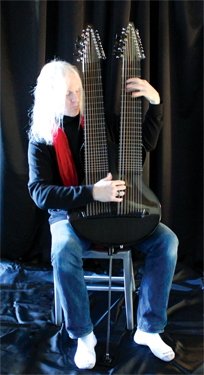

Back to top