
Reviews and Press for Returning
 Exposé
Magazine
Exposé
Magazine
Returning by Sándor Szabó and Kevin Kastning
"For readers who have memorized every review this magazine has published, I
won't have to remind you that we've covered the two previous releases by this
duo of unusual guitarists. For the rest of our readers, I will clarify that when
I say "unusual guitarists," I actually mean they play unusual guitars, not
that they themselves are unusual (which may or may not be the case and would be
irrelevant anyway). Szabo plays 12-string baritone guitar; Kastning is listed
with three different instruments, one of which is a 12-string extended baritone
guitar, a custom instrument built in the baritone guitar range (almost as low as
a bass), but with all six primary strings doubled (usually at the octave, though
he's been known to use all sorts of other tunings). All of which should indicate
to you that this is an instrument with rich sonic possibilities. The music is
among the most pleasant improvisation I've heard, with delicacy and subtlety
ruling, not intensity and angst. Unlike the previous releases from the duo, the
cover doesn't clearly specify that all the pieces were improvised, and they are
credited as joint compositions. The tones of the guitars are so rich that even
dissonances sound beautiful. this CD serves as a gentle reminder that there's
more to the guitar than the aggressive, heavily-amplified wankery generally
associated with guitar "heroes."" - Jon Davis
- Exposé Magazine Issue 39 Summer 2011 (USA)


The New York City Jazz Record
Returning by Sándor Szabó and Kevin Kastning
"On Returning, Sándor Szabó duets with fellow guitarist Kevin Kastning, their acoustic 12-string baritone models blending with deep, rich resonance. Szabó has studied classical, jazz and Far Eastern music, but his approach is highly abstract, creating harmonic canvases defying identification, suggestive of a parallel tonal universe. In spite of his uncompromising modernity, Szabó seems to be in love with the sound of sound, lingering over each eerie chord as if afraid to hear it fade. ... “Engelschreit”, “Over the hills, the clouds seem so distant,” “Sempiternal” and “Vanishing Point” all contain mesmerizing musical moments."
- New York City Jazz Record October 2011 (USA)
 Sandor Szabo/Kevin Kastning
Returning
Greydisc Records
www.kevinkastning.com
By George W. Harris
"Here’s a disc that serves as a feast for guitar fans. Sandor Szabo sticks to a 12 string baritone, while partner Kastning mixes 12 strings in alto, extended 12-string baritone and a 6-string baritone on this collection of ten co-composed originals. The music is a mix of sounds ranging from classical, jazz and eastern European folk, with songs ranging from the highly melodious “Point Of Entry” to the ethereal “Over The Hills…” The mood overall is reflective, at times melancholy and pensive. No exhibitionist display of chops here; the emphasis is more like light bouncing through a stained glass window. Intriguing and contemplative fretwork here."
 Szabo,
Sandor & Kevin Kastning: Returning
Szabo,
Sandor & Kevin Kastning: Returning
"The musical art form of Classical improvisation is alive and well with the
virtuoso guitar twins, Sandor Szabo and Kevin Kastning, on their new record,
Returning. Featuring 10 songs of 12 string acoustic guitar playing bliss,
Szabo and Kastning are simply two marvels on their instruments.
A modern day guitar explorer, Kevin Kastning has invented two instruments that
had not previously existed; the 12-string Extended Baritone guitar and the
12-string Alto guitar, both of which are used by both musicians on Returning.
Kastning from Kansas and Szabo hailing from Hungary are both regarded as
compositional genius's and the awe inspiring performances throughout the new
disc signal that true improvisation is only performed once.
In the styles forged by Jazz giants like McLaughlin, de Lucia and Di Meola, and
Coltrane, Szabo and Kastning take the torch and continue to forge along in a way
that is no longer heard in modern music. The thing is improv has pretty much
solely been an art form steeped in Jazz, NOT in Classical music. Classical music
has been the form of interpretation, not that of improv. This is what makes this
recording so interesting. Returning is simply a marvel to sit and intake
and the pure unadulterated brilliance of the Classical compositions and their
organic improvisation will leave you breathless. Recorded in one day, with no
overdubs, no cheating and no "studio magic", these are all more reasons to bask
in the greatest contained within. The music is dark, eloquent and vibrant and
will move you.
Understand that these songs are created from the playing of one single note that
is not planned out in advance and then cultivated into a rich tapestry between
two vastly competent musical impresarios. They give you the feeling that the
songs are memorized but they are not. The pieces are conceptualized in each
others minds and are usually played off of each other with their eyes closed to
bring them musical guidance. This is improv in its truest sense. The creations
are gorgeous, full of expression, full of heart and ONLY played once. If the
opportunity arises for you to catch these two maestro's locally in your area,
you will be treated to completely new, completely written on the spot,
improvisational pieces that have not been played previously. This is such awe
inspiring talent that we have here, folks. I have no idea how these two can do
this, but it is simply amazing. Returning is quite unpredictable, complex
and challenging, all the while channeling each others thoughts to their combined
24 strings of brilliance. This record will sit well as dinner party music, as
well as thought provoking fodder for the musician types that you might know. The
music is beautifully rich and intensely complex, composed by two musicians of
the utmost caliber."
Sándor Szabo: 12 string baritone guitar
Kevin Kastning: 12 string extended baritone guitar, 6 string bass-baritone
guitar, 12 string alto guitar
- Sea of Tranquility (USA)

Returning – Sandor Szabo, Kevin Kastning
July 24, 2010 by Gray Hunter
"If you view life as a journey, this could be your soundtrack.
I was intrigued by this record because it features two guitars invented by Kevin
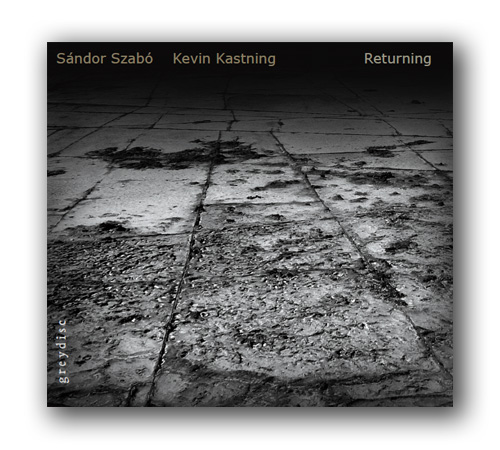
Kastning. Additionally, the simple cover design and unassuming but evocative
title, Returning, made me interested in trying to understand this music. I’m not
sure I accomplished the understanding part, but it was beautiful journey. I wish
I knew more about guitar history so I could truly see how Kastning’s 12-string
alto and 12-string extended baritone guitars have expanded the guitar sound. The
instruments certainly sound exquisite on this CD. This is due to the talent of
both guitarists and the recording ethic of Greydisc Records.
These are new instruments, to a degree, and with their twenty-four plus strings
Kevin Kastning and Sandor Szabo have forged a mythical world of sound. It
begins, appropriately, with “Point of Entry” which creates the contemplative
setting of the whole CD. The rest of the songs are like a tour of this world.
For example, the second song is “Returning to a place we’ve never been,” which,
to me, suggests familiarity blended with singularity and maybe a little
mysticism – or just mystery. It’s a a subdued song, unfolding slowly like a
hidden path. “Fourth Pleochroism” made me do research on that term. It refers to
minerals and the colors they reflect depending on the angle from which they are
observed. They can reflect up to three colors if I understood the information
correctly. So, this made this title even more appealing. This world of the
guitarists creation is beyond the normal boundaries of guitar.
The intelligence behind some of the titling is as appealing to me as the
intelligence of the music. And I probably didn’t grasp the title’s meanings much
more than the music’s. The music itself is incredibly rich. The sound is like a
blend of classical Spanish guitar and Middle Eastern rhythms, if that makes
sense. Kastning has composed many other works, too, and from what little I’ve
read of him I’d say he brings the story to the music. These songs all blended
into a single story, a single composition, not just individual songs that
highlight virtuosity or something. Szabo seems to imbue the music with a deep
meaning, a mystery, and listeners will desire to hear this music more and more.
Their guitars dance perfectly together just as intimated in “In daunsigne.” This
is apparently a reference to T.S. Eliot’s work (who simply referenced an earlier
work) and carries the theme of conjunction. Marriage partners dancing. Teamwork.
It’s all on display here. You can’t listen to this CD without thinking about
later and trying to make sense of it all. I haven’t done it justice, to be sure.
It’s a beautiful piece of art, a fascinating journey, an exploration of the
power of guitar."
A Hand In the Act of Writing
- Gray Hunter (USA)
 Returning
Sándor Szabó / Kevin Kastning
A review written for the Folk & Acoustic Music Exchange
by Mark S. Tucker/Edited by David N. Pyles
"The new Szabó / Kastning CD is out, thank God, and it's another gem in a line
of duet releases carrying on the best of the old ECM 'Dark Period' wherein
masters like (and one cannot, trust me, help, as I have done repeatedly,
mentioning these giants when reviewing S/K) Abercrombie, Towner, Connors,
Rypdal, and sundry others cloaked the world in pensive grey miasmas and lurking
mystery, a vale of fascinatingly threnodic landscapes and existential-nihilistic
ponderings. Returning is composed entirely of two interlocking, circling,
pondering guitars, brooding presences roaming benighted landscapes, this time
extending beyond the customary baritone axes invented by Kastning into new
territory: the 12-string alto guitar, likewise created by same. The result, as
ever, is darkly beautiful to a fault.
I've had the pleasure of reviewing several of their releases in past years, here
in FAME and elsewhere, and Returning is just as its name infers, a
pathway back into the unique territories Szabó and Kastning perpetually create:
spare, foggy, articulate, and literary a la modernist chamber-jazz-Goth, broad
meditative milieus of arcane mysteries. One is seduced into a Stygian purgatory
at the very outset, cascading chords and lurking follow-lines everywhere,
pinging harmonics, closely tracked rondos, mutations and the far borders of the
moors, lonely vales, and wuthering heights. Some cuts, such as Engleschriet,
get elegantly crazy, patchworks of energy and activity skewed up from the earth,
down from fragmented skies, before resolving into fitful propriety. Then Over
the Hills, the Clouds Seem so Distant settles into vaporous prosody,
pastorality set within a Montana skyscape or the steppes and tundra of distant
climes.
If I say that one need not start with this particular disc at all, don't take
that to be a curious statement but instead highest praise, as every cut and
every release is the match and mode of every other, 100% steeped in consummate
artistry. These guys have, individually and as a duo, received accolades around
the world from fans and critics alike...not to mention the luthiers who craft
new instruments to facilitate such high-flown creativity, woodworking gents who
do not extend their talents and put aside their workloads for just anyone.
Nonetheless, if you're new to Szabó & Kastning, start here, because it really
indeed does not matter: you'll be picking up the rest of the catalogue soon
enough."
Track List:
Point of Entry
Returning to a Place We've Never Been
Fourth Pleochroism
Engelschreit
Over the Hills, the Clouds Seem so Distant
Sialia Sialis
Sempiternal
In Daunsinge
Leaf Dawn Resist
Vanishing Point
All compositions by Kastning / Szabó.
June 2010: FAME Magazine (USA)
This review ©2010
Peterborough Folk Music Society
Beautiful, eerie 12-string guitar duets by Sandor Szabo/Kevin
Kastning on "Returning."
- David Adler;
Adlermusic

[Avant Garde] from Sandor Szabo & Kevin Kastning; greydisc
Returning review by Laima
Sandor Szabo and Kevin Kastning continue their collaboration in
improvisation/composition with 10 more ambient, surreal and intriguing works for
12-string baritone guitar and 12-string extended Baritone guitar (and bass
baritone guitar, and alto guitar in G). Play any!
WRUV-FM Radio; Vermont (USA)
"I had the pleasure to listen to your new CD "Returning"
with Sándor. Your CD is going further with exploring total new musical material.
As I was listening to the disc, I had the feeling, being on a road, where I
don't know any curve or anything else around me. It was a fantastic trip full of
musical adventure. Thank you for this!
Earnestly, you are roaming on totally undiscovered areas... maybe this kind of
music is not even from Earth :-) but it has a great artistic reason for
existence and further developing. The cover art is really great again, and
has a very nice touch! Congratulations on your new CD!"
- Roland Heidrich, guitarist (Budapest, Hungary)

KEVIN KASTNING & SANDOR SZABO / Returning
Guitar explorers that play guitars of their own design that they invented go
deep in serving up art. Not chasing soundscapes but not doing the usual guitar
duo type material, this is listening music for those that are big on creating
atmosphere in their atmospheres. Clearly players passionate about their work,
their explorations veer from the beaten path and are for the adventurous, even
if the sound is subtle. A solid diversion for those looking for it.
3506
MIDWEST RECORD (US)
Volume 33/Number 245
July 5, 2010

SÁNDOR SZABÓ / KEVIN KASTNING
"RETURNING"
TRUE IMPROVISATION,
DIRECTLY OUT OF THE HEART
Classical Improvisation is true improvisation!
"Creativity is more than just being different. Anybody can play weird; that's
easy. What's hard is to be as simple as Bach. Making the simple complicated is
commonplace; making the complicated simple, awesomely simple, that's
creativity."
~ Charles Mingus
"The fabric of existence weaves itself whole. You cannot set art off in a corner
and hope for it to have vitality, reality, and substance. There can be nothing
exclusive about substantial art. It comes directly out of the heart of the
experience of life and thinking about life and living life."
~ Charles Ives
MCLAUGHLIN/DE LUCIA/DI MEOLA versus SZABO/KASTNING?
Who are the best improvisers on guitar? John McLaughlin, Paco de Lucia and Al
DiMeola aren't improvising. If you follow them from concert to concert, you will
hear the same songs over and over again. Sandor Szabo and Kevin Kastning never
play the same tune twice. In any fair contest of improvisation on guitar, Szabo
and Kastning would win . . . BY DEFAULT. Classical improvisation is true
improvisation.*
"The true improviser should only perform once."
~ Billy Jenkins (avant guard blues and jazz guitarist and composer)
"And that's the name of that tune!"
~ Baretta (TV character played by Robert Blake)
THE REVIEW PART
"Alright, so I'm working on this review at 6:00 a.m. on a hot day with the
sliding door open to let in the air. I'm thinking the "Returning" with it's
cracked earth cover after two albums of with geometrical or astronomical titles,
and this symphony of birds starts up out my window. I'm not listening to the
album, so when I say I'm "working" on the review I'm just thinking, but I start
to notice a pulse in the symphony of birdsong. I can see a few birds, but they
are all starting their day in a collaboration of incredible complexity. God help
anyone who presumed to transcribe this music! The notation would be thick with
parts. Some birds repeat their tweets five times, some four, some three and many
are single tweeters. There's an owl who is finishing his day playing bass for
this orchestration and something croaking like a frog or a güiro. Each singer is
limited to a few notes, but there are some exceptional birds who improvise with
a wider palate and may be mimicking the totality of the composition. I have to
get back to that "Returning" review, and my little earthly ear training exercise
has given me some insight. I can't find a better illustration of the organic
changes that Sándor Szabó and Kevin Kastning find improvising on their extended
guitars than the complex music in nature this morning right outside my window.
"Returning" is unpredictable on so many levels, I think these two guitarists are
channeling nature in their choices as close to simultaneous in their expression
as the birds in the trees. The same magical sense of pulse and rhythm are at
work in these two guit-box players the likes of which is seldom heard though a
host of improvisers will claim such inspiration while playing some predetermined
repetitive deal that just don't leave much room for anything more organic than a
jack hammer half the time.
“I never even thought about whether or not they understand what I'm doing . . .
the emotional reaction is all that matters as long as there's some feeling of
communication, it isn't necessary that it be understood.”
~ John Coltrane
"We think by feeling, what is there to know?"
~ Theodore Reothke from the poem "The Waking"
APOLOGETICS
Now, I've had a helluva time with this review. It's scaring me a little. I've
had direct access with Kevin Kastning for a long time with emails about music
and things that friends share with small talk included over the long haul. I
just wrote Kevin an email trying to work out what I need to say about this
album. He's been writing detailed answers to a punishing number of questions I'd
be embarrassed to ask of anyone less than a friend. I think I may have said what
I need to say to him, and it looks better than what I was about to write to the
readers of this review. So here's the email. There's no point changing it to
look like I was writing the review, because I think it helped to write it to
Kevin.
EMAIL TO KEVIN KASTNING
Kevin!
To play at your level improvising together, it has to be a direct connection to the music. If either of you were to think about the time signature, name the mode, or picture the chop chart of the chord, it would sound contrived. Modes are emotional things. Chords and clusters are physical expressions of specific places in the mind specially formed to process clouds of meaning. Like there is a spot in the mind dedicated to processing loss, and several for the various aspects of love, attachment, identification, connection, disconnection, and all the various aspects of the re-legato of experience.
"I am a religious Russian Orthodox person and I understand ‘religion’ in the literal meaning of the word, as ‘re-ligio’, that is to say the restoration of connections, the restoration of the ‘legato’ of life. There is no more serious task for music than this."
~ Sofia Gubaidulina
A Fresnel in theatrical lighting is an instrument for pushing color. Your guitars are instruments for delivering very specific emotional content in a real time dialogue. You have recorded a conversation with the verbal construct extracted, but the very specific emotional underpinning of that deep conversation between brothers presented as music.
So much of speech is disconnected from feelings in common parlance. It's freakishly reduced in content to plain meaning. Your conversation restores the connection to direct gut and mind feelings traded in an ongoing exchange.
And these thoughts are probably paragraphs in the review, but it might not have been written except to you personally. Looks like I've said what has been eluding me when I consider a generic reader. Perhaps that generic thing is always a mistake. So I'm saying you two are having a verbal conversation with the subject and predicate removed to focus on the underlying psychic exchange. Maybe that's what music is all about, but it's a bit clearer in your exchange on the various guitars.
Ain't we have some fun with this? There's no right answer at this level, but the cloud of meaning in "Returning" is certainly lively, lovely, mysterious and resonant. Can't beat that with anything on "Frampton Comes Alive."
- Billy
WHERE HAVE ALL THE IMPROVISERS GONE?
Gone to grave yards every one. When will they ever learn? When will they every
learn?
Everybody knows that improvisation is the exclusive property of jazz, right?
Classical musicians are interpreters of music, not improvisers, right? Sadly,
there is some truth to that in the current crop of "classical" musicians, but
that's a new development and it's never really been even half right. Beethoven
was a classical musician. I mean, you can't write a list of classical musicians
without Beethoven. He's the big cheese. I just saw this nutty story on the PBS
program called "Keeping Score with Michael Tilson Thomas." I guess Beethoven
didn't the memo on improvisation, because he was known as a wicked and dangerous
improviser who nobody wanted to cross, truth be told. So the story goes some
hack composer wrote variations on a theme by Ludwig Van, and he didn't do a good
job. Ludwig didn't like that, so he bought a ticket for the next concert of that
guys nice little pieces of music and sat waiting for the polite applause. Then
he did this crazy thing. He walked up to the stage and took the music from the
cellist and walked over to the piano. He turned the music upside down, sat at
the keyboard and played a deadly and brilliant improvisation of variations on
that crappy music reading it backwards from the page for an hour and a half,
ending in thunderous applause. That hack composer never came back to that town
again. He had been humbled old school by a great improviser. He'd met his match,
and lost big. Now in jazz, that would be called a "cutting session." But there
weren't any jazz at that time because this was a chunk of time before the New
World was playing it, so nobody could call it anything but classical. They
didn't call it classical because it was just called music at that time. Fact is,
Bach was also a dangerous dude with an improvised variation. Paganini was
thought to be possessed by the Devil when he improvised a great chunk of time
before Robert Johnson met with the Crimson King at the Crossroads. So I guess
it's all jazz, right? Or maybe we've imprisoned the explosive power of
improvisation behind bars in "classical" music after we fell crazy in love with
notation, and forgot that those perfect notes on that white page didn't start
out that way but all that music was developed at the keyboard by some very cool
cats playing stuff that didn't exist on paper and then later wrote it down. So
what is this "Returning" album all about? Maybe it's a return of extemporaneous
music to the world we have come to call classical after a long trip up the river
behind bars, staffs, and notes right there in black and white which we have come
to call music. That's not music at all. That's just shorthand to make the music
portable, and it's very very cool. Music is an oral tradition and there have
been improvisers since Ogg the Trogg first banged a stick against a tree when
there was no earthly purpose to do it but that it sounded good. Maybe that was
just his way of blowing of steam, but he kept doing it when it sounded cool. And
that was where improvisation started. It's never left us, but maybe we sent it
off on sabbatical when we started making money selling sheets of paper with
marks on it and calling that "sheet music." Kevin and Sandor call this album of
improvisation between composers "Returning," and the music they put on that disk
is as rich and deep as you might expect from an art form that has been behind
bars for far too long and needs to get back where it once belonged.
"Returning" brings back what has never really been gone. We've been punch drunk
on common wisdom about many things in this world, and the notion that classical
music must be improvisation free is a gaff worthy of ridicule. All of the albums
by Kevin Kastning and Sandor Szabo are improvised classical music. Same as it
ever was. World without end. Amén.
BUT IS IT PRETTY?
Oh, yes! The music on this album won't scare your grandma or make the chickens
nervous. It's rich, dark, beautiful music. You can play it for all your friends
and even have a dinner party with this album on your stereo without any
complaints. And yet, this is high art with all the subtlety you would expect
from a great living composer, with the added bonus that it's only been played
one time once live in the studio. Here's the kicker that should make you stand
up and give these guys a standing O. The four albums "Resonance," "Parabola,"
"Parallel Crossings," and this new "Returning" were each recorded in a single
day in the recording studio. There was no cheating. No overdubs. No pitch
correction. If you get the opportunity to see these two play at a concert in
your town, you will be hearing something new played just that once in that room
and it will be as detailed and brilliant as a careful composition worked on
paper by some hard working composer. These guys are that good. Here's the best
part: This music will move you. There is heart in it. I don't know how they do
it, but these compositions start with a note played on the guitar with nothing
much planned and they sound like they had memorized the music and played it with
depth and feeling. That's as close to a miracle as I'm prepared to accept in
this world. It's just achingly beautiful and intimate from beginning to end.
Beethoven and Bach are dead. Long live Sandor Szabo and Kevin Kastning! I don't
care what you critics say, classic improv is here to stay!"
Sandor Szabo: 12 string baritone guitar
Kevin Kastning: 12 string extended baritone guitar, 6 string bass baritone
guitar, 12 string alto guitar
* It may be unfair to compare three guitarists playing 18 strings
to these two guitarists playing 24 strings. It may be argued that Sandor Szabo
and Kevin Kastning have an unfair advantage.
Billy's Bunker Magazine July 2010 (USA)
 "Athena Lux readers who enjoyed hearing the album "Parabola"
after reading our review, are congratulations following the recent publication
of the new musical work of Sándor Szabó and Kevin Kastning entitled "Returning."
As it could not be otherwise, the songs written for this album are based
instrumentally on guitar, but in the case of "Returning," giving a much
more expansive environment than in the previous work. With the sound detail and
harmony as the main focus of the composition, each item appears in the mind and
imagined a world characterized by complex sensory and independence. A musical
interplay that takes as its conceptual basis the entire set, but within the
particularities of each of these wonderful songs. Some issues that force you to
develop the imagination through musical figuration with precious and beautiful
melodies. A real delight for the senses.
"Athena Lux readers who enjoyed hearing the album "Parabola"
after reading our review, are congratulations following the recent publication
of the new musical work of Sándor Szabó and Kevin Kastning entitled "Returning."
As it could not be otherwise, the songs written for this album are based
instrumentally on guitar, but in the case of "Returning," giving a much
more expansive environment than in the previous work. With the sound detail and
harmony as the main focus of the composition, each item appears in the mind and
imagined a world characterized by complex sensory and independence. A musical
interplay that takes as its conceptual basis the entire set, but within the
particularities of each of these wonderful songs. Some issues that force you to
develop the imagination through musical figuration with precious and beautiful
melodies. A real delight for the senses.
We started hearing this extraordinary album, listening to the song "Point of
Entry", with a brightness and warmth that will stimulate our ears gently
until the arrival of the next topic, "Returning to a Place We're Never Been",
much darker, night and introverted. "Fourth Pleochroism" will be
presented as glossy reflections illuminating our eyes, a look at the life time
and which will be continuity in the musical spirit of "Engelschreit" but
much more vibrant and intense in its definition. With the light enter
protagonist in the song "Over the Hills, the Clouds Seem so Distant," a
beautiful composition that will bring us entirely to the unique beauty of Mother
Nature itself, and looking at the sky appears the song "Sialia Sialis"
with winds of nostalgia. In "Sempiternal" will be the reflection and
fantasy who to play with our imagination through the language of musical notes.
The song "In Daunsinge" is much more vibrant, giving an almost ethereal
and evanescent atmosphere to our environment and, following this magical way, go
into the theme "Leaf Dawn Resist" with the pulse cycle time and mark
everything that all conditions and orders. With "Vanishing Point" back to
the introverted, internal resistance against the observed and way, in contrast
to events whose background we refuse to admit, putting an end to an album that
is pure fantasy. "Returning," when the music is able to integrate
seamlessly with the universal harmony and the human spirit. Enjoy it!"
- Lux Atenea Magazine, (Spain)
 "GREYDISC - A pretty amazing album of adventurous yet harmonious guitar duets,
Returning is the 2010 CD from guitarists Sándor Szabó and Kevin Kastning.
Reviewers have already compared Returning to the early ‘70s classic ECM
sound but what benefits this album even more is the modern, innovative recording
approach, wider dynamic range and expert sonic care that is skillfully
implemented here. A masterful guitar inventor and designer who works
closely with the California-based Santa Cruz Guitar Company, Kevin Kastning
performs on his own 12-string extended baritone guitar as well as 6-string bass baritone guitar,
while Sándor Szabó shares the sound stage with his 12-string baritone guitar.
Szabó and Kastning released their 2009 Greydisc album called
Parabola, to great acclaim and now surely
they’re poised for more accolades with the 2010 CD release of Returning.
Interesting to note, the perfectionists these guys obviously are, the album was
recorded on July 5, 2008 (two years to the day this review is being written by
the way!) and was engineered by Kastning while the recording was superbly mixed
and mastered by Szabó in his native Hungary. Fans of the the finest acoustic
jazz fusion guitar masters—from Abercrombie to Metheny to Kottke and Hedges—will
appreciate the guitar expertise in play on Returning."
"GREYDISC - A pretty amazing album of adventurous yet harmonious guitar duets,
Returning is the 2010 CD from guitarists Sándor Szabó and Kevin Kastning.
Reviewers have already compared Returning to the early ‘70s classic ECM
sound but what benefits this album even more is the modern, innovative recording
approach, wider dynamic range and expert sonic care that is skillfully
implemented here. A masterful guitar inventor and designer who works
closely with the California-based Santa Cruz Guitar Company, Kevin Kastning
performs on his own 12-string extended baritone guitar as well as 6-string bass baritone guitar,
while Sándor Szabó shares the sound stage with his 12-string baritone guitar.
Szabó and Kastning released their 2009 Greydisc album called
Parabola, to great acclaim and now surely
they’re poised for more accolades with the 2010 CD release of Returning.
Interesting to note, the perfectionists these guys obviously are, the album was
recorded on July 5, 2008 (two years to the day this review is being written by
the way!) and was engineered by Kastning while the recording was superbly mixed
and mastered by Szabó in his native Hungary. Fans of the the finest acoustic
jazz fusion guitar masters—from Abercrombie to Metheny to Kottke and Hedges—will
appreciate the guitar expertise in play on Returning."
- Music Web Express 3000 Magazine (US)

Returning Kevin Kastning and Sándor Szabó |
(2010)
By Dan Bilawsky
"Returning is a rare album that is remarkable for its instruments as well
as its instrumentalists. Guitarist Kevin Kastning brings some of his inventions,
including the 12-string extended baritone guitar and 12-string alto guitar, into
play once again, on this fourth duo disc with guitarist Sándor Szabó.
A stark immediacy is present on all ten tracks, and the desolate, grey surface
on the album cover is reflected in the dark, searching quality within these
performances. While the idea of duo guitar pieces might bring about the
assumption that one musician solos while the other is relegated to a supporting
role, things aren't quite that simple here. Foreground and background ideals
still come into play, but both guitar parts mesh together to make this music
both whole and wholly unique. Sometimes the music plays out like incidental—but
not insignificant—music for a compelling desert drama; think of the 2006 movie
Babel, as on "Point Of Entry." The recording quality here—superb
throughout—allows every small gesture to resonate with significance, and the
cleanly articulated lines from both players are always in perfect focus and
balance.
Everything from Spanish-tinged sounds and vague Middle-Eastern influences to
avant-garde twentieth century classical composition comes into play. Gothic—in
the dark and unsure sense, but not the loud, metal-leaning music way—is a word
that comes to mind in certain places. Single-note lines, whether rhythmic in
nature or delivered in a floating, arrhythmic manner, are key here. The
occasional brittle chords or plinking harmonics set off ideas of a certain order
in one place, while drab hues are at the center of the musical color scheme at
other times. Once or twice, the instruments evoke different sounds—like an
occasional single-note sitar-sounding line, or a momentary harpsichord-like
passage—but, for the most part, they retain their individualistic aural DNA
throughout.
While it's hard to know whether to classify this as jazz, or what to call it at
all, the debate is irrelevant. The skill involved in composing and carrying out
this music on these particular axes is extraordinary, and the pictures painted
are all one-of-a-kind. There's no need to waste time figuring out where composed
material ends and improvisation begins. A better reason for a come back to
Returning is to simply soak in the wondrous talents of these two
guitarists."
Track listing: Point Of Entry; Returning To A Place We've Never Been; Fourth
Pleochroism; Engelschreit; Over The Hills, The Clouds Seem So Distant; Sialia
Sialis; Sempiternal; In Daunsinge; Leaf Dawn Resist; Vanishing Point.
Personnel: Kevin Kastning: 12-string extended baritone guitar, 6-string
bass-baritone guitar, 12-string alto guitar in G; Sándor Szabó: 12-string
baritone guitar.