 MUSIC
WEB EXPRESS 3000
MUSIC
WEB EXPRESS 3000
presents an interview with
SÁNDOR SZABÓ AND KEVIN KASTNING
July 2010
MWE3: Tell us something about each of your musical backgrounds and how
long you’ve been playing guitar and any other instruments as well.
Sandor: I started studying classical guitar at age 13 and then I
tried all the possible styles, rock, folk, jazz. Then my attention turned to the
real improvised music, and I also began to compose. In the meantime I started to
search for the eastern music and I went deeper into the contemporary classical
music also. By now all these influences determined what and how I play now. From
the beginning I play many different kinds of acoustic guitars, nylon and steel
strings, 10,12,16 strings, fretless 8 and 24 string double neck koboz, baritone
6 and 12 strings.
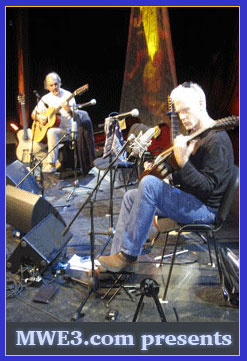 Kevin:
I began playing trumpet and piano when I was 7. I wrote my first pieces that
same year, too, using piano. To this day, I still compose on piano; never on
guitar. I added French horn when I was about 10; the school orchestra needed a
French horn, and I love learning new instruments, so I volunteered right away. I
started playing guitar when I was 11 or 12. I also play mandolin and bass. Since
about 2002, I’ve been an artist endorser for Santa Cruz Guitars, and Richard
Hoover (owner/founder of SCGC) has been incredibly supportive; both to me
personally and to my music. The Santa Cruzes are perfect for what I do; their
voicing is so balanced and responsive. They have built three instruments for me
which I’ve basically invented: the 6-string extended baritone, the 12-string
extended baritone, and the 12-string alto guitar. Some of the other guitars I
play are fretless acoustic 6-string and also classical guitar; as well as
standard acoustic 6- and 12-string. My main instruments are the three KK series
from Santa Cruz. I’m working now with a very gifted luthier in Montana named
Daniel Roberts. I could never say enough good things about him. Dan was at Santa
Cruz when the two KK series baritones were built; he had a big hand in both of
those. At present, he’s building another of my inventions called the
Contraguitar. It will be a 14-string instrument with a wider range than anything
else. I suspect this will become my main instrument.
Kevin:
I began playing trumpet and piano when I was 7. I wrote my first pieces that
same year, too, using piano. To this day, I still compose on piano; never on
guitar. I added French horn when I was about 10; the school orchestra needed a
French horn, and I love learning new instruments, so I volunteered right away. I
started playing guitar when I was 11 or 12. I also play mandolin and bass. Since
about 2002, I’ve been an artist endorser for Santa Cruz Guitars, and Richard
Hoover (owner/founder of SCGC) has been incredibly supportive; both to me
personally and to my music. The Santa Cruzes are perfect for what I do; their
voicing is so balanced and responsive. They have built three instruments for me
which I’ve basically invented: the 6-string extended baritone, the 12-string
extended baritone, and the 12-string alto guitar. Some of the other guitars I
play are fretless acoustic 6-string and also classical guitar; as well as
standard acoustic 6- and 12-string. My main instruments are the three KK series
from Santa Cruz. I’m working now with a very gifted luthier in Montana named
Daniel Roberts. I could never say enough good things about him. Dan was at Santa
Cruz when the two KK series baritones were built; he had a big hand in both of
those. At present, he’s building another of my inventions called the
Contraguitar. It will be a 14-string instrument with a wider range than anything
else. I suspect this will become my main instrument.
MWE3: How did you two guitarists meet and what would you say was the
initial chemistry that led to your first recordings?
Sandor: Things never happen by chance. A few years ago I was
searching for baritone guitar makers, and I found Kevin Kastning as an endorser
of the Santa Cruz baritone guitars. When I listened to his samples on his
website, I thought that I found the most modern American guitar player, who
seemed to me as if he came from another planet. Then when I toured in the States
and Canada, I visited Kevin, and at once we started to record. The chemistry was
obvious and so strong. When we started to play freely, he reacted and responded
in the music in a way that no other guitar player could. The improvisation with
him sounded as structured composition. It was refreshing to improvise with
someone who never used any jazz clichés.
Kevin: In 2006, I received an email from Sandor. I had heard of him, and
knew who he was. He started by asking some questions about the Santa Cruz KK
baritones. We exchanged some of our albums, and found that we had much in common
both artistically and personally. It wasn’t long until Sandor asked if I’d do an
album with him. I wasn’t looking for a new duet partner or collaborator, but I
knew that something special would come of this. I sensed I had found a kindred
soul. So I said yes. On our first studio session together, we recorded the album
“Resonance” in a single day. As an aside, we’ve recorded all of our albums in a
single day each. We both knew we had a connection unlike any either of us had
experienced; I think we meshed musically more than either of us ever had with
anyone else. During a break in the recording sessions on that first day, Sandor
asked if I’d do an album per year with him. By then, I knew we had to!
MWE3: Tell us about your new CD, Returning, when and where it was
recorded, some information on the way the album was recorded and how it reflects
your overall musicianship and/or guitar style.
Sandor: With Returning, we symbolically wanted to return to
the Source of All The Music, and we wanted to show that the music still has the
ritual and sacred power if it is played properly. We think that there are many
kinds of ways to improvise. We have chosen the most difficult, when we just lift
over the music from another reality. When we play it is a ready and complete
music, nothing more to do with it. This means of course a lot of responsibility
from the player. We never experiment, because in the Source the music is waiting
for to be reborn in and via the human soul and it just manifests as a ready
music on the instrument.
When we play in duo, we play in a different way. I am mostly a solo guitar
player, but I always play in a different way in duo. We are solved in each other
and this creates another kind of approach of the Source.
Kevin: The compositions on Returning are more extended than the
pieces on our previous albums; not just in compositional duration, but more
extended in emotional depth, harmonic complexities, and even structural form.
One person wrote to me, and said they hear the pieces on Returning as darker
than the other records. I wouldn’t refute that; I think that kind of depth and
intensity can come across as dark.
With our records, I think each one goes deeper than the preceding one. That is
certainly true with Returning.
We recorded Returning in a single day in my studio in northern Massachusetts. It
was tracked live in the studio, just as you hear it on the record; no overdubs,
no EQ, no compression or limiting.
MWE3: How would you compare the sound of Returning to your earlier
CD releases including Parabola, Parallel Crossings and the Resonance albums? Can
you describe the evolution in the sound and/or development of musical ideas
between the different recordings?
Sandor: Each album sounds a little different. However, we created a
typical sound which can be heard on all the albums. The difference is much
rather in the guitars and the tunings we played and used. We are also different
every time, so even if we do not want to change anything, things changes and
that can be heard.
Kevin: As far as sonics, recording and mixing, are concerned, I think all
our albums sound very good. I don’t know that the recorded sound, the quality of
the recordings, has changed all that much. The evolution of the musical ideas,
as you put it so nicely, certainly has. Sometimes I think of our records as
steps on a staircase; each album is the next higher step. The communication
between each other, as well as with the Source, is ever evolving and becoming
deeper. And is something I’m always pursuing.
MWE3: How did recording the Returning album with 24bit/96k resolution
impact the overall sound quality and can you describe the special steps that
were taken in the mixing and mastering stages?
Sandor: We recorded the albums in Kevin’s studio in a high resolution
hard disc recorder, using the possible highest quality mics and preamps. The mix
was done in my studio in Hungary also on devices of the possible highest level.
As for my recording concept I have a very simple concept for recording acoustic
guitar. I use mics in stereo setup with Jecklin Disc. I try to find the only one
position which gives me the guitar real sound. I never record a guitar with only
one mic, it sounds if you had only one ear.
If all is recorded properly, there is no need for mastering, because we start
everything in the right way from the beginning. I never use EQ and compressors.
These units are forbidden from my studio. I am trying to move the mics instead
of using EQ until I get what I want to hear. The only effect I use is a Bricasti
M7 or a Quantec 2498 Space Simulator. These units sound much better and three
dimensional as even the best recorded space. In this way we keep the original
dynamics and the spectral range of the guitar and the result is a very lifelike
recording where you can have the illusion that you feel the deepness, the width
of the space, the distances of the guitar in the space, and you can almost touch
it. A very 3-dimensional audio experience.
Kevin: Sandor and I divide up the work like this: I am the recording
engineer, and he is the mixing and mastering engineer. My studio has nothing in
the way of compressors, limiters, or EQ; everything is accomplished with mic
selection and placement. Everything was recorded using Millennia microphone
preamps, and a combination of Gefell, AKG, and Neumann microphones. I have a
coincident stereo mic pair on each instrument, and put up a stereo pair of 414s
as overheads, so we end up with a 6-track master. I am blessed to have a studio
which is a good sounding acoustic space, and that comes across in the recording;
you’re not just hearing the equipment. Tracking at 24/96 results in a much more
detailed and three-dimensional soundscape for sure. Sandor’s studio in Hungary
is very high-end; just excellent. Of course, having great gear doesn’t matter if
you don’t have the ears and know how to make an ideal mix. Sandor’s mixes are
wonderful, he’s got amazing ears and many years of studio experience, and it
shows. The only effect allowed on our recordings is in the mix, we use the
Bricasti M7 reverb unit. It is like having Boston Symphony Hall in a box;
everything just breathes and comes to life with it. So with the careful mic
selection and placements, the high-res tracking in a great room all with the
magic of the M7, it makes for a very good sounding recording to say the least. I
think the depth and breadth of the sonics and recording quality of Returning is
palpably deep.
MWE3: The artwork on all four albums is very impressive. What kind of
effect were you going for regarding the artwork and packaging on the CD
releases?
Kevin: Thanks, Robert. I didn’t do any of the artwork or album design
on any of them. I will usually start by sharing my thoughts with Sandor as to
the kind of album cover I’m “hearing,” based on the pieces for the album, and
we’ll discuss what we’re both hearing. We are always in agreement on this.
The last three albums were done by a great artist in Australia named Lea
Hawkins. Lea has been listening to my music for many years, and I think she will
sometimes know what the cover should be before I do. I send her a copy of the
final mix of the album, and a description of what I’m going for in terms of a
cover; a feeling, something conveyed; things hinted at, a thematic overview, an
essence; all based on and connected to the compositions. Sometimes I will
provide a vague verbal compositional overview. She always creates something
which truly reflects the compositions on the albums, while at the same time
enhancing the impact of them, I think, by her art and design and how it all is
connected to, and is even an extension of, the music. Using Returning as
an example, I think the cover art is a palpable crystallization of the music.
The pieces have that sense of depth, that texture, and then there is the fading
into blackness which seems to hover like a mist with this album. There is also a
photo in the gatefold inside the album cover which is connected. I am proud to
have Lea’s paintings and photography as our cover art.
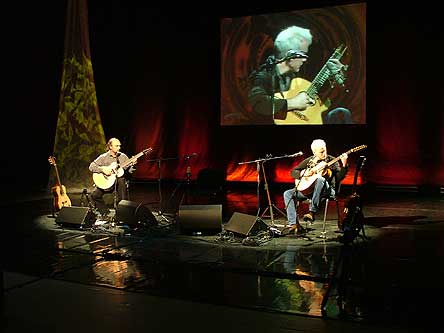 MWE3:
Tell us something about the guitars featured on the Returning
album, adding in something about any special guitar set ups, strings and pedals
or recording effects. Were the same guitars featured on the earlier album
releases too?
MWE3:
Tell us something about the guitars featured on the Returning
album, adding in something about any special guitar set ups, strings and pedals
or recording effects. Were the same guitars featured on the earlier album
releases too?
Sandor:
On Returning I used a Lance McCollum 12 string baritone guitar with
different tunings. I use John Pearse strings. I never use effects, I am a really
purist acoustic guitar player. On amplified concerts the only effect is a high
level reverb unit.
On the earlier albums I used also the McCollum, sometimes with 6 string setup,
sometimes with 12 string. I do not remember the tunings, but you can find some
on my website.
Kevin: The main instrument for me on Returning is my Santa Cruz
DKK-12 Extended 12-string Baritone. I’m an artist endorser for John Pearse, so
all John Pearse strings for me. No effects or special setups, but plenty of
special tunings. I used my own intervallic tunings on the entire album, and that
is very freeing; these tunings allow for harmonic depth and expression which
just is not possible with standard tunings. I can grasp textures and create
entire harmonic environments and establish densities which are otherwise
unattainable. There are no standard tunings used at all on the entire record. I
also used my Santa Cruz KK series Extended 6-string baritone in low E tuning on
a couple of pieces, and my alto 12-string guitar on a couple of pieces.
Everything else is the DKK-12, that is currently my favorite instrument.
On the other three records, I’m using just the two baritones. The DKK-12 is
usually my main instrument on each record, with the DKK-6 used on a few pieces.
Like Sandor, I have most of my tunings posted on my website.
MWE3: Can you mention some of your musical influences, favorite
guitarists and most influential albums?
Sandor: Earlier I mentioned my music influences. Until my 30’s I had
favourite guitar players, but from that somehow I felt listening to others will
affect my playing in a bad way. I wanted to play in my style, so from that point
the favourite players became much rather kind of handicap for me. Of course I
follow what happens in the world, but my path leads to different direction. One
thing is sure, that I was deeply influenced by John McLaughlin when I was 20-25,
then Ralph Towner and Egberto Gismonti. After my 30’s I just wanted to hear
MUSIC, composers like Béla Bartók, Zoltán Kodály, Arvo Part, Schonberg, Berg,
Wagner, Debussy, etc. Now I am much rather interested in music than guitar
playing, which means that I am first of all a musician, and only then a guitar
player. Some albums are still my favourites from my early years, like Between
Nothingness and Eternity, Apocalypse, from the Mahavishnu Orchestra, the Batik
from Ralph Towner and those two duo albums with John Abercrombie and Ralph
Towner in duo. Yes, those two albums were my reference duo guitar albums for
long time. Since I know the Kastning/Siegfried duo albums, the reference has
shifted quite a lot. These albums are not famous at all, but they are genius. It
was a big mistake always from my part when I wanted to find the best musics only
from the famous players. The deepest musicians are unknown. All the famous
guitar players became millionaires, and they seem to have lost their real honest
contact with the music because they are part of an industry and as such they are
not free anymore. They cannot renew themselves anymore. Of course I respect them
a lot, they did a lot to the world of the guitar.
Kevin: My father was a musician, and when I was growing up, there were
always just piles of records around, everything from country and western to jazz
to classical. I would listen to his records for hours and hours every day before
I started playing an instrument. From playing in school orchestras, I developed
a deep love of classical music. I don’t recall being all that impacted by
guitarists; my heroes were always composers. It is not an overstatement to say
that the work of Bela Bartok made an intensely profound impact on me. Other
heavy influences are composers such as Gesualdo, Ockeghem, Bach, Beethoven;
especially his late-period string quartets, Schoenberg, Webern, Berg, Elliott
Carter, Charles Ives, Schnittke, Shostakovich…. It is quite a long list! I can’t
really point to specific albums which had an impact, but I can point to a few
works which did: Bartok’s string quartets, Alban Berg’s 1935 Violin Concerto,
Elliott Carter’s string quartets, and Beethoven’s late-period quartets. For me,
Bartok’s quartets were like the Rosetta stone and an artistic GPS rolled into
one. I also cannot underestimate the deep impact of the works of Carlo Gesualdo.
Favorite guitarists…. That’s tough. I don’t think I have any! I always really
enjoy Paul Galbraith and Goran Sollscher, very much. Though not a guitarist, I
really like Robert Barto performing the Sylvius Leopold Weiss lute works, he’s
playing multi-course baroque lute. And of course Sandor is one of my very
favorite guitarists. His is a totally unique voice. When we did the European
tour last year, he would open each concert with a few solo works. Standing
backstage every night listening to that was a very spiritual experience for me.
MWE3: What are your current and upcoming plans regarding your recordings,
new recording sessions and upcoming tours and performances?
Sandor: Well, we have two more unreleased recordings with Kevin, a
duo and a trio together with Balázs Major on percussion. I am quite scheduled
now, here in Europe there is a decreasing interest for the music that I created
as a result of my Hungarian music researches. This project is called Modern
Hungarian Maqams. ( www.hunmaqam.hu) I just returned from a 9 concert Estonian
tour. People liked a lot the ancient Hungarian instrumental music that I
recalled 2000 years later. Upcoming tours will be in Hungary , Mexico and
Germany in the autumn. We work on making European concerts with Kevin, however
in this time it is extremely difficult to find promoters for such a deep music.
Kevin: As Sandor said, we have two more albums completed; the first of
those will be out in 2011. It will be a very special record; it was
recorded during the 2009 European tour. It was recorded on location in a church
in a tiny 9th century village in Hungary, in the shadow of a castle which also
dates from the 9th century. We also have two other album projects in the works
together; each will be very, very different from what we’ve done so far. Our
next European tour is coming up, too. Siegfried and I have completed a new album
which should be out late this year or early next year. It is the best work he
and I have ever done together. I’m working on three solo albums; each very
different. I am working on an album project with a wondrous reed player and
composer named Carl Clements. I also compose for non-guitar settings; for
example, I’ve got about four or five string quartets in the works right now,
another piano sonata, various trio sonatas. I have two duo album projects coming
up with two other artists. A bit too early to go into specifics right now, but
I’ll be making announcements on my website soon.
I also compose for non-guitar settings; for
example, I’ve got about four or five string quartets in the works right now,
another piano sonata, various trio sonatas. I have two duo album projects coming
up with two other artists. A bit too early to go into specifics right now, but
I’ll be making announcements on my website soon.
- MusicWebExpress3000 (USA)

 Interviews
with Kevin Kastning and Sándor Szabó
Interviews
with Kevin Kastning and Sándor Szabó
Billy's Bunker: 07.14.2010 (USA)
Sándor Szabó and Kevin Kastning have created four albums of subtle, spiritual and emotional music each recorded in a single day. There were no overdubs and nothing changed post-recording. Each song tells a story that comes from the heart, from the Source and from the beyond. They play extended guitars with the skill of masters. They know what they are after. Each describes a process of letting go, getting out of the way, and allowing Music to sing through their strings. The interview below was conducted through email on the subject of the latest album called "Returning."
A Musician's Guide to Instant, Immediate, Collaborative
Composition:
An interview with Kevin Kastning regarding the album Returning
A MUSICIAN'S GUIDE TO IMMEDIATE, INSTANT, COLLABORATIVE
COMPOSITION :: RETURNING TO THE HEART OF THE SOURCE OF MUSIC
INTRODUCTION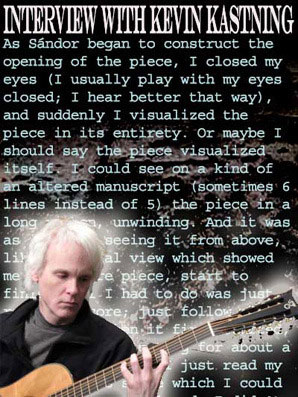
Sándor Szabó and Kevin Kastning have created four albums of subtle, spiritual
and emotional music each recorded in a single day. There were no overdubs and
nothing changed post-recording. Each song tells a story that comes from the
heart, from the Source and from the beyond. They play extended guitars with the
skill of masters. They know what they are after. Each describes a process of
letting go, getting out of the way, and allowing Music to sing through their
strings. The interview below was conducted through email on the subject of the
latest album called "Returning."
OPEN EMAIL TO KEVIN KASTNING
"Kevin,
Reading through the text again largely for pleasure. It's beyond anything I
could have anticipated. The sweep of that interview is extraordinary. You are
very specific in your answers, and there are detailed descriptions of way you
visualize music. Nothing in that interview is inaccessible and nothing in those
pages could be described as "dry." It reads like a spiritual text on music to
me. If I could teach a course in listening, I'd use the words you wrote. Nothing
I've read short of Ives has been such a window in the mind of a composer in
practice.
I started the evening reading Fela Kuti's biography which is written street
language from transcribed incendiary dialogues. Your "interview" is as
challenging to me emotionally. I find myself dreaming of the direct experience
of music in your compositions now. I imagine the music flowing through me. That,
I believe, is the magic of your collaboration. A listener who is aware of the
nature of your collaboration in these "instant" or "immediate" compositions, can
begin to feel the music flowing from that other Source. Writers sometimes feel
they are taking dictation. Some attribute their writing to spirits, fairies, or
brownies. It is a connection with some more vital part of the mind than the
conscious analytical brain can achieve. But it's part of who we are at our
uncontrolled, natural best.
So there really is more to your music than meets the ear. I didn't try to
describe the individual compositions. I could record my personal hallucinations
while listening, but they change as I change day by day. It's as though I can
begin to be swept away into that direct stream from elsewhere that you two have
given a voice. I understand that sense of release from a sense of ownership of
the music. There is a sense of ecstasy about it. My brother's description of
glossolalia seems to apply here: "Speaking in tongues is for intellectuals,
because we've forgotten what to pray for." Perhaps this ecstatic music is what
flows through when profoundly connected musicians are able to reach beyond all
the tiny thoughts of technique and catalogs of form into the unencumbered music
from the Source.
Perhaps your sight reading has tapped into second sight. This revolution in
music will not be contained behind bars, staffs, or measures. There is something
else at work here. Something other. Something from beyond. I've been steeped in
Christian imagery, so that's what comes to mind.
"For where two or three come together in my name, there am I with them."
~ Matthew 18:20
My longtime best friend and writer Michael Van Himbergen would frequently say,
"If 2 then 3." Maybe it's God or love or the great unknown, but there's no
better word for it than Music. It's your own personal experience of Music
visiting with you with a voice of it's own. Maybe the lame can't walk and the
blind can't see at your concerts, but there are miracles in the music that can't
be explained or understood. Sure can feel them though! Don't have to be a
believer walking in the door, so long as you have ears and a soul that's not so
full of certainty that it can't listen. I don't hear music theory on your
albums, I hear something living, singing, and dancing. It's a language of
feeling freer than words.
I can't seem to write for the website lately, so I'll probably publish this
email as the introduction to your interview. I guess that's appropriate. Your
music, after all, makes us all witnesses to a private moment between two
friends. This email is less intimate than that music. It fits.
-
Billy"
INTERVIEW WITH KEVIN KASTNING ABOUT THE ALBUM
"RETURNING"
(A MUSICIAN'S GUIDE TO IMMEDIATE, INSTANT, COLLABORATIVE COMPOSITION)
Baoku [Moses, founder of the Image Afro-Beat] heard all of
Returning and said just two words, "Good marriage." When did you first
know that Sandor and you had that connection? How quickly was that apparent?
I think we knew we would be a rare and excellent fit before we ever played
together. Sándor originally contacted me, and we started to get to know each
other. We had sent each other some of our previous records, and established a
rapport and friendship. And a bit of a mutual admiration society. Eventually,
Sándor started asking questions which led to “Do you want to do a record
together?” While I wasn’t looking for a new collaborator at the time, I knew,
just knew, that what we would have artistically would be very unique and had to
happen. When he asked, I said yes.
It became fully evident the first time we sat down to play together. It was in
the studio in 2006 or 2007. Tape was rolling. The first piece we ever played
together can be heard on Resonance; it’s the track entitled “First Confluence.”
That piece, exactly as it is on the album, is the first time we ever played
together. When the final chords of that piece died away, we looked at each other
and we both had huge smiles! We knew.
That first day, we recorded the entire album Resonance. Since then, every
one of our albums have been recorded in one day.
Where earlier albums had an excited feel to them, "Returning" takes a
slower pace and cuts a deeper groove. Is this like two friends reaching the
place where the conversation gets more personal?
Sándor and I connect on very deep levels: artistically, spiritually, and as
friends. With each album, that connection strengthens and deepens, and I think
that’s reflected in the end result. I know that our development is constantly
evolving; both singularly and together. We didn’t set out to create something
darker or lugubrious or slower. It’s just where we were that day in the studio.
I'm able to hear the places on "Returning" where the talking stick is passed to
the other player. Is this process between the two of you like writing a poem
trading one line at a time -- accepting the direction created by what came
before and extending the poem with the next line, in both pitch, timber, meter
and meaning?
I think the pieces flow very organically. There isn’t a specific concept of
“soloing” in the traditional sense. If you ever look at any of Alban Berg’s
scores, you will see a large, slightly altered H or N marking in certain
locations. This is his indication of his own concept to indicate what should be
in focus or in the forefront and in the background at that time. The H indicates
“Hauptstimmen,” which is a German concatenation for “main voices.” N represents
“Nebenstimmen” which is a German concatenation for “secondary voices.” I hear us
moving through the compositions using that kind of approach; yet we’ve never
discussed either this concept, or where the H and N will fall in any of the
pieces.
There is a principle in acting improvisation that each player must accept the
premise of the other or the improvisation grinds to a halt. Is it the same with
you and Sándor?
If you listen to any of Mozart’s or Haydn’s string quartets, you’ll hear parts
which are very clearly supporting roles. If you took that section out of the
score and played it solo, it wouldn’t really stand on its own; it would be of
little interest. At times it will even be static; just a single repeating note.
Haydn’s quartets, while interesting, are not constructed of four equally
independent lines. If you listen to Bartok’s quartets, you can extract any part
at any time, and it will stand on its own. Bartok was composing with the idea of
four fully independent, equal lines; yet all four parts entwine and weave
together to form a singular entirety. I think we both take a kind of supporting
role when it’s required, and I think our supporting roles tend more toward the
Bartok concept than Mozart and Haydn. Again, Berg’s H and N. However, in our
music, a supporting role is not always required. At times, both parts are equal
and moving in parallel or even contrarily to arrive at the same point. Yet our
parts are closer to the conceptions of Bartok or Schoenberg than Mozart or Haydn
in that the parts stand on their own, instead of being static background parts.
In that regard, I don’t think there is a “premise of the other” in a manner
indicating two unrelated parts. I think there is just a central premise: that of
the composition; we’re both just supporting that at any moment.
Each song has a unity and magically ends with an appropriate resolve. How
does that come about, and how do you reach that resolution together in so short
a time? Are there logical ends to each chosen path?
The endings are never discussed. For some pieces, introductions and form may get
a very cursory discussion, but not endings. When we’re performing a piece, the
piece will tell us when it’s ending, where, and how.
It seems both of you have come to imagine a music that requires an extended
range. Has that vision outgrown the six string?
Maybe, but I don’t think so. There are pieces we have recorded for the next
album wherein Sándor is playing 6-string. I think it’s like the difference
between charcoal or graphite drawings, and oil or pastel paints. In our work, I
hear concert-pitch 6-string as a sketch or drawing; I hear my other instruments
as a full palette of colors. I specify concert-pitch 6-string as opposed to my
other 6-string, the bass-baritone; I turn to that voice rather often in our
work. In the solo projects on which I’m currently working, I’m not using any
concert 6-string. So it is possible that in my own work, I’m moving away from
it. Not really consciously; I’d not thought about or realized until you just
asked that.
By playing an extended guitar, you are able to orchestrate in a range just
about equal to an orchestra. Is there a sense in your gut as to what the shape
of the piece will be? At what point in the improvisation does that "through
line" (actor's term) or overall song structure become apparent?
There is always a strong sense of where the piece is leading. Using extended
instruments allows me to have a further reach. They allow for compositional
extremes and the removal of compositional limitations. Color and texture which
would otherwise, for me, be unattainable. For years, I was hearing things
internally; both compositionally and especially texturally and orchestrally
which could not be realized. Much of what that turned out to be was in fact
music for guitar, but not for any existing guitar. Now those guitars are coming
to be, and consequently, the previously inexecutable music attached to them, or
achieved through them, is also coming to life.
There are a couple of moments when a song will take an unexpected turn to me
as a listener, and somehow you and Sándor begin that detour with an unexpected
note simultaneously. That scare you a little? How does that happen?
Synchronicity at work? Collective unconscious? Implied structure given the
framework built in the earlier part of the improvisation?
Yeah, that sounds good. Let’s go with that! Really, I’m sure it’s all those
elements and more. I believe that the implied structure of the form as it
reveals itself can influence that. If you listen to Prokofiev, sometimes a line
of his will just take a completely unexpected turn; not only in direction, but
also in timing. It’s beautiful. I always smile when I hear him doing that. Our
process is certainly arduous if not impossible to define, though. Does it scare
me? It hasn’t yet.
Do you perform these songs improvising together in the same room live in
front of the microphones?
Yes. What you hear on the record is how it was performed in the studio that day.
[Note from Billy: What you hear on each album is what happened in the studio
that day. Forgive my repetition for emphasis, but each album was recorded in a
single day at one location without compression, and nothing is ever added in
"post." Okay, that's a miracle to me. Back to the interview.]
Do you discuss the theory of the next album when you have returned to your
respective corners of the world? Is that a discussion of feelings or modes or
both or are they the same thing?
We’ve not discussed (prior to recording them) any of the four albums which are
currently released. We have discussed compositional elements within a piece
prior to recording it, but not usually, and then only briefly; maybe a couple of
sentences. We have two in the can (unreleased albums) which are different than
the first four; those involved a bit of discussion around which instruments and
combinations of instruments we’d each be utilizing, including which combinations
of instruments and their tunings for which pieces. What we have discussed as
preparation for upcoming record dates are tunings. Both he and I devise our own
tunings; mine are almost exclusively intervallic, while Sándor’s are usually,
though not always, variants of the Nashville tuning. We will send our new
tunings back and forth to each other; I’ll send him two or three new tuning
scenarios which I plan to use for the studio dates, and he will excavate some of
his older tunings, or devise new ones to complement and provide counterpoint and
additional color to my new tunings. And there have been instances wherein Sándor
will ask me to change the tuning of one or two of the courses for specific
tunings or pieces. I think this is just one more way in which we fit together so
well.
There are two or three other album projects which we have discussed and will
require further discussion. They will all be very different and more
experimental than what we’ve released thus far.
The nuts and bolts of composition: key, voicing, chords, progression, modes,
tone, timber, etc. , each have specific emotional meaning. When you move into a
particular scale or mode, is that driven by emotion or some intention or
understanding of musical theory? How you make them decisions, dude? Gut or
analysis?
Good question. I’ve studied composition literally all my life; I started writing
music when I was 7. And I still read and study and analyze composers, scores,
compositions, music theory; critical analysis; everything. I still feel as if I
don’t know much about it; all my research only underscores just how little I
know. The more I learn, the more I see how little I know and how much more I
have to learn. I like to superimpose elements of pieces which were never
composed for guitar onto guitar. One of these excursions was excerpting passages
from Bartok’s string quartets, analyzing the type of symmetrical scales from
which he derived that passage or was using as source material, and then working
out fingerings for that scale across three-plus octave ranges on guitar. I have
devised many of my own hybrid scales, established entire harmonic frameworks or
systems for compositions, devised compositional forms which can be restrictive
or experimental. Sometimes the best way to open your mind is to impose
limitations. I have a string quartet which was based on a 10-note row, for
example. I have composed chamber pieces where the source material was a 9-note
row. These are all tools, like an artist has his brushes, paints, the way he
mixes paints to arrive at the colors he uses. But when putting brush to canvas,
it’s doubtful that he is thinking about color theory, concrete perspective, or
any of the study topics. In my day to day study and practice disciplines, I am
very consciously working on all these issues and more. I focus very intently on
whatever it is on which I’m studying: analyzing a score, working on etudes, and
so on. When I’m hunched over a manuscript pad at a keyboard, or on stage or in a
recording studio, I’m not thinking about any of those things. So maybe we could
say that the cerebral happens away from the creating; the actual moment of
creation is based upon emotion, instinct, expression. Personally, I think a vast
reservoir of music theory and extreme technical mastery of your instrument are
prerequisites for having the wherewithal and facility to execute in the moment
of real-time composition. And it’s all a lifelong pursuit; personally, it’s a
slow process. For me, it’s a very asymptotic relationship between myself and all
the other elements I’ve discussed here.
What do your current guitars fail to do that you will fix with the next
generation of Kastning guit-boxes from your luthier?
Great timing on that question! I’m currently working with two luthiers on two
new instruments right now. I'm working on an 8-string classical. Those are a
known entity; they’re not one of my inventions; though they are rather rare in
the classical world. The other instrument in the works is one about which I am
very excited. I’m working with a very gifted luthier who is an artist in his own
right: Daniel Roberts in Montana (video). He and I have had an affiliation and a
friendship since 1999 or 2000; when he was at Santa Cruz Guitar Company, he was
the luthier who brought to life my other inventions: the 6-string Bass-Baritone,
the 12-string Extended Baritone, and the 12-string Alto guitar in A. Those are
the three instruments I use most often. I have been an artist endorser for Santa
Cruz since 2002, and they have been incredibly supportive of me and of my music.
Richard Hoover (Note: Santa Cruz Guitars founder and owner) has gone out of his
way for me on more than one occasion, and for him I am very grateful. Last year, Dan left Santa Cruz Co., and
is now his own company. He and I are at work on another of my inventions that
I’m calling the Contraguitar. It will have a wider range than anything else, and
will have 14 strings. This instrument will be nothing short of orchestral. The
Contraguitar will open compositional doors for me which are at present
unattainable. I’m very excited about that, and again happy and thankful to be
collaborating with Dan. I don’t think there is any other luthier who could have
brought these instruments to life as he has. His specialty, at least with me,
has been achieving a perfectly balanced voice in instruments that have never
existed. That is no mean feat, and actually just about borders on the
impossible. That is key to me, and I am always humbled and amazed at Dan’s work.
He is a great partner in what I do.
Does the song write itself in that "if two then three" extra party in the
room consciousness?
I’ll share a story with you I’ve never shared with anyone which may answer that.
During the sessions for
Parallel Crossings, something happened to me which has
never happened before, though it has happened since. This transpired when we
recorded what would become the opening track, (Preludium); though it wasn’t the
first piece we recorded that day. As Sándor began to construct the opening of
the piece, I closed my eyes (I usually play with my eyes closed; I hear better
that way), and suddenly I visualized the piece in its entirety. Or maybe I
should say the piece visualized itself. I could see on a kind of an altered
manuscript (sometimes 6 lines instead of 5) the piece in a long ribbon,
unwinding. And it was as if I was seeing it from above, like an aerial view
which showed me the entire piece, start to finish. All I had to do was just read
the score; just follow along. At the time when it first started, it seemed
disorienting for about a second or two, but I just read my part off this score
which I could see with my eyes closed. I didn’t question it. The result is what
you hear in the opening track of
Parallel Crossings. I think the overall
consciousness between he and I comes from somewhere else. We are only the
biological interfaces.
What tendencies have you discovered in Sándor's musical consciousness through
these improvisations? What have you discovered about your compositional
character through your own participation in these improvisations?
Sándor is a very sensitive and meditative and expressive artist. Which is the
kind of artist I strive to be as well. Playing in duo has to be the most
difficult setting for a musician. But I think we blend and match and almost fuse
together. While duo playing can be incredibly challenging, and not all musicians
will “fit” with another, my work with Sándor has felt very natural; very
organic. Not sure how to explain or to what I can attribute that, but certainly
the consciousness and character is one element of it. In duo settings, there is
nowhere to hide.
Which of you is the better cook?
The extent of our self-executed culinary excursions is like this. When Sándor is
in my kitchen in Massachusetts, I cook green tea for him. When I have been in
his kitchen in Hungary, he has cooked espresso for me. Since I like espresso
better than tea, I’ll say he is the better cook.
Is there a friendly or brotherly sense of competition in the collaboration?
None. We both are there as equals in service to the music.
 How much of your individual consciousness is surrendered into the marriage of
this music when you play these tunes? Is that like Spock's mind meld on Star
Trek?
How much of your individual consciousness is surrendered into the marriage of
this music when you play these tunes? Is that like Spock's mind meld on Star
Trek?
Yeah, I think so! There are always passages on the albums which I don’t remember
playing which sound as if one person was playing both parts. That happens pretty
frequently with Sándor and I.
You love [Charles] Ives and we've discussed that. Can't get enough of him,
either one of us. What of Ives is in "Returning?"
Interesting question. I’m never conscious of any single influence or composer in
my work; yet they’re certainly there. If there is any Ives in
Returning, it
would have to be his Fourth Symphony. There are so many layers happening
simultaneously in that piece. In Ives 4, there are just complexities atop
complexities; yet what emerges is a singular homogeneity. A singular whole, but
in 3-D. The complexities aren’t there for the sake of displaying complexity,
like an ostentatious compositional construct. The complex layers are there only
to achieve the finality, the end result, which couldn’t be achieved or reached
with any other approach or path. You won’t end up with a monumental piece like
Ives 4 in any other possible way than to employ those layers, those densities.
Every time I hear that piece, I hear new elements in it.
Furthermore, if you look at some of the subtitles of Ives’ 2nd string quartet,
he has devised some of his own score markings which become the titles of the
submovements. In the 2nd movement, there are passages with the titles “Allegro
con fisto,” "Allegro con scratchy,” and “Allegro con fistiswatto.” Which tells
me that Ives was looking for new methods to express and contain his art and
expression. And he wasn’t afraid to break with established convention; both
composition and titular.
I think
Returning has an element of that.
"Good composers borrow. Great composers steal." ~ Igor Stravinsky
What composers have you stolen from as you improvise on "Returning" with Sandor?
Consciously, I have no idea. But I am sure there are some ghosts in there.
What makes these compositions "not-jazz?"
Oh man…..this answer will probably get me in trouble with certain factions, but
here goes. And the following doesn't apply to anything ever composed by Ornette
Coleman. To my way of thinking, jazz is defined as song-form pieces, or
blues-form pieces, based on a swing rhythm; almost exclusively in either 3/4 or
4/4. Harmonically, these pieces are based around 7th chords: Major 7th, minor
7th, and dominant 7th chords. So, the typical jazz structure is pretty limited
to me; you’re locked into a relatively diatonic harmonic structure, and a
pre-defined song form or blues form, all with a swing rhythm. All chords are
pre-determined. The form is rigidly fixed. Metrically, you’re locked into either
3/4 or 4/4. The roles of each instrument are pretty concretely determined; for
example, the bassist is tasked with churning out the bass line. Obviously there
are exceptions, but this is a good basis of a definition for this scenario. I’m
not an advocate of labels in art, but for the sake of argument, let’s contrast
this with what we’ll call “classical” music from about 1910 forward. In that
music, the rhythm and meter can be anything. The harmonic structure can be
anything: diatonic, chromatic, or pan-tonal. Or any combination of those.
Metrically, anything can happen. The meter can change at every bar! The roles of
the instruments can be anything in any register. Our music, while improvised,
has none of the elements of jazz as I've just defined it. It does contain and is
structured upon the classical elements I’ve outlined; yet I don’t know if I am
comfortable labeling it as classical. This is possibly somewhat akin to the
theory of Rayleigh scattering, which explains why we see the sky as blue. In
short, the theory states that while all colors are present in sunlight in our
atmosphere, the other wavelengths get filtered out, leaving what we see as the
color blue. Rayleigh scattering doesn’t exactly say “the sky is blue,” it’s
closer in stating “the sky isn’t these other colors; hence, the remaining
visible wavelength is blue.” So not what the sky is, but what it isn’t. Our
music may well be defined by what it’s not. And it will probably be something
different to each person who hears it.
Charlie Mingus was influenced greatly by both Duke Ellington and Charles
Ives. Grant that Mingus in the larger works, and especially the brass symphony
"Epitaph," slips a bit beyond what might be jazz in the common sense. What makes
Duke Ellington and Charles Mingus (from that larger work) jazz, and your
compositions with Szabó "classical" or new composition or whatever they are
that's different?
I fear that the term “improvised music” carries some unfortunate baggage with
it. I think people hear that term and instantly think “jazz.” It’s documented
that Bach was a great improviser. So was Bach playing jazz? Same for Mozart.
Same for Messiaen. And Beethoven. Improvised does not mean defacto jazz. What it
does mean is real-time composition. Another way to think of it is this. When you
see a printed, complete score from a composer, there was a time when what is
printed on those score pages was indeed improvised music. Written music is
really frozen improvisation. Yes, it can be edited, manipulated, arranged,
reconstructed, refined, rewritten, attempted to be made perfect in the eyes and
ears of its composer, but whether a piece is created over a long period of time
on the canvas of manuscript paper, or if it is created in real-time using tape
as the canvas, they’re both compositions. Differing paths leading to the same
location.
[Note from Billy: My own possible description in the naming contest is
"immediate composition," "instant collaborative composition," or some
combination of the above. What about "instant immediate collaborative
composition?" Winner gets a box of chocolates.]
Your compositions are "orchestrated" in feeling if not in fact. Are you
thinking about that while playing, or feeling it assemble as you play?
Thanks; I hear much of what we do as orchestral as well. I’m sure I’m mentally
processing more when performing these compositions than I’m aware, but two
elements of which I am conscious is register and texture. The one single main
thing I’m doing when composing in real-time with Sándor is listening. There are
many data points to consider and process in this concept, but two are register
and texture. I am ever conscious of the overall texture, and this is impacted
by, but not defined by, register. For example, if Sándor is working on a line in
the upper register of his instrument, I may spin a counterpoint in the bass
register of my instrument to provide a more orchestral range and texture
involving width and depth. Then again, I may work the counterpoint in my upper
register to create a much denser, closer-voiced and tighter texture. Or maybe I
don’t provide any counterpoint; maybe I support what he’s doing with a carpet of
chordal harmonic structures. And in matters of harmony, I don’t think in terms
of chords, but in terms of harmonic structures. That’s just an abbreviated
example of one element; at any given time there are many of these occurring
simultaneously.
You two are great at leading and great at comping or supporting the other.
How does it come about that your lead has reached it's moment when it's time for
Sándor to take it further? Is that decided by time, bars, and such or is it when
your movement has found it's statement and you are ready to hear the dialogue?
Our compositions occur in real-time, and for lack of a better explanation, write
themselves. All I can do is give the piece what it wants when it’s demanded, and
stay out of the way. The piece will tell you what it wants and where it’s going.
In form, in content, in direction. I have read interviews with authors that
explain that in the process of writing a novel, often a character will tend to
dictate his or her own direction, action, dialogue; in short, take on a life of
its own which is outside the control of the author. This is pretty close to what
happens with us; the piece comes to life, and determines its own direction,
path, and ultimately, end point.
The first three albums showed more of the wowy zowy fast and complex scale
work right up front. There are some wicked guitar-god sort of runs near the end
of "Returning." Was this more of an intimate, quiet, poignant moment between the
two of you? Has the conversation become more personal?
The pieces on
Returning are more extended than the previous albums, both in
compositional length and depth and intensity.
I know that we are really tuned in to each other. When we were on tour, we were
creating pieces every night; sometimes the pieces were intimate and almost had a
prayer-like reverence. Other pieces would take on something akin to Elliott
Carter meets Bach in contrapuntal complexity. We recorded two albums on the 2009
European tour. The first of these will be out next year; the pieces on it are at
another level than our current records. This could be in part contributable to
the fact that as you say, the conversation has become more personal. I think it
is also due in part to further development of us as a unit. Further growth and
expansion. Each record we’ve done extends further and delves deeper. The second
record we recorded on tour is actually a trio record; the third person is an
incredible percussion artist named Balazs Major. Balazs is a true artist. It was
a very humbling honor to work with him.
Parabola and Parallel Crossings have song titles that reference
geometric or mathematical concepts or objects, and the album covers are
astronomical. "Returning" is earthbound in it's song titles and gray
cracked terrain cover. Was your shared frame of mind more terrestrial for this
album?
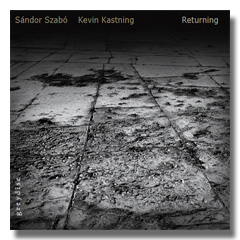 Not intended as more or less terrestrial. I think the compositions on Returning
are more extended, not only in duration, but also in depth, texture, and
densities. I believe that is reflected in the cover art. The cover photo was
shot by a wonderful artist in Australia named
Lea Hawkins. She also painted the
cover of Parallel Crossings, and did the abstract photography which is the cover
of Parabola. She is very good creating a piece of art which visually expresses
or reflects the overall setting of the compositions on one of our albums. The
titling conventions on each album are intended to serve as further illustration
or underscoring of an overall theme or direction for that album, much like
movements in a symphony. When performing or recording the pieces, the titles or
intent are never discussed or considered. The titling comes last; in fact, it
comes after the album is mastered. Titles are kind of a sore spot with me. How
do you tell the listener what a composition is about without telling the
listener what the composition is about? It’s a conundrum. This is one reason I
really prefer and feel a connection to conventional classical composition
titling. If you title something as “String Quartet No. 3,” you are giving away
nothing. It keeps the content pure. There is no preconditioning of the content
by the title to disturb or distort the perception of the content of the piece to
the listener. Here again, the listener becomes a de facto participant. Jackson
Pollock used titles like “Untitled No. 1,” instead of “Landscape in Mist at
Dawn,” or something to try to get the viewer to see something specific. He used
titles which forced the viewer to see what they wanted, to interpret it freshly
with no preconditioning. With our work on our albums, I try to title it all as
something almost like poetry, where all the titles are related to, and
reinforce, what could be the overall theme, direction, or emotional path of the
album. Yet I try to keep it all vague enough that the listener is forced to, or
has the option to, devise their own reality in the meaning and content of the
actual piece itself. To find their own message. A friend of mine related this
story to me several years ago. He is a bassist; his father was an abstract
expressionist painter. Once when he was a child, he was showing some of his
father’s paintings to one of his friends. His friend asked “What is it?” My
friend didn’t know how to answer that. So, the next day, he asked that question
to his father. His father answered, “It’s whatever you want it to be.” That is
one of the most brilliant and succinct interpretations and approaches to modern
art and also modern music which I have ever heard.
Not intended as more or less terrestrial. I think the compositions on Returning
are more extended, not only in duration, but also in depth, texture, and
densities. I believe that is reflected in the cover art. The cover photo was
shot by a wonderful artist in Australia named
Lea Hawkins. She also painted the
cover of Parallel Crossings, and did the abstract photography which is the cover
of Parabola. She is very good creating a piece of art which visually expresses
or reflects the overall setting of the compositions on one of our albums. The
titling conventions on each album are intended to serve as further illustration
or underscoring of an overall theme or direction for that album, much like
movements in a symphony. When performing or recording the pieces, the titles or
intent are never discussed or considered. The titling comes last; in fact, it
comes after the album is mastered. Titles are kind of a sore spot with me. How
do you tell the listener what a composition is about without telling the
listener what the composition is about? It’s a conundrum. This is one reason I
really prefer and feel a connection to conventional classical composition
titling. If you title something as “String Quartet No. 3,” you are giving away
nothing. It keeps the content pure. There is no preconditioning of the content
by the title to disturb or distort the perception of the content of the piece to
the listener. Here again, the listener becomes a de facto participant. Jackson
Pollock used titles like “Untitled No. 1,” instead of “Landscape in Mist at
Dawn,” or something to try to get the viewer to see something specific. He used
titles which forced the viewer to see what they wanted, to interpret it freshly
with no preconditioning. With our work on our albums, I try to title it all as
something almost like poetry, where all the titles are related to, and
reinforce, what could be the overall theme, direction, or emotional path of the
album. Yet I try to keep it all vague enough that the listener is forced to, or
has the option to, devise their own reality in the meaning and content of the
actual piece itself. To find their own message. A friend of mine related this
story to me several years ago. He is a bassist; his father was an abstract
expressionist painter. Once when he was a child, he was showing some of his
father’s paintings to one of his friends. His friend asked “What is it?” My
friend didn’t know how to answer that. So, the next day, he asked that question
to his father. His father answered, “It’s whatever you want it to be.” That is
one of the most brilliant and succinct interpretations and approaches to modern
art and also modern music which I have ever heard.
I hope that for listeners of our music, that our music will become whatever they
want it to be.
[Note from Billy: I've discovered over the past three years of writing about
music not to make too much of a title. There were some nutty reviews trying to
make a story out of the names. Words about words are just easier than words
about music. But the song remains the same. The music is it's own best
definition. A rose is a rose is a rose.]
Is Returning a reentry into the atmosphere of earth and humanity?
Not consciously or intentionally. Why would it have to be one or the other?
What do you believe might be the meaning of a slower tempo, whether that was
intentional or something coming from your spirits at the time?
Sándor and I both approach music in general, and our music in particular, with a
quiet and humble reverence. We see music as a spiritual communication, and a
vehicle for expression of thoughts, feelings, emotions, concepts, entire worlds
which could never come to life otherwise. That could be an element of the
genesis of some of the slower pieces. It’s never been discussed directly during
recording sessions, but it is something we both feel, and have discussed on
hikes or long drives together.
I believe that music of a certain connected sort has comes whole cloth from a
point of view, and that perspective might possibly be conveyed in instrumental
music. There is a struggle in the modes, chords and melodies of "Returning,"
explored tenderly. If that music were to cause a change in the listener, what
might be that change in perception or state of mind?
I can’t predict the effect our music will have on listeners. That’s up to them.
I do believe that one of the inherent beauties of abstract art, regardless of
medium, is that the listener/observer becomes a participant. By that I mean that
it can have a different impact, a different meaning, varied interpretations, for
each person. It is up to each person to determine what that is for them. So in a
sense, they are participating by finding what it means to them; by ascribing a
definition to it. They are finding their own meaning in it, their own reality.
Hence, the impact will probably not be the same for any two people. Sometimes, I
hear pieces at a slower tempo as being meditative, cathartic, spiritual, or
possibly a tabula rasa. There was a piece we performed on tour every night to
which I gave the title “Invocation,” as it felt prayerful and meditative.
Although it was never the same note-for-note performance, it did have the same
spiritual element with each performance. It just depends on the piece and all
its compositional elements and components. Returning was never intended as a set
of slower-tempoed pieces; it’s just how it happened that day in the studio. My
studio is out in the woods in the hills of New England. Often Sándor and I will
take a break and go for a hike. I think that artists are to some extent a
product of their environment. While it’s not intentional or conscious, I don’t
think it would possible to exclude the element and deep influence of nature in
our work.
One idea I might offer to listeners prior to hearing our work, or really any
kind of abstract, new, adventurous music, is to leave your metrics behind. I
have heard people say things about modern classical music like “Where’s the
melody?” One idea I have offered in response is “Everywhere. It’s ALL melody.”
As in multiple melodies, or lines, occurring at once. To return to Pollock for a
moment, a viewer of his work probably wouldn’t look at one of the drip series of
paintings and say “Where’s the landscape? Where is the still-life?” It’s not a
painting from the 18th century; it won’t have those elements as subject. New
metrics are required, new eyes are needed to view Pollock if one is to
appreciate his work and what he is saying. And where that art will take you if
you allow it. Same with music. If you listen to a lot of Haydn, then are
presented with an Elliott Carter string quartet, you can’t be looking for the
still-lifes in Carter. You have to jettison the old metrics. You can’t
superimpose 18th century metrics upon 21st century art.
If 2 then 3. Describe the relationship you have discovered in musical
collaboration and friendship with Szabo as though it were a personality all it's
own.
It would take more time to really expound on that than you want to hear! I will
say this. To call what Sándor and I have a “friendship” is to cheapen and
underestimate it. It is more of a brotherhood. I mean that both artistically and
personally.
How does the embodiment of the musical and personal relationship you have
with Szabó differ from your own persona? (I assume that aspects you share would
be part of the relationship persona, but less so any differences.) What
struggles do you find, if any, present themselves between Kevin and Sándor in a
recurring way in these improvisational compositions?
I’ll attempt to answer those questions with one answer. I have never met anyone
who was more like me artistically than Sándor, and he has said the same. We are
tuned in to the same things, the same vibrations, the same frequencies; however
you’d like to phrase it. I believe that is part of why our music at times sounds
as if it’s being performed on a single instrument by one person. There haven’t
been any struggles or differences, there has only been the music. And joyful
discovery.
Do these songs surprise you when you hear them later?
Sometimes. I have heard elements in the recordings that I don’t remember playing
or hearing when it was recorded. I’ve heard things I’ve played that I don’t know
how it was executed, as in I have no idea how I did or could have technically
executed certain passages. By that I don’t mean any qualitative judgment; I’m
not saying it was good or bad. Just that there is the element of the
unexplainable sometimes. More than once, I have gone over tiny passages on one
of our records, and still can’t figure out how I executed something.
What might be the song that changed for you most between it's performance and
hearing it later?
It wouldn’t be a single composition; to answer that question, it would be an
entire album, and that record would be Returning. I don’t remember recording it.
I mean, I remember the studio date and being in the studio all day, but I don’t
recall performing any of the pieces. From the day it was tracked until the day I
heard the final mix was over a year. When I listened to the final mix, which was
in fact the first time I’d heard anything from the sessions for what would
become Returning, none of it sounded familiar. It sounded like us. I just don’t
remember any of the pieces or recording them.
How is your improvisation or composition altered because of what you have
discovered about yourself in this collaboration?
Yeah. That is a fascinating question. I am still determining what I’ve
discovering about myself. I have discovered new depths of artistic realities.
Not so much within myself, but within a vast spiritual and artistic ether and
space. Waiting to be tapped into. Discovering that kind of formless, limitless
space can be very mentally and emotionally liberating, certainly.
Have you found anything about Szabó you would consider to be a Hungarian
mentality in his musical inclinations? Have you transcended your roots as an
American in your music, or do you feel something in your character causes your
music to be rooted in country or society or locality?
Sándor and I obviously come from different places geographically, historically,
societally, and in other ways. Yet I don’t approach anything we do or have done
as having any nationalistic elements; personally, I don’t think politics have
any place in art. I don’t hear him as a Hungarian artist; nor do I think of
myself as an American artist. We are really only just two artists in service of
art. And with such divergent backgrounds, it makes it all the more remarkable
that I have never met anyone so like myself artistically and spiritually.
Speaking for myself, I want to serve the music as a whole, and keep myself out
of it as much as possible. I am merely a biological interface. That may not make
much sense, but what I am trying to say is that in our work, as the compositions
unfold in real time, if you’re tuned in, the pieces will tell you what they want
and where they’re going. If I follow that, the compositions come to life
organically and live. If I think I can impose my preferences over that, or think
that I’ll do something which is not being asked for at that moment, it just
doesn’t work. It’s deviating from the blueprint. So I have to keep my
inclinations out, and just let the music live and breathe as it wants.
Which is a greater influence on the character of your improvisation on a
given day: the music you have been listening to, or your personal gestalt at the
time?
If I am performing with someone, either live or in the studio, the influence on
my playing will be determined by what is demanded by and in that current
setting. If I am composing, or doing any solo recording, and I am currently
working on two solo records, then what happens can be various things. It can
just be where I am spiritually that day. Or it can be to work through a
composition which may have been started on a previous day; to sort of continue
where I left off. I don’t think my current listening selections have an
immediate, tangible impact or determination on what I play or write; or perhaps
I should say I can’t tell it if they do. If I’ve been out on a hike, I think
there is as much of that interaction with nature in my work as much as any other
external influence; elements of nature can jolt me into another place
spiritually. I also don’t really believe in the concept of inspiration for
artists. If you’re an artist, the inspiration is there within you, always. It’s
part of you. It doesn’t come from an external source; an outside stimulus
shouldn’t be required.
Van Gogh once stated that the definition of a true artist is one who is always
seeking, but never finding. I feel that in our music as well.
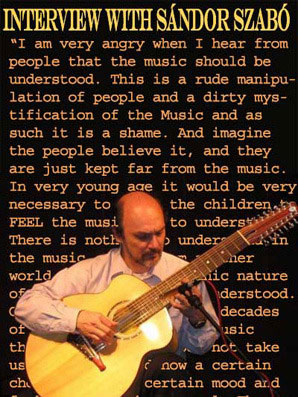 INTRODUCTION
Sándor Szabó and Kevin Kastning have created four albums of subtle, spiritual
and emotional music each recorded in a single day. There were no overdubs and
nothing changed post-recording. Each song tells a story that comes from the
heart, from the Source and from the beyond. They play extended guitars with the
skill of masters. They know what they are after. Each describes a process of
letting go, getting out of the way, and allowing Music to sing through their
strings. The "interview" below was conducted through email on the subject of the
latest album called "Returning."
INTERVIEW WITH SÁNDOR SZABÓ ABOUT THE ALBUM "RETURNING"
Are the musical conversations between you and Kevin Kastning a "Returning" or
restoration of improvisation to "classical" music?"
To answer to this we should know what the improvisation is, what the purpose of
the Universe/Creator with the improvisation in the life of the human being. And
also the answer is long. First of all the music is the only direct passage
between the invisible and the visible world and reality. That is why we can be
in constant and direct contact with the Source. By now I know that the music is
not a human invention. It exists independently of us, like the physical acoustic
laws, etc., and they are valid without our existence. We are just capable of
perceiving these things — The same with the music. We are capable of perceiving
the music.
When a good musician is REALLY improvising, he/she never thinks on what to do.
In those moments the improviser acts as a biological interface, in a special
state of consciousness, like a receiver in order to lift over the music from
another reality. It is kind of transmission, or translation. The Returning is
symbolic for me because we return to the Source of ALL THE MUSICS. For musicians
like we are with Kevin, we have to learn first of all how to be such a sensitive
receiver to bring up the music from the Source, much rather than practicing
things that are already played here by others.
I think a big and whole restoration would be necessary in the last 200 year's of
classical music. Why? Because it concentrates only the composed music, and the
performers are not trained to be improvisers but only to interpret. The bigot
academism is a big handicap and somehow it would be necessary to set free the
classical/academic music of this rigid attitude. The so-called jazz is not
always real improvisation. Since it is taught in schools, it became kind of game
for the brain. That is why we have more and more such musicians who are able to
make real time variations of pre-learnt and pre-practiced music phrases (parts).
These musicians have excellent rational intelligence, but almost no spiritual
intelligence. The real improviser should have mostly spiritual intelligence.
This cannot be obtained in jazz schools.
So now there is a big gap and distance between the real improvisers and the
classical musicians. In the age of Bach, the improvisation was absolutely
natural. A decent musician could improvise a fugue with 3 or more voices any
time. I can also say that we feel a big distance from the contemporary jazz
musicians, because they stuck into a very rigid stylistic, esthetic system, they
want to play CERTAIN style of music in a CERTAIN way. This makes them
compromised with themselves and with the music itself.
So with Kevin we just recalled something of that ancient attitude. In our
present world the materialism dominates in the life of the people. In these
times the world "soul" is very often meaningless for people, just because they
grown up in a materialistic world. They have never used their spiritual
intelligence and that is why it is extremely difficult to give validity to such
music which comes directly from the Soul. We just do this.
Bach, Beethoven, Paganini, and most likely all composers of the common practice
period were known as master improvisers. Had there been recordings of those
improvisations available, do you think "classical" music would have developed to
include improvisation throughout the years?
You can see that the world of classical music is divided into casts, like
player, composer and conductor. The player acts like a slave, the conductor is
mostly the star, and the composer is always is in the background. Actually the
composer is the receiver of the music, even if it is not a real time improviser.
The improvisation and composing are absolutely a practical thing, which means
that if it is not done, it does not exist. There are educated modern composers,
and they have never tried to improvise — not even a children's song. To be a
sensitive composer or improviser, you have to do it constantly. So I clearly see
that without such genius improvisers as Bach, Bartok and others today's
classical music would be very primitive, rigid. I think that our musical world
needs a new genre of improvised music which comes directly from the Source. Of
course, there are so called free jazz musicians who are actually simple
noisemakers, they try to express their untalentedness and frustration in a loud
way, I speak about not of them.
"The fabric of existence weaves itself whole. You cannot set art off in a corner
and hope for it to have vitality, reality, and substance. There can be nothing
exclusive about substantial art. It comes directly out of the heart of the
experience of life and thinking about life and living life." ~ Charles Ives
Do the songs you play in dialogue with Kevin Kastning come "directly out of the
heart of the experience of life and thinking about life and living life?"
Well, as I told you we are simple organic interfaces, with sensitive receivers
and we are influenced of all the mental, physical, etc. circumstances in our
life. When we play together the music is just being lifted over from the deeper
reality, and we also work as a filter, because we are exposed to the
above-mentioned influences. In this way the music we "create" is very personal
of both parts. That is why it is very intimate because the listener can see and
feel our soul directly.
“I never even thought about whether or not they understand what I'm doing . . .
the emotional reaction is all that matters as long as there's some feeling of
communication, it isn't necessary that it be understood.” ~ John Coltrane
"We think by feeling, what is there to know?" ~ Theodore Roethke from the poem
"The Waking"
What do you hope a listener will understand about your music?
John Coltrane was a genius improviser and huge MIND. He managed to see behind
the "curtain."
Of course I know this quote from the age of my 20's and it was always a thought
to me, which was a guide in approaching the music. I am very angry when I hear
from people that the music should be understood. This is a rude manipulation of
people and a dirty mystification of the Music and as such it is a shame. And
imagine the people believe it, and they are just kept far from the music. In
very young age it would be very necessary to teach the children to FEEL the
music not to understand. There is nothing to understand in the music. It is from
another world and the real organic nature of the music cannot be understood. Of
course, you can learn decades of different human-made music theories, but that
does not take us closer why and how a certain chord creates a certain mood and
feeling in the human soul. The music is at our disposal and we should contact it
by feeling. There is no any other way.
What do the songs on "Returning" cause you to feel?
It is like you have children and meet them every day. You recognize them always
but they radiate different feelings every time for you. I do not care about the
titles of the songs. They are only for identification. I do not really like very
direct, concrete titles because they can determinate the feeling of the
listener. I like very abstract or neutral titles, not to be deviated from the
clear feeling.
"I am a religious Russian Orthodox person and I understand ‘religion’ in the
literal meaning of the word, as ‘re-ligio’, that is to say the restoration of
connections, the restoration of the ‘legato’ of life. There is no more serious
task for music than this." ~ Sofia Gubaidulina
Is your music on "Returning" an attempt at a restoration of the 'legato" of
life?
I also knew this quote, but in my case I think that we should recover and
restore the sacral quality of the music. For this we have to get direct contact
with the Source, and then if we have the contact we do not have to do anything
because the music is already sacred. This sacred attitude and quality is missing
from the industrially made very materialistic music productions, even from the
contemporary jazz. There are only a few players who do the music in a sacred
way. In this point of view, yes the Returning is an attempt of the "legato" of
life.
How has your collaboration with a young Berklee School of Music graduate on
guitar changed your understanding of music?
To be honest, the fact that someone is a graduated musician from
Berklee School
of Music means nothing to me. It of course does not mean that I would not
respect that knowledge that can be learn there. My problem is that they do not
teach anything in the Berklee about human nature, about how to get to such a
state of consciousness where the Source opens up for an improviser. There are
such talents like Kevin, who attended the Berklee and he was aware of this, and
nobody could wash out his mind, and now he is for me the most revolutionary
American improviser. I am completely frustrated about the jazz guitar world.
Nothing happens, it is a standing water, it became materialistic. There are
several new talents, with brilliant new approaches in this filed but in these
day they do not have chance to emerge from the unknownness.