
The following is an English transcript of the 9 July 2026 episode of the Universos Parallelos radio program in Madrid, Spain. This installment of the show featured all my 2026 album releases (thus far). You can stream a recording of the show here: https://universosparalelosradioshow.blogspot.com/2026/07/emision-09072026-especial-kevin-kastning.html
~=~=~=~=~=~=~=~=~=~=~=
UNIVERSOS PARALELOS
KEVIN KASTNING SPECIAL 2026-07-09
"Welcome to Universos Paralelos! Our musical discovery session begins here on
the Onda Verde dial, 107.9 FM in Madrid, also at radiopra.blogspot.com.es,
broadcasting from Nava, Asturias, the cider region, and of course, always on our
blog and podcast at www.universos-paralelos.com. We're also featured on the
Esferajazz.com platform and on our own Telegram channel, which you can subscribe
to completely free of charge. Each week, you'll receive both the blog post with
comprehensive information on everything we're playing and listening links to
recommended albums, as well as the program itself in high-quality MP3 format, so
you can download, collect, and enjoy it on your favorite device.
We begin today our final edition of this 31st season, which has been thrilling
here at Universos Paralelos, and we're putting an end to it with a blast, a
special dedicated to one of our favorite musicians, a musician who enjoys his
own language, his own musical concept, his own dark beauty, and who has also
been sharing his work with us for many years. If you heard that first track that
played, you'll have immediately realized that we're talking about Maestro Kevin
Kastning, a splendid and absolutely innovative guitarist who was a student at
Berklee College of Music in Boston and later studied privately with none other
than Pat Metheny himself. He has composed more than 300 pieces for different
ensemble configurations, and his discography exceeds 50 albums. He is a
completely established musician and, as I said, with his own musical concept,
even with his own instruments designed specifically for him.
We kick off today's edition with what is our first album to explore by Kevin
Kastning. As you know, he's a very prolific artist. We had planned our albums
for the first half of 2026, from January to June, and had selected six tracks
from his last six albums. But the whirlwind of releases Kevin Kastning is
currently involved in has overwhelmed us again, and we have two more albums to
premiere and share with you all. They just arrived last week, at the beginning
of July, so that makes eight premieres, eight recommendations we have to share
and discover with you from Maestro Kevin Kastning. Four of them are solo guitar
albums, a format he last explored in 2018, and we've began today's edition with
the first album to explore, Codex I, which was released at the beginning of the
year.
It's his seventh solo album, and it's a new solo guitar work with a new
recording and performance concept to discover. The album was released on January
26, 2026, and features a tremendous array of double contraguitars and double
subcontraguitars. The majority of his instruments, at least in this series of
recordings called Codex, are double-neck guitars, and he writes he's been
working on a new way of recording. The compositions in the Codex series, which
at the beginning of the year comprised two volumes and with these July releases
now has four, are quite complex compositions that involve new guitar techniques.
Each piece was recorded live in a single performance and a single take. There
are no re-recordings or edits, and his technique is such that he's playing his
double-neck guitars with one hand on each neck—that is, using a percussive,
tapping technique, in guitarist terms, which facilitates polyphony, multiple
lines, and harmonic structures that wouldn't be possible otherwise. He also
tells us that the recording setup is directly in stereo and that each
double-neck instrument has been recorded so that the left neck is in the left
stereo channel, and the right neck is in the right channel. Therefore, listening
with headphones is highly recommended, because you'll hear exactly what Kevin
Kastning would hear playing—that is, each guitar neck sounding on a different
side. This recording technique is used throughout all four volumes of Codex,
both in the first two, which we're about to premiere, and in the last two, which
will close this special program.
I can already tell you that the program will be considerably longer than usual,
so our colleagues at the radio stations have our permission to cut to the next
program whenever they deem it necessary. We're going to extend our runtime and
fully enjoy this final seasonal edition of Universos Paralelos.
We opened the program with Kevin Kastning's Codex Volume 1, his first solo
guitar album since 2018. Some time ago, we also played a very notable album here
on the show: Otherworld, released in 2015, which reached number one on the
iTunes classical charts in September of that year. In this case, he presents a
series of improvised constructions with distinct characteristics, and in fact,
when the structure or way of working on a piece relates to others in the
project, he numbers them. Today, as the first piece of this special, we listened
to track number 7, which closes Codex I, titled Structure 2. Structure pieces
are more percussive and have a more defined rhythmic structure. Incipit pieces
are a mix of percussion and silence or rubato, and there are also other pieces,
such as Arcana, which are entirely melodic in a single line, with little to no
polyphony. Each time a structure, a way of conceiving a piece, is similar, it is
numbered, hence the name Structure 2 for the piece with which we opened today's
program.
We will continue with his next album, Codex number 2, which was released on the
same date as Codex I, January 26th. Codex 3 and 4 were released on July 6th. The
first two volumes date from a single recording session, or a series of sessions,
that took place in the summer of 2025, and Codex 3 and 4, which will be played
at the end of the program, were recorded in the autumn of last year. Codex 2 is
his eighth solo album, and we're going to listen to a very special piece that
doesn't correspond to, or at least isn't part of, any of the four Codex series.
It has a very special atmosphere, with a strong emphasis on silence and space,
depicting a temple. The piece is titled Sanctuary 1, and it evokes a sense of
majesty and also spiritual contemplation. We're going to premiere this Codex 2
by Kevin Kastning by listening to this second track, titled Sanctuary 1. We
continue enjoying Kevin Kastning's most recent discography here at Universos
Paralelos.
< Playing Sanctuary 1 >
We were listening to Sanctuary 1, which is the second track of this second
volume of the Codex series, released in January 2026. I chose this piece because
it doesn't have an exact correspondence with any series like Structure or
Arcana. In this case, it's a unique piece with a very special character. At the
beginning, there was a lot of silence and space, followed by those first chords
reminiscent of a church bell. It's a very special work and a very personal
concept, with its unique way of recording double-neck guitars, one neck in the
left channel and the other in the right. For those of you who don't know him,
Kevin Kastning has his own line of instruments crafted for him by the Irish
brand Emerald. The entire instrument is made of carbon fiber, the only material
that could withstand the tremendous stress he puts on them. Some are
contraguitars with 30 strings paired in twos or threes, meaning the tension on
the necks and the instrument's structure is immense. These guitars are played
almost vertically, with a pointer resting on the floor. The truth is, like the
rest of his musical vision and his way of communicating it, they are absolutely
special and unique to him.
With this, we conclude this series of the first two albums called Codex,
released in January 2026, and we're going to move forward in time. We're going
through Kevin Kastning's albums from this first half of the year in
chronological order of release, and we're going to listen to Across Tall Rain,
which is the name of the new project by the duo formed by Kevin Kastning with
the splendid double bassist Bruno Råberg, a Swedish-born who emigrated to the
USA in 1981 and teaches at the Berklee Global Jazz Institute, directed by Danilo
Pérez. His collaboration with Kevin Kastning already has several albums released
and proves to be very special and dynamic, contributing with many resources:
percussion with the double bass body, bowing, and other techniques that he
brings to his duets with Kevin Kastning, and the result is very unique and
interesting. They've been collaborating for two years, since Silent Dimensions,
their first album as a duo, in addition to their trio album Intervallum, which
also featured trumpeter Phil Grenadier, who will also have a very special role
in this season finale of Universos Paralelos.
For now, let's explore Kevin Kastning's new collaboration with Bruno Råberg,
Across Tall Rain, and focus on one of the longest tracks on the album. It
exemplifies everything we'll find throughout this new recording, released on
February 24, 2026. Here, Kevin Kastning plays double 36-string contraguitar, a
16-string contraguitar—his usual arsenal—along with Bruno Råberg's acoustic
double bass. All the compositions are collaborative and were recorded without
overdubs at Kevin Kastning's studio in York County, Maine, on December 9, 2023.
It was mixed and mastered by the Hungarian maestro Sándor Szabó, who regularly
handles this work for many of Kevin Kastning's recordings at his Tandem studio
in Vac, Hungary. Let's listen to this work now with track number 3. It's called
Dark Branches Faster, and this is what Across Tall Rain, the new album by Kevin
Kastning and Bruno Råberg, sounds like, here on Universos Paralelos.
< Playing Dark Branches Faster >
Tremendously electrifying, intense, creative… very powerful. Dark Branches
Faster, this third track, is the longest piece in the new collaboration between
Kevin Kastning and master Swedish double bassist Bruno Råberg, who, as you've
heard, not only contributes pizzicato and bow to his playing in this
improvisation, but you've also heard percussion with drumsticks, creating a
tension that barely dissipates until the very end of the piece. Kevin Kastning
and Bruno Råberg undoubtedly share a very special chemistry and continue their
collaboration with this album, released on February 24, 2026. Kevin Kastning
plays, among other instruments, double contraguitars, and Bruno Råberg plays the
double bass on this second duet album. It's a true pleasure to share this duo
project, which continues to evolve over the years, with this new album, Across
Tall Rain.
Now I'd like to take a moment here to remind you that all the material we're
going to listen to today is available on Kevin Kastning's Bandcamp page. The
digital albums are quite affordable and worth buying on the first Friday of each
month when the platform donates its commissions to independent artists and
labels. This entire discography is available at Kevinkastning.bandcamp.com, and
in this week's blog post, you'll find all eight albums accessible along with
eight links to access their Bandcamp pages and listen to them directly there,
including Across Tall Rain by Kevin Kastning and Bruno Råberg. This album was
mixed and mastered by Sándor Szabó, achieving the excellent sound he usually
delivers in his studio.
We're continuing with Kevin Kastning's new discography, and now comes what is
undoubtedly the surprise of the year. A new stage begins, a new duet
collaboration that is already developing with other projects in addition to the
one we're premiering today: Kevin Kastning's duet with Paul Wertico, the former
drummer of the Pat Metheny Group. This is quite an unprecedented collaboration
because, apart from his work with Hungarian percussionist Balazs Major, there
haven't been any regular collaborations with percussionists, much less with a
drummer. In this case, a new line of work has opened up with Interchange One,
the title of Kevin Kastning's first duet album with Paul Wertico, a truly
remarkable work that was recorded remotely.
Paul Wertico was a member of the Pat Metheny Group from 1983 to 2001 and has
worked with a multitude of musicians, primarily from the Chicago area, where he
lives, such as Kurt Elling, Paul Winter, and even David Bowie. He is an
associate professor of Jazz and Contemporary Music at Roosevelt University's
School of Performing Arts, conducts drum clinics worldwide, and has received
numerous awards, including Chicagoan of the Year, bestowed by the city's
authorities.
We're going to explain how Kevin Kastning and Paul Wertico's Interchange One
came about, because it's a long-distance collaboration. Kevin Kastning proposed
this project to Paul Wertico. He sent him a pre-recorded track, and the drummer
played it and listened to the first few seconds. He immediately stopped it,
restarted the track, and began recording over it, responding to what he heard in
real time—in other words, the response was completely instinctive. This is
explained in Kevin Kastning's liner notes and Paul Wertico's own words. He
listened to roughly the first 30 seconds and decided to record his drums over
that track without having heard the entire piece at all. He sent the results,
and they concluded that there was a special chemistry between them and developed
this concept of a 'double current,' similar to water flows that can exist
independently, coexist, merge, or even collide sonically. It's also based on the
concept of organic time, time that flows naturally, and inorganic time, that is,
time marked by the metronome. So their musical conversation was primarily about
listening to the other person speaking through their instrument and reacting to
what they felt or heard with their own instrument. They completed 14 tracks, he
mixed his drums, sent the result back, and then Kevin Kastning did the joint mix
and mastering.
This is how Interchange One was born, which will be followed by Interchange Two,
to be released in August. As I said, Kevin Kastning's release schedule is
practically impossible to keep up with, at least with the programming structure
we have here at Universos Paralelos, but it's worth taking a break now and then
to listen to all his new releases, as we're doing today. Interchange Two, the
second part of this collaboration, will be released on August 4, 2026, so we'll
be checking it out in the second half of the year. For now, let's explore the
results of this Interchange One, this first collaboration with this wonderful
surprise. As I mentioned earlier, Kevin Kastning was a private student of Pat
Metheny, and that seems to be the link that has finally brought Kevin Kastning
together with Paul Wertico, who was the drummer for the Pat Metheny Group for
many years. Let's premiere this recording, Interchange One. All the tracks are
titled Adjacent Flowing Streams, and we're going to focus on one of the most
interesting pieces. Although they're all interesting, I have the feeling that
from the first tracks to the last, the relationship loosens up a bit more,
becoming more agile and organic. Let's listen to track number 6, the penultimate
track on the album, titled Adjacent Flowing Streams 6. This is what Interchange
One sounds like; this is what Kevin Kastning and Paul Wertico sound like for the
first time here, on Universos Paralelos.
< Playing Adjacent Flowing Streams 6 >
There were those currents, in this case musical ones, demonstrating in a
completely practical way what maestro Paul Wertico said about this conception,
this way of perceiving music, these currents that can coexist independently, can
unite, or can even collide. We also heard practically all of these modalities in
this piece, which is quite paradigmatic of what you can find, especially at the
end of the recording. We were listening to the sixth track, the penultimate of
the seven on this Interchange One, which is the first collaboration between
maestro Paul Wertico, none other than the former drummer of the Pat Metheny
Group, and Kevin Kastning.
Here, Kevin Kastning plays contra-baritone guitar, double contraguitar, and
double sub-contraguitar, among others, and Paul Wertico plays acoustic drums,
cymbals, and also the talking drum, which also appears in the recordings they
made, as I mentioned, one on top of the other, reacting almost instantaneously.
The album was released on March 31st of this year, 2026, and this is a sample of
what they've achieved in this first recording, or rather, these first two
recordings, because Interchange Two is coming out in August.
Imagine if, instead of recording remotely, they had been able to see each other
and react and communicate physically. This is a completely new addition to Kevin
Kastning's discography and work. This first duet album with drums will surely be
followed by others, because, as you know, Kevin Kastning establishes very long
lasting relationships with his collaborators, as is the case with what's coming
next, which is none other than the work called 2 + 2, the next stop on the long
journey of Kevin Kastning and British guitarist Mark Wingfield.
The album is titled 2 + 2 because each composition, each piece, is made up of
four parts, with each musician contributing two parts to each composition. In
other words, two musicians, two parts of each composition: 2 + 2.
Kevin Kastning plays guitars in this case, mostly acoustic, along with
contra-baritone guitar, double contraguitar, and double sub-contraguitar, while
Mark Wingfield plays electric guitars, expanding the palette considerably. Here,
I get the impression that there are indeed overdubs, as there are also
soundscapes, backgrounds, landscapes painted with Mark Wingfield's electric
guitar. This is something new compared to Kevin Kastning's recent collaborations
with Mark Wingfield, which were relatively minimalist, featuring only two
guitars. In this case, you'll find a broader and more interesting timbral
spectrum to get lost in, or to immerse yourself in. For now, let's take a first
bite of this duet, this new collaboration between Kevin Kastning and Mark
Wingfield, and we'll start with one of the tracks that I liked most almost from
the first listen: the second track, titled "2 + 2, Part 2." This is how Kevin
Kastning and Mark Wingfield sound in 2 + 2, here at Universos Paralelos.
< Playing 2 + 2, Part 2 >
The tension between Kevin Kastning and Mark Wingfield was tremendous, with
successive re-recordings of both Kastning's acoustic guitars and Wingfield's
electric guitars and soundscapes wrapping the recording. These re-recordings
featured calls, responses, counterpoints, and all sorts of messages between the
two musicians, creating an almost unbearable tension that lasted until the end
of track number 2, "2 + 2, Part 2." This was the piece we chose to introduce you
to 2 + 2, the latest work under their own names by the two masters, American
Kevin Kastning and British Mark Wingfield.
The album was released on May 26, 2026, and was recorded in several sessions at
Kevin Kastning's Traumwald North studio and Mark Wingfield's Heron Island
studios in England. The mixing and mastering were done by Wingfield in England,
and the compositions are a joint effort, as is the cover art, which both artists
created for this 2 + 2, a relatively new work compared to their previous career,
which spans many years and numerous recordings.
We continue with this special season finale of Universos Paralelos. We've
already completed our usual hour of broadcast, and from now on we enter bonus
territory. We still have much to listen to and much to discover in the
discography of this first half of 2026 from maestro Kevin Kastning. We finished
with this duet with Mark Wingfield, and now we're going to delve into one of my
favorite projects, or practically my absolute favorite, of Kevin Kastning's
recent work: this collaboration with jazz trumpeter Phil Grenadier. This Unreal
City, as their new recording is called, is a true marvel. It's a relatively
short recording, just over thirty minutes, but the result is impressive. It's
practically a sonic journey to immerse yourself in and experience a story told
by that dark, urban sound, the sensations produced by the combination of Kevin
Kastning's acoustic guitars and Phil Grenadier's incredible trumpet. The
combination is very interesting because Kevin Kastning provides the polyphony
and harmony, and the contrast is marked by that monophonic instrument, the
trumpet, whether muted or unmuted, with an impressive phrasing and narrative
style that truly adapts to the guitarist's language, while maintaining its
connection to jazz, and leaving that feeling of contemporary urban melancholy
that is striking.
Without a doubt, this album is my favorite of all the recordings Kevin Kastning
has released in the first half of the year, and it recaptures the feeling of
previous works with master Phil Grenadier, both Intervallum, a trio with Bruno
Råberg, and his debut, In Visible Ascent, which we also premiered in a special
program here on Universos Paralelos. Let's get to know Unreal City without
further ado. Today we're not going to set any limits and we're going to listen
to the longest track on the album, one of the four it has. There's a 4:45 piece,
another of almost 4 minutes, another of 10 minutes, and this essential track,
this improvisation that's a journey through memory, which is track number 4.
We're going to enjoy Unreal City, the new collaboration between Kevin Kastning
and Phil Grenadier, released very recently on June 23, 2026. We'll find Kevin
Kastning with a double 36-string contraguitar, another of 24, another of 30, and
another contraguitar of 18 strings, and Phil Grenadier on trumpet and
flugelhorn. The combination is incredible, and we're going to focus on the track
that closes the album, this amazing piece of almost 16 minutes and 20 seconds.
This is Unreal City, and this is how Kevin Kastning and Phil Grenadier sound on
Memory Passage Echo, here at Universos Paralelos.
<Playing Memory Passage Echo>
This track, which closes Unreal City, is both impressive and breathtaking. It's
the last recording Kevin Kastning and trumpeter Phil Grenadier made together.
What a display of communication, synergy, and respect—including the silence to
allow the other musician's instrument to shine in its full glory—and a
spectacular, pristine, crystal-clear sound, achieved by Kevin Kastning at his
studio in Traumwald North, York County, Maine, USA, on April 28, 2024, where
this sesión was recorded. The final sound, mixing, and mastering were done by
Sándor Szabó at his Tandem Studios in Vac, Hungary, and the cover art is by
Russian artist George Korunov, who has illustrated most of Kevin Kastning's
recent discography. Without a doubt, Kevin Kastning's Unreal City with Phil
Grenadier is one of the highlights of his entire discography, in my opinion, and
my favorite recent work. I find it a unique combination, and the chemistry is
palpable; at no point does this nearly 16-and-a-half-minute piece drags or feels
like asking for a break. Both the album and the collaboration between Kevin
Kastning and Phil Grenadier are truly magic. Grenadier is a renowned trumpeter
in the jazz world, as you know, brother of bassist Larry Grenadier, and an
incredible musician in his own right on both the trumpet and the flugelhorn.
We're approaching the final stretch of this special season finale of Universos
Paralelos, and we're going to do so by discussing these two very recent albums.
These last two volumes of Codex, from the series that began at the start of the
year (at least with the summer 2025 sessions), were released just a few days
ago. These last two Codex releases correspond to recordings made in the autumn
of 2025. The working method and concept remain the same: the kind of structures
that are repeated across different volumes, numbered in various sequences, like
Construction or Structure, for example, which we heard in the first Codex. I
also mentioned at the beginning of the program those pieces called Arcana, which
have a special touch because they are practically single-line pieces, without
polyphony. These are melodies based on Kevin Kastning's musical conception,
played in a single line, like the trumpet of the maestro Phil Grenadier, but in
this case, just solo guitar.
From this Codex 3, we'll be focusing on one of the Arcana tracks, specifically
number 3, which is track 6 on this Codex. We're going to delve into the last two
solo guitar volumes by Kevin Kastning to reach the end of this special and also
of season 31. Here's Arcana 3. This is how Codex 3 by Kevin Kastning sounds on
Universos Paralelos.
< Playing Arcana 3 >
There it was, playing that interpretation of single-line melodies that Kevin
Kastning has named Arcana, of which there are a few throughout the four volumes
of Codex, in the two we premiered at the beginning of the program and in these
two that are providing the epilogue to this final edition of season 31 of
Universos Paralelos. We're going to say goodbye now. It's been a pleasure
sharing these 31 seasons with all of you. If you'd like, we'll be back on
September 17th from 5 to 6 PM on Onda Verde, 107.9 FM in Madrid, and from 3 to 4
PM on Radiopra.com from Nava, in Asturias, the cider country, and of course,
always on our blog and our podcast at www.universos-paralelos.com. You know you
can find us both among the new releases on the Esferajazz.com platform and on
our own Telegram channel, which you can subscribe to completely free of charge.
Each week, you'll receive the blog post with comprehensive information on
everything we're playing, as well as listening links to our recommended albums
and, of course, the program itself in high-quality MP3 format so you can
download, collect, and enjoy it on your favorite device.
We're going to say goodbye for now; were taking a break until mid-September.
We'll leave you with the latest volume of the Codex series by maestro Kevin
Kastning, featuring his unique approach and recording technique with one neck on
the left channel and another on the right. We're going to focus on one of the
more varied pieces, because it includes percussion, rhythmic changes (or the
absence of rhythm), and this piece has a very interesting tension. Furthermore,
Incipit IV is the track that welcomes us to the final album, the last volume,
number 4 in Kevin Kastning's Codex series. Today we listened to four solo guitar
albums from him, one track from each. We also thoroughly enjoyed his duet
series, both with Bruno Råberg and that huge surprise with Pat Metheny Group
former drummer Paul Wertico, as well as with his old friend Mark Wingfield and
that incredible combo he forms with Phil Grenadier—a formidable duo. I hope you
enjoyed this farewell edition of season 31 of Universos Paralelos. See you in
September, be good!"
< Playing Incipit IV >
-
Universos Parallelos radio (SPAIN)
July 2026


Kevin Kastning:
Unique and
Unclassifiable
- tomajazz Magazine; October 2025 (SPAIN)


 By
By 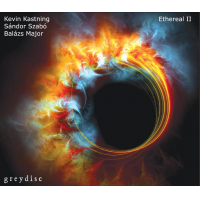
Kevin Kastning/Sándor Szabó/Balázs
Major
Ethereal II
Greydisc
2018
Kastning seems to gravitate to the duet format, but this is a recurring
trio. Kastning's 36-string Double Contraguitar, 30-string Contra-Alto
guitar and piano are joined by Szabó's electric guitar and electric
baritone guitar and Major's drums and percussion. It is an especially
rich timbral mix. Kasning's acoustic guitar provides chiming
double-coursed sounds reminiscent of a 12-string guitar, as well as
occasional bass parts. The electric guitar provides electronic washes
for accompaniment, as well as a contrasting lead voice. And the
drumming is an equal partner, sometimes atmospheric, sometimes keeping
time. Opener "Arrival (Second Recall)" contains all of this;
"Etheriality I," which follows it, sticks to a mostly slow moving
soundscape. Major includes Indian tabla drums in his arsenal: they are
especially prominent on "Supernal Vapor" and "Portals I." This is a
splendid improvisational session, full of variety in tempo and texture:
an excellent starting place for listeners new to Kastning's music.

Kevin Kastning//Balázs Major
Kismaros
Greydisc
2018

Kevin Kastning
17/66
Greydisc
2018
Kastning solo, playing three of his signature guitar designs. The music
makes use of a new compositional structure he calls harmonic blocks,
which he can only describe as "a rather dense concept...almost crosses
the line from compositional structure into music theory." Sonically
this translates into some of his most abstract music, possibly the
result of his improvisational instincts being tempered by the formal
structures he is working with. The program does offer the opportunity
to hear all of the instruments unaccompanied and clearly identified (as
well as recorded live in the studio with no overdubs). The first three
tracks feature the 30-string Contra-Alto guitar; the second group of
three the 17-string Hybrid Extended Classical guitar; and the final
group the 36-string Double Contraguitar.

Kevin Kastning/Sándor Szabó
Ethereal I
Greydisc
2017
The first Ethereal album features Kastning's 36-string Double
Contraguitar, 30-string Contra-Alto guitar and piano along with Szabó's
electric guitar and electric baritone guitar—the same instrumentation
as the second album, minus the percussion. There is even more
acoustic/electric contrast here. Opener "Choros Nympharum" includes
rich electronic soundscaping. Kastning's piano is up front on "The
leaves are full of voices," with Szabó's volume-pedal guitar in the
lead. Throughout the session both players seem especially in tune with
each other, smoothly exchanging lead and accompanying roles. The album
closes with Kastning's piano again accompanying Szabó's electric guitar
on "Sylvia Nympharum."

Kevin Kastning/Mark Wingfield
The Line to Three
Greydisc
2017
Another acoustic/electric contrast, with British experimental guitarist
Mark Wingfield providing electric guitar, live electronics and
pre-recorded soundscapes. Kastning plays 30-string Contra-Alto guitar,
17-string Hybrid Extended Classical guitar, piano and percussion.
"Invisible Landscapes I" opens the album with very legato electric
guitar lines, their pitch shifting from Wingfield's sophisticated
whammy bar technique—accompanied by low electronic rumbles and
sparkling acoustic guitar chords. Like some of the tracks on the duo
with Szabó, Kastning sometimes accompanies on the piano for an entire
track, as he does here on "All the Clouds Around You," "The Gathering
of Shapeless Forms" and "Momentary Books of Leaving" (which contains
especially dramatic piano playing: Kastning has a strong voice on the
instrument). Of all of Kastning's collaborators, Wingfield arguably has
the most distinctive, well-established sound, as well as the most
virtuosic technique. But he is also a sympathetic collaborator, as
demonstrated on "A Nameless Unfolding II," where the two guitars
alternate, Wingfield frequently providing accompaniment. Wingfield fans
who have not heard his collaborations with Kastning may want to start
here.
--
All About Jazz magazine (US)
October 2018

Kevin Kastning: Otherworld and Others
"Kevin Kastning cuts a striking figure, not just for the winter-white
hair cascading down his shoulders but more significantly for the
30-string contra-soprano guitar and 36-string double Contraguitar he's
seen cradling in photos. The pioneering work he's done in the field of
modern acoustic guitar composition extends beyond these remarkable,
self-invented instruments to the music he composes and performs.
Kastning, who studied privately with Pat Metheny at Boston's Berklee
College of Music and currently calls northern Massachusetts home, has
written in excess of 200 works and issued nineteen recordings, many of
them with notable figures such as Michael Manring, Balazs Major, Mark
Wingfield, Sándor Szabó, and Carl Clements. Stylistically, Kastning's
work resists easy categorization: it's neither strictly blues, jazz,
folk, rock, nor classical, even if traces of each might be found within
it. In its dense array of microtonal textures and tones, his music
might best be described as impressionistic tone paintings that allude
to classical composition without being bounded by it. Compositional
structure and improvisation are both present in the material. Needless
to say, Kastning is a virtuoso, but grandstanding is foreign to his
approach and anathema to his sensibility. The six albums reviewed here
(all issued on his own Greydisc imprint) offer an in-depth portrait,
especially when five present him in partnership with others and one
features him alone; in those that pair him with another, an effective
balance is achieved, with neither musician dominating the other. We
begin with the latest and then jump back to consider the five others in
logical manner.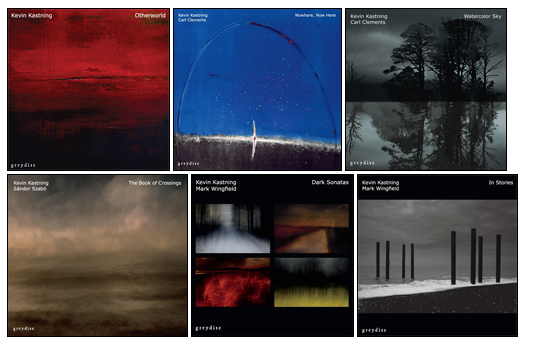
For whatever reason, Otherworld is his first solo album despite it being the nineteenth he's issued. Regardless, the sixty-six-minute collection offers a compelling sampling of his artistry, especially when heard in its purest form. Alternating between the orchestral density provided by the double-neck 36- and 30-string guitars and the 12-string soprano and 15- and 6-string classical guitars, Kastning picks, plucks, and strums his way through sixteen settings whose crystalline glisten can be appreciated by listeners and guitar musos alike. His technical facility is evident throughout but always used in service to the song, the implication being that Kastning's credibility as a musician and artist is most effectively revealed in his rendering of the compositional material. Space, dynamics, and tempo are tended to with care, the guitarist often opting for slow tempos to accentuate the reflective dimension of the recording. As emphatically pursued as such aspects are on “In Stillness Defined,” it's hardly the only instance: notes also bleed reverberantly into the pregnant pauses between notes within “Lingua Ignota,” “Veiled Silent Overturn,” and “Arc Rotation Shadow,” and as wonderful as it is to hear the rich sound generated by the 36- and 30-string guitars, there's also much to be said for the stark clarity the 6-string classical brings to “A Lingered Chamber to Wake” and “Whisper Garden.” Mark Wingfield's comment that Otherworld is “guitar playing on the highest artistic level” isn't, it turns out, hyperbole.
Of the five collaborative releases, it's The Book of Crossings that aligns Kastning with another musician most like himself, sonically speaking, though the recording indicates that the two also are very much soulmates in general terms. Recorded on March 23, 2012 in Hungary while the two were on tour in Europe, the seventy-three-minute collection pairs Kastning on a number of 14- and 12-string guitars (plus E-bow and piano) with Sándor Szabó on classical, 16-string, 10-string viola caipira guitar, and guzheng. On no less than twenty-one pieces, they produce an elegant, multi-layered sound that in its stately presentation exudes the formal character of classical music. On “First Transversal” and “Modus Novus II,” the Eastern sonorities of Szabó's guzheng playing dramatically expands on the musical breadth of the recording (in the latter piece, it even takes on a zither-like quality); in similar manner, Kastning's E-bow adds a powerful sense of mystery to “To Carthage Then I Came.” The music also sometimes flirts with an outdoorsy peacefulness (though they're hardly needed, faint bird sounds even sometimes surface to strengthen the effect) that likens it to folk music as much as classical, and their playing is at times so complementary it could pass in places for the playing of one musician only.
The albums with Carl Clements are welcome additions to Kastning's catalogue for above all else the different soundworld the collaboration presents; whereas all four of the other releases reviewed here are guitar-oriented, the two with Clements are distinguished by the contrasts between Kastning's arsenal and his partner's saxophones and flutes. Issued in 2013, Nowhere, Now Here adheres to the format of the typical Kastning release in featuring fourteen settings, almost all in the four- to six-minute range; released a year later, Watercolor Sky changes things up in presenting seven pieces only, though these generally longer tracks often push into the nine- and ten-minute zone. One other key difference is that on the latter recording, Clements supplements his saxophone (tenor and soprano) and alto flute playing with Bansuri flute. On Nowhere, Now Here, the pairing of Clements' sinuous soprano lines and Kastning's spidery runs makes for a compelling combination on “Lunar Incantation Precision,” a prototypically explorative meeting of the spirits. As satisfying are the pieces featuring alto flute, with one such as “Somewhen” exuding a subtly aromatic allure, especially when the 30-string guitar's luscious textures are present. Listening interest is maintained through alterations in mood and the musicians' approach: during “Incomparably Light and Repose” and “Deceptive Corridors Passing,” for instance, there are long stretches where the soprano sax and alto flute are heard alone, with Kastning's commentary arising as interjections more than continuous flow. With respect to mood, differences surface, such that the brooding, subdued “Rust in Form” stands in stark opposition to the spirited animation of “First Hovering; First Vanishing” and the labyrinthine “Into Propagation Suspension.”
At sixty-one minutes, Watercolor Sky is slightly shorter than the seventy-six of Nowhere, Now Here, though the more significant difference lies in its aforementioned focus on longer settings. That change allows the duo to cultivate moods of even greater mystery and potency, as the haunting “A Transparency Through” reveals when the lonely call of Clements' Bansuri flute emerges alongside Kastning's dark 36-string shadings. Clements once again plays tenor and soprano saxophones, though only on two of the seven pieces, and the emphasis on flute textures naturally lends Watercolor Sky a differentiating character. If anything, the material is slower and more ruminative on the later recording, and the musicians use silence in bolder fashion, too: “Complete and Early if Later,” for example, opens with a minute of unadorned tenor sax musings, and during “This Daytime Haunted,” the two separate alternating soprano sax and 30-string expressions with prolonged measures of open space. There are many striking moments (even a few macabre, as attested to by “While Still and Moving”), and of the six Kastning projects reviewed, it's arguably the most meditative of the lot.
The Dark Sonatas outing with electric guitarist Mark Wingfield (their third such collaboration, in fact, 2011's I Walked into the Silver Darkness the first) is the one that most overtly nods in classical music's direction, specifically for drawing inspiration from American composer Elliott Carter (1908-2012). But though both acknowledge his influence on their work, Dark Sonatas isn't a collection of Carter works newly interpreted and arranged for two guitarists; no direct quotes of Carter pieces arise, the two instead choosing to channel his spirit in thirteen live in-studio improvisations sans overdubs. The classical character of the project is reinforced by track titles such as “Andante Sostenuto,” “Sonata Tenebrae No. 2,” and “Allegro Cimmerian,” but that detail notwithstanding the material itself positions itself comfortably alongside the other Kastning releases. The musical pairing is effective, especially when the contrast between the electric and acoustic instruments is so pronounced. Armed with the 30-string contra-soprano as well as 16- and 12-string variations, Kastning proves to be an ideal foil to Wingfield, the former doling out thick clusters and the latter sharp, single-note lines. The British guitarist opts for a largely distortion-free sound on the recording and shapes his notes elastically, deviating from rote bar notation and introducing vibrato-tinged warbles here and bent notes there. Much of the music's impact derives from the unpredictable, real-time interactions between these kindred spirits and the contrast between Kastning's pointillism and Wingfield's piercing undulations, their to-and-fro escalating and intensifying during certain episodes and then decompressing elsewhere. One of the primary pleasures in listening to Dark Sonatas involves monitoring their interactions, as many of the tracks really do unfold like dialogues (“Illustratio Triocha I” and “Andante Sostenuto,” for example), and their angular material evokes the character of Carter's bold soundworld without literally referencing it.
Issued a year later, In Stories updates the sound of its predecessor minus the Carter connection and captures the two catalyzing their expressions into sound painting form. The feel on the duo's fourth outing, an hour-long set featuring thirteen pieces, is slightly more relaxed, the approach less brittle and explorative, the hard edges smoothened ever so slightly. An autumnal tone is pervasive, noticeably so during “A Season While Fading” where sparse brush strokes nurture a wistful mood, and there's also an emphasis on atmosphere, with a representative improvisation such as “Halcyon Mist Unknown” spotlighting the mistier side of the project. Kastning's playing on “From the Passing of Summer” is folk-like in its sparcity, and the restrained approach nicely supports Wingfield's lead lines. Though the latter's electric can't help but stand out, the two are equal partners, and Kastning is often as forceful a presence as Wingfield. Formal by comparison, “In Stories Without” wends a stately path through dramatic chambers where the acoustic guitarist forcefully challenges the electric for supremacy. A strong impression of musical maturity is generated when the two execute the settings with such restraint and control.
All six of these high-quality releases are worthy of recommendation, and even though they constitute a small part of Kastning's recorded output they still provide an in-depth portrait; certainly one comes away from the six with a clear grasp of who he is and where his interests lie, and you certainly get your money's worth when each is an hour long at minimum. Yet as rewarding as it is to listen to his solo playing on Otherworld, the recordings with Clements and Wingfield appeal for the instrument contrasts they introduce as well as the conversational interactions the collaborations engender."--
Textura Magazine (CANADA)
January
2016